
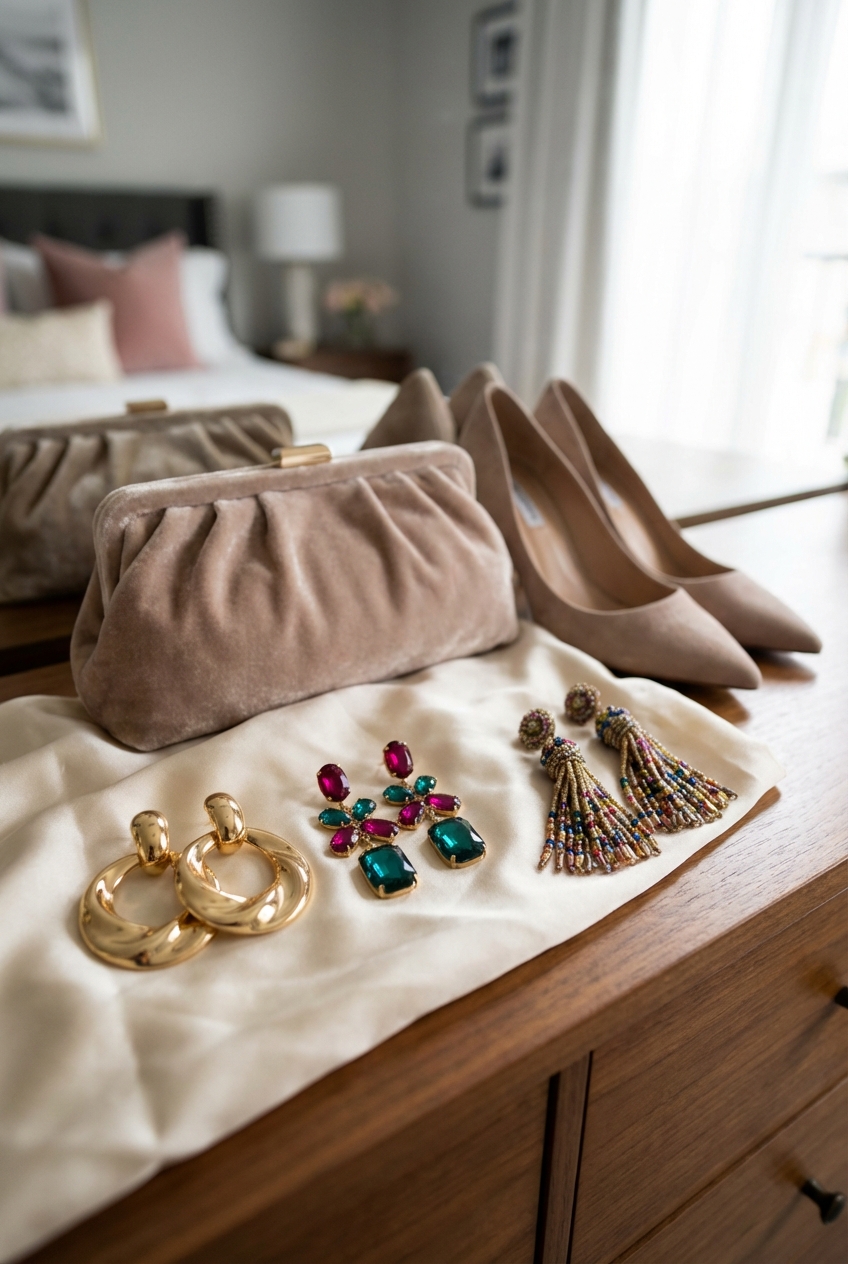
Bold Statement Earrings For Dressed Up Looks
There is a distinct moment in the dressing process where an outfit transforms from simply “wearing clothes” to “making an entrance.” In my years styling high-end clientele for galas, weddings, and red carpet events, that moment almost always happens when the jewelry goes on. Specifically, it happens when we select the earrings. While shoes and bags are essential, earrings are the only accessory that sits directly in your communication zone. They frame the face, catch the light in your eyes, and dictate the vibe of your entire evening.
I remember styling a client for a major charity ball last winter. She had chosen a stunning, but very simple, black velvet column gown. She felt it was too plain and was panicking, thinking she needed to buy a completely new dress with more beading or drama. Instead of changing the dress, I pulled out a pair of vintage oversized crystal chandelier earrings that brushed her collarbone. Instantly, the velvet became a rich, quiet canvas for the jewelry, and she looked regal rather than plain. That is the power of a bold statement earring. It does the heavy lifting so you—and your dress—can simply exist.
However, navigating the world of statement jewelry requires a bit of strategy. It is not enough to just pick the biggest pair you can find; you have to consider weight, face shape, neckline, and hairstyle to ensure the look remains elegant rather than costume-like. In this guide, I will walk you through the exact rules of thumb I use to style bold earrings for formal occasions. For visual inspiration on how to pull these looks together, make sure to browse the curated Picture Gallery at the end of the blog post.
The Geometry of Glamour: Matching Earrings to Face Shape
When selecting statement earrings, the first variable I analyze is the client’s face shape. The goal is always to create balance. If you introduce shapes that mimic your face, you emphasize those features; if you introduce opposing shapes, you soften them. For high-stakes events where photographs are inevitable, this balance is non-negotiable.
If you have a round face, your objective is to elongate. I always steer clients toward linear drop earrings or long, narrow geometric shapes. A hard rule of thumb I use is the “jawline clearance.” For a round face, the earring should ideally extend past the jawline by at least half an inch. This draws the eye downward and creates a vertical line that slims the profile. Avoid large circular hoops or button styles that sit on the lobe, as these will only emphasize width.
Conversely, for square or heart-shaped faces with strong jawlines, we want to soften the angles. This is where curves are your best friend. Teardrop shapes, oval chandeliers, and oversized hoops work beautifully here. The curve of the metal or gem acts as a counterpoint to the angular bone structure. For heart shapes specifically, look for earrings that are wider at the bottom (like a triangle or a pear shape) to add volume near the jawline, balancing a wider forehead.
Stylist’s Note: The “Finger Test”
In the fitting room, I use the “Finger Test” to check scale. Place two fingers horizontally between the bottom of your earlobe and your shoulder. If the earring fills this space completely and touches the shoulder when you are standing still, it might be too long for a formal dinner where you will be turning your head frequently. Ideally, you want at least half an inch of clearance above the shoulder for comfort and movement, unless the “shoulder grazer” look is a deliberate styling choice.
Navigating Necklines: The Architecture of Your Look
The interaction between your earrings and your neckline is the most critical structural element of your outfit. A common mistake I see is a “collision” of visual elements where the jewelry fights with the fabric. When you are dressing up, you need to treat the space between your chin and your bust as a composition.
Strapless and Off-the-Shoulder: This is the playground for your most dramatic pieces. Because there is no fabric near the neck to compete with, you have a blank canvas. I often pull the longest, most intricate chandelier earrings for these necklines. The skin exposure allows for heavy detailing without looking cluttered. A vertical drop of 3 to 4 inches works exceptionally well here, bridging the gap between face and dress.
High Necks and Halters: This creates a realistic constraint. With a halter or a turtleneck gown, you have a lot of fabric and visual weight already gathered near the face. Adding a massive, wide chandelier earring can make you look like you are drowning in material. Instead, opt for “button” styles that are oversized but sit on the ear, or sleek, sculptural metal shapes that climb up the ear rather than dangling down. If you must do a drop, keep it sleek and linear, avoiding width.
V-Necks and Plunging Cuts: These necklines naturally guide the eye downward. You can echo this V-shape with your earrings. Triangular drops or pendants that taper to a point look harmonious here. However, be careful with necklaces. If you are wearing a bold statement earring with a deep V, I usually recommend skipping the necklace entirely to let the décolletage breathe.
Metal Mixing and Undertones
Gone are the days when you had to match your handbag hardware to your earrings, but harmonizing metals with your skin tone remains a pro-level requirement for a polished look. Statement earrings sit directly next to your skin, acting almost like makeup. They can either brighten your complexion or wash you out.
If you have cool undertones (veins appear blue, you burn easily), silver, platinum, and white gold are your natural enhancers. These metals act like a highlighter, adding crispness to the face. For gemstones, think icy tones: diamonds, sapphires, or clear crystals. A heavy gold earring on very cool skin can sometimes look jarring or clash with the natural pink in your cheeks.
For warm undertones (veins appear green, you tan easily), yellow gold, rose gold, and brass are incredibly flattering. They bring out the golden glow in the skin. Earthy gemstones like amber, emeralds, or garnets set in gold are stunning for evening wear. If you really want to wear silver but have warm skin, look for “oxidized” or antique finishes which are less stark than bright chrome.
Common Mistake: Ignoring the dress embellishments. If your gown has silver beading or a metallic zipper that is visible, try to coordinate your earring metal to that hardware. While mixing metals is trendy in street style, for formal black-tie looks, matching the hardware creates a cohesive, expensive aesthetic.
The Hairstyle Factor: Visibility and Volume
You cannot plan your jewelry without planning your hair. I have seen clients buy magnificent $500 earrings only to wear their hair in loose, voluminous curls that completely swallow the jewelry. If you are investing in a bold statement piece, you have a responsibility to make sure it is seen.
The Updo: This is the safest bet for statement earrings. A sleek chignon, a high pony, or a French twist exposes the entire ear and neck. This styling allows for 360-degree visibility of the earring. When the hair is up, you can get away with wider, more three-dimensional earrings because there is no hair to get tangled in the design.
Hair Down or Half-Up: If you prefer wearing your hair down, you need to fight for visibility. Avoid delicate wire earrings or thin chains; they will disappear into the texture of your hair. Instead, choose earrings with solid surface area—like hammered metal discs, thick acrylics, or pave-encrusted shapes. The earring needs to be “heavier” visually than the hair texture. Additionally, I always recommend tucking the hair behind the ear on at least one side to create an asymmetrical window for the jewelry to shine.
Pro Tip: The Movement Check
Before finalizing the look, shake your head. If your hair is down, do the earrings get caught? Styles with prongs or open hooks are notorious for snagging on loose hair. For hair-down looks, I prioritize smooth bezels or polished metals that will glide over the strands rather than tangle in them.
Balancing the Rest of the Jewelry
In high-end fashion, editing is just as important as adding. There is a concept I use called the “One Star Rule.” In any given zone of the body, there should only be one star attraction. If the earrings are the star, the necklace needs to step back to a supporting role or exit the stage entirely.
When you wear bold statement earrings—especially those that are longer than 2 inches or have significant width—I almost always advise going bare-necked. This is particularly true for dressed-up looks where the dress likely has its own texture or sheen. A necklace cuts the visual line of the neck, while statement earrings elongate it. Doing both often results in a cluttered, “Christmas tree” effect.
Instead of a necklace, balance the weight with bracelets or rings. A bold cuff bracelet or a large cocktail ring creates a beautiful diagonal balance. It draws the eye from the face down to the hand, creating a full-body visual journey without overcrowding the face. If you feel naked without a necklace, opt for something barely there, like a solitaire diamond on a whisper-thin chain, but ensure it doesn’t overlap with the visual drop of the earrings.
Comfort and Mechanics: The Reality of Wear
Nothing ruins a sophisticated look faster than a woman who is visibly uncomfortable. Heavy earrings can be painful, and over the course of a 5-hour wedding or gala, that pain shows on your face. Furthermore, heavy earrings can pull on the lobe, causing the piercing to stretch into an unsightly vertical slit. As a stylist, I have to ensure the mechanics work as well as the aesthetics.
Weight Limits: Be realistic about your tolerance. If you aren’t used to wearing heavy jewelry, do not test drive a 20-gram pair of earrings on your wedding day. Look for materials that offer volume without mass. Hollow gold tubing, acrylics, resin, and filigree metals give you the “bold” look without the headache. Clips are also a fantastic option for heavy styles, even if you have pierced ears, as they distribute the weight over the whole lobe rather than a single hole.
Support Patches: I have a secret weapon in my kit that I use on almost every client wearing statement pieces: lobe support patches (like Lobe Wonder). These are small adhesive ovals that stick to the back of your earlobe. You push the earring post through the patch. The patch takes the weight of the earring, relieving the pressure on the hole itself. It instantly perks up the earring so it sits straight rather than drooping forward.
Backing Types: Never trust the tiny butterfly backs that come with heavy earrings. They are rarely wide enough to support a statement piece. Swap them out for “disc backs”—large plastic or metal discs that sit flat against the back of the ear. This increases the surface area and keeps the earring flush against your head, preventing the dreaded forward droop.
Finish & Styling Checklist
Before you head out the door, run through this quick mental checklist. It is what I do before sending a client onto the red carpet to ensure nothing has been overlooked.
- The Shake Test: Shake your head vigorously. Do the earrings stay secure? Do they hit your cheek or collarbone painfully?
- The Snag Check: Run your hand continuously from your hair down your shoulder. Are there prongs catching on your hair or the lace of your dress?
- The Backing Check: Are you using a wide disc back or a support patch? Ensure the earring is sitting perky and straight, not drooping.
- The Photo Test: Take a selfie with flash. Does the metal reflect too much glare? Does the color of the stone hold up or look black in the shadows?
- The Balance Scan: Look in a full-length mirror. Is your necklace fighting the earrings? If yes, take the necklace off.
FAQs
Can I wear statement earrings if I wear glasses?
Absolutely. In fact, glasses and statement earrings can look incredibly chic together. The key is to coordinate the materials. If you have thick, dark acetate frames, opt for metal earrings to create contrast. If you have wire-rimmed glasses, you can get away with bolder, colorful resin or gem earrings. Just avoid earrings that are the exact same shape as your lenses (e.g., round glasses with round hoops) to keep the geometry interesting.
What if I have sensitive ears?
For dressed-up looks, we often turn to costume jewelry which can be tricky for sensitive skin. Look for posts made of titanium, niobium, or surgical steel. Alternatively, you can coat the post of the earring with a clear jewelry shield lacquer (or clear nail polish in a pinch) to create a barrier between the metal and your skin. However, the best investment for sensitive ears is to have a jeweler swap the posts for 14k gold, even on cheaper earrings.
Are clip-on earrings tacky for formal events?
Not at all. In the world of high-fashion and vintage couture, clip-ons are actually the standard for heavy statement pieces. Brands like Chanel and Oscar de la Renta frequently use clip backings because they sit better on the ear and allow for heavier designs. Do not be afraid to wear them; just ensure the tension is tight enough to hold but loose enough to avoid a headache.
Conclusion
Bold statement earrings are the exclamation point of a dressed-up look. They possess the unique ability to illuminate the face, correct proportions, and elevate a simple gown into a high-fashion moment. By paying attention to the geometry of your face, the architecture of your neckline, and the mechanics of comfort, you can wear these pieces with the confidence of a professional stylist.
Remember that the goal is not just to wear a beautiful object, but to let that object highlight your own beauty. Whether you choose cascading crystals for a gala or sculptural gold for a dinner party, the right pair will make you stand taller and smile brighter. Go bold, edit the rest, and let your earrings do the talking.
Picture Gallery


