
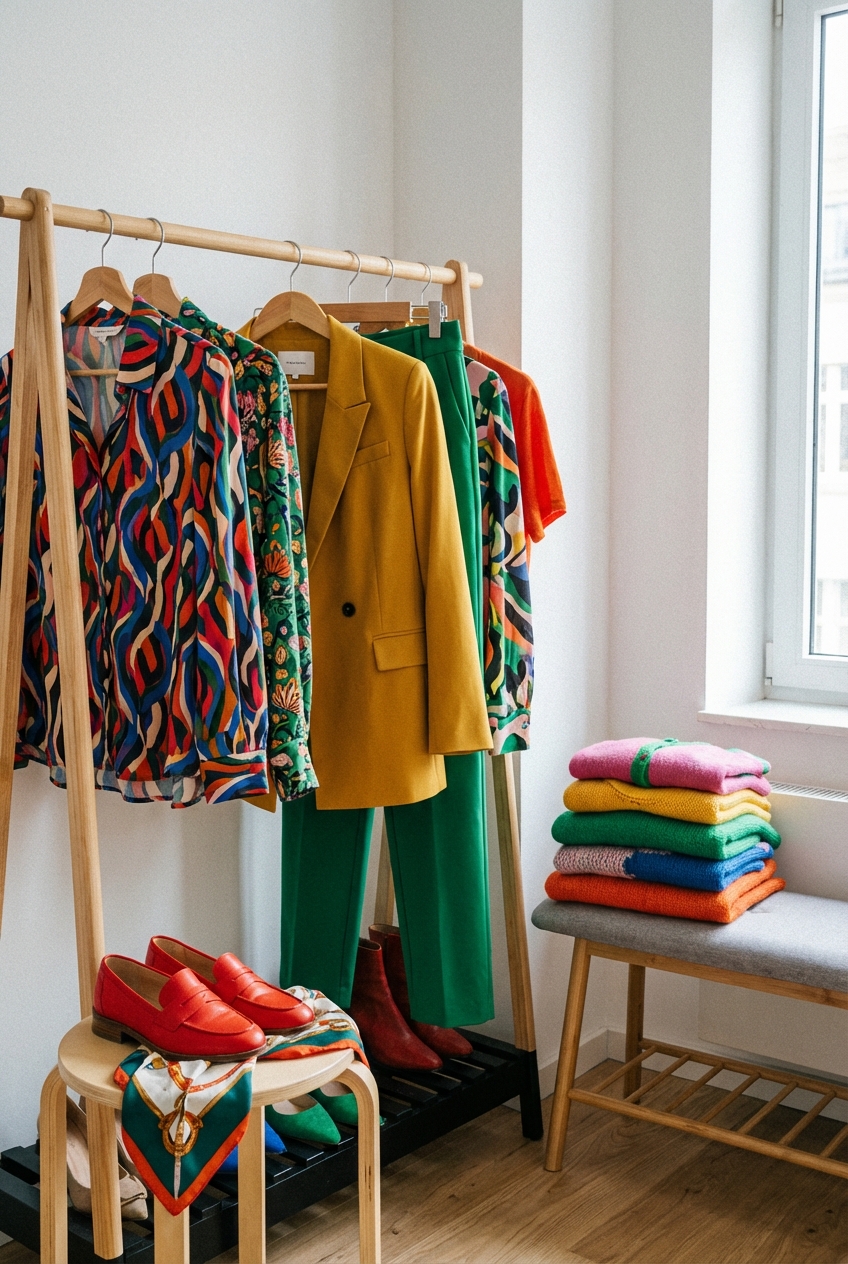
Capsule Wardrobe For Bold And Colorful Style Lovers
There is a persistent myth in the fashion world that a “capsule wardrobe” must consist entirely of beige trenches, white tees, and black trousers. While minimalism is a valid aesthetic, organization does not require you to sacrifice your personality. I have spent years styling high-end clients who love vibrant hues, and I can tell you that structure and color are not mutually exclusive.
In fact, a capsule wardrobe is actually more necessary for color lovers than for minimalists. When you own bright patterns and bold shades, the risk of having “nothing to wear” is higher because items can easily clash. A curated system ensures your electric blue blazer actually has a partner in your closet, rather than hanging there as a lonely statement piece.
My journey with color capsules began when I realized I was buying beautiful, loud items that never left the house because they required too much mental energy to style in the morning. By applying strict design principles to a maximalist aesthetic, we can create a closet that sparks joy without creating chaos. If you are looking for visual inspiration, check out the Picture Gallery at the end of this blog post.
The Anchor Color Strategy
Building a colorful capsule requires more planning than a neutral one. You cannot simply throw random brights together and hope for cohesion. You need a roadmap. In my studio, we start by identifying “Anchor Colors.” These are the shades that will replace black or white as your foundation.
For a bold wardrobe, navy, camel, and charcoal are often too safe. Instead, consider deep teal, rich burgundy, or chocolate brown as your neutrals. These shades play well with others but maintain a level of saturation that supports brighter accent colors.
Once you have your two base anchors, choose three to four “Hero Colors.” These should be distinct enough to stand alone but related enough to mix. For example, a palette of teal (anchor), mustard, rust, and dusty pink works because they share warm undertones.
Designer’s Note: The 3-Color Rule
In professional styling, we often use the “Rule of 3” to prevent a look from becoming a costume. An outfit should generally consist of no more than three distinct colors. If you are wearing a printed dress, the colors in the print count toward this total. This keeps the look intentional, not accidental.
Selecting Your Hero Pieces
In a capsule of 30 to 40 items, your “Hero Pieces” are the heavy lifters. These are usually outerwear, tailored blazers, or statement dresses. In a standard capsule, these would be a tan trench or a black blazer. For you, this is where the personality shines.
I recommend investing in a high-quality wool coat in one of your Hero Colors. A tailored coat in emerald green or cobalt blue transforms even a simple jeans-and-tee outfit into a fashion moment. Because this is a high-cost-per-wear item, prioritize natural fibers like wool or cashmere blends for longevity.
Do not shy away from colored leather or suede. A moto jacket in oxblood or a suede skirt in cognac can act as a neutral while adding significant texture. The goal is to choose items that make you happy every time you put them on, but that physically fit with at least three other items in your selection.
Common Mistakes + Fixes
- Mistake: Buying a statement piece that requires specific undergarments you don’t own.
- Fix: If a top requires a strapless bra and you hate wearing them, do not include it in your capsule. Comfort is the key to consistency.
- Mistake: Buying “fantasy self” items (e.g., 6-inch heels for a walkable commute).
- Fix: Be honest about your lifestyle. If you walk 5,000 steps a day, your hero shoes should be colorful loafers or block heels, not stilettos.
The Science of Print Mixing
Patterns are the glue that holds a colorful capsule together. A well-chosen print can bridge the gap between two solid colors that might otherwise clash. However, print mixing is where many people get overwhelmed. The secret lies in the scale of the pattern.
You need a hierarchy of prints. Include one “large scale” print (like a bold floral or wide stripe) and one “small scale” print (like a micro-dot, gingham, or tight geometric). The small print acts almost like a solid texture from a distance, allowing the large print to take center stage.
Stripe shirts are the “neutrals” of the print world. A classic Breton stripe in red and white or navy and white can be paired with almost any floral or geometric print. It breaks up the blocks of solid color and adds visual interest without dominating the look.
What I’d Do in a Real Project
- Step 1: Select a multi-colored scarf or blouse that contains all your chosen capsule colors. This serves as your “Rosetta Stone” for matching.
- Step 2: Hold every solid piece against this print. If the solid color exists within the print, it’s a match.
- Step 3: Ensure you have a mix of organic prints (florals, paisleys) and linear prints (stripes, plaids) to create dynamic tension.
Fabric Composition and Color Saturation
Color renders differently on different fabrics. This is a crucial detail that is often overlooked. A synthetic polyester satin might hold a vibrant fuchsia dye well, but it often lacks the depth and elegance of a silk charmeuse or a wool crepe.
When building a high-end capsule, pay attention to how the fabric reflects or absorbs light. Velvet and suede absorb light, making colors appear richer, deeper, and softer. Satin and silk reflect light, making colors appear brighter and sharper.
I advise clients to mix these finishes. If you are wearing a bright satin skirt (reflective), pair it with a matte cashmere sweater (absorbent). This contrast prevents the outfit from looking flat. Cheap synthetic fabrics can often make bright colors look plastic or costumey; natural fibers generally elevate the sophistication of the hue.
Quality Check: The Stretch Test
When buying printed knits or jersey fabrics, always perform a stretch test. Pull the fabric taut. If the print turns white or distorts significantly because the dye is only on the surface, put it back. High-quality prints should maintain their integrity and color depth even when stretched over curves.
Bottoms: The Groundwork of the Wardrobe
While tops are often where we play with color, bottoms need to be the workhorses. In a colorful capsule, you still need versatility. I recommend a ratio of roughly 3 tops to 1 bottom. If you have 10 tops, you need about 3 or 4 excellent pairs of trousers or skirts.
Denim is a universal neutral, but consider the wash. A dark, raw indigo denim looks dressier and pairs beautifully with jewel tones. Light wash denim feels more casual and pairs well with pastels or neons. Avoid distressed denim if you want your colorful capsule to feel polished and high-end.
Tailored trousers in a non-black neutral are essential. A high-waisted wide-leg trouser in camel, olive, or slate grey allows you to wear a neon top without looking chaotic. The classic silhouette grounds the loud color.
Designer’s Note: Hemlines Matter
For a capsule to function, your bottoms must work with your shoes.
- Wide Leg Trousers: Hem should graze the top of your foot (about 0.25 to 0.5 inches off the floor) with your most-worn heel height.
- Ankle Pants: Should hit right at the ankle bone or slightly above. If they bunch over your shoes, it ruins the clean line.
- Midi Skirts: Ideally, the hem should hit the slimmest part of your calf. Avoid hems that cut across the widest part of the calf, as this can visually shorten the leg.
Accessories as Exclamation Points
In a minimalist wardrobe, accessories provide the only interest. In a maximalist capsule, accessories are the punctuation. They dictate the vibe of the outfit. You do not need a shoe in every color of the rainbow. You need shoes that bookend your look.
The “Sandwich Method” is a foolproof styling trick I teach all my clients. Match your shoes to your top (or your jacket), and wear a contrasting color in between. For example, a red blouse, blue jeans, and red loafers. This creates visual symmetry that the human eye finds very pleasing.
Metallic accessories—gold, silver, or copper—are technically neutrals. A gold loafer or a silver boot acts as a “nude” shoe for the bold dresser. They go with everything but add more excitement than a beige pump.
Hardware Harmony
Decide on a metal finish for your capsule. Mixing metals is trendy, but sticking to one (usually gold for warm palettes, silver for cool palettes) makes daily dressing faster. Ensure the hardware on your bags, belt buckles, and jewelry all coordinate. This subtle consistency makes even a riotously colorful outfit look intentional and expensive.
Finish & Styling Checklist
Before you finalize your capsule, run your selection through this practical checklist to ensure it functions in the real world.
The Versatility Test
- Can every top be worn with at least 3 different bottoms?
- Can every bottom be worn with at least 3 different tops?
- Do you have a “Third Piece” (blazer, cardigan, vest) that matches every base outfit?
The Weather Reality Check
- Do you have footwear that works for rain/snow that still fits the color palette?
- Are your fabrics breathable enough for your climate? (e.g., avoid heavy synthetics if you live in humidity).
The “Sit Down” Test
- Put on your tightest trousers or skirt. Sit down for 60 seconds. If it digs in or you have to unbutton it, it does not belong in a daily capsule. Comfort equals confidence.
FAQs
How do I stop bright colors from fading?
Wash less frequently. Wool and cashmere usually only need airing out or steaming between wears. When you do wash cottons or linens, use cold water and a detergent formulated for dark/bright colors. Always turn garments inside out to protect the surface fibers from abrasion in the machine.
Can I mix pastels with jewel tones?
Yes, but you need a bridging element. A pastel pink blouse can work with emerald green trousers if you add a belt or shoe that is a deeper shade of pink (magenta) or a neutral (camel) to soften the transition. Contrast is good, but value (lightness/darkness) needs balance.
Is animal print a neutral?
In the fashion world, yes. Leopard print (black and brown) functions exactly like a neutral. You can pair it with red, pink, green, or blue. Snake skin (grey and white) functions like a cool grey neutral. Treat them as solids when mixing with other patterns.
How many shoes do I really need?
For a functional capsule, 3 to 5 pairs are sufficient. 1 sneaker, 1 loafer/flat, 1 boot (for colder months), 1 heel (for events), and 1 sandal (for warmer months). Focus on quality leather that molds to your foot.
Conclusion
Creating a capsule wardrobe for a bold style lover is an act of curation, not deprivation. It is about removing the noise so your favorite colors can sing. By establishing a clear color palette, respecting fabric quality, and understanding the geometry of your silhouettes, you build a closet that serves you.
Fashion should be a source of energy, not stress. When you open your wardrobe and see a rack of colors that all speak the same language, getting dressed becomes the creative, joyful ritual it was meant to be. Trust your eye, measure your hems, and never be afraid to be the brightest person in the room.
Picture Gallery


