
Capsule Wardrobe Tips For Dressing Up Jeans
I remember the first time a client told me she felt “sloppy” in denim. She had a closet full of expensive jeans, yet every time she tried to wear them to a dinner or a client meeting, she felt underdressed and awkward. The problem wasn’t the denim itself; it was how she was contextualizing it within her wider wardrobe.
Jeans are the neutral canvas of the fashion world. Much like a wood floor in a well-designed living room, they provide a grounding element that allows other textures and pieces to shine. When you treat denim as a deliberate foundation rather than a default “lazy” option, the entire outfit shifts.
In this guide, I will walk you through the architectural approach to elevating jeans. We will cover the specific fabrics, cuts, and ratios that turn a basic pair of pants into a high-end look suitable for almost any room you walk into. If you are looking for visual inspiration, you can find a curated Picture Gallery at the end of this blog post.
The Foundation: Selecting the “Dressy” Jean
Not all jeans are created equal. If your goal is to dress up a look, you cannot rely on the same pair you wear to the playground or for Saturday morning chores. A capsule wardrobe requires a dedicated “smart” pair of jeans that serves a specific function.
The first rule of thumb is wash and rigidity. For a polished aesthetic, darker washes are non-negotiable. Deep indigo, charcoal, or jet black read more like trousers than workwear. They absorb light rather than reflecting it, which hides wrinkles and creates a cleaner vertical line.
You must also consider the fabric weight and composition. High-end denim usually falls between 11 and 14 ounces. This weight provides structure. Avoid denim with more than 2% elastane (stretch). High-stretch denim clings and ripples, looking casual. Rigid or semi-rigid denim hangs straight, mimicking the drape of a wool suit pant.
Designer’s Note: The Distressing Trap
I often see clients trying to dress up ripped or distressed jeans with a silk blouse. This rarely works because the contrast is too jarring. Distressing breaks the visual line of the leg and immediately lowers the formality of the outfit.
To maintain a luxury feel, the fabric must be flawless. No whiskering at the hips, no fading at the knees, and absolutely no frayed hems. The hem should be a clean, finished stitch.
The Third Piece Rule: Architecture and Tailoring
In design, we look for a focal point. In fashion, a simple top and jeans lack a focal point. The “Third Piece Rule” suggests that every outfit needs three key elements: a bottom, a top, and a structured layer.
A tailored blazer or a structured jacket acts as the frame for your outfit. It adds shoulders and straight lines, which counteracts the casual nature of the denim. When selecting a blazer for your capsule, pay attention to the lapel width and the button stance.
For a modern, high-end look, an oversized blazer with a strong shoulder pad works wonders with straight-leg jeans. If you are petite, ensure the blazer length does not go past your thumb knuckle when your arms are at your sides, or it will swallow you.
Common Mistakes + Fixes
Mistake: Wearing a blazer that is too tight or pulls at the waist when buttoned.
Fix: Size up. High-end fashion prioritizes drape over tightness. A jacket that hangs loosely looks expensive; a jacket that pulls looks ill-fitting.
Mistake: pairing a cropped denim jacket with jeans (the “Canadian Tuxedo”).
Fix: While denim-on-denim can be stylish, it is rarely “dressy.” Swap the denim jacket for a wool crepe blazer, a trench coat, or a leather moto jacket to introduce a new texture.
Shoe Selection: The Anchor of the Outfit
Shoes are the most critical variable in dressing up jeans. They dictate the posture and the break of the pant leg. You cannot dress up jeans with a rounded-toe sneaker or a flat, unsupportive sandal.
To elevate the look, you need a pointed or almond toe. A pointed toe extends the line of the leg, tricking the eye into seeing a longer, leaner silhouette. This is crucial when wearing denim, which can sometimes visually thicken the leg.
Heel Height and Hemline Math
The interaction between your shoe and your hem is a precise science.
- Cropped/Ankle Jeans: The hem should hit 1 to 2 inches above the ankle bone. This creates a gap that showcases the narrowest part of your leg. Pair this with a loafer, a mule, or a pump.
- Full-Length/Wide Leg Jeans: The hem should hover 0.25 to 0.5 inches off the floor while wearing your shoes. The jean should break slightly over the top of the foot but not bunch up.
- Skinny/Straight Jeans: These should end right at the ankle bone. If they bunch around the ankle, they need to be tailored. Puddling fabric at the ankle ruins the clean lines we are aiming for.
Fabric Contrast: Introducing Luxury Textures
If denim is the rough, durable element of your outfit, you need to balance it with soft, luxurious materials. This contrast creates tension and interest.
In a capsule wardrobe, focus on natural fibers. Cashmere, silk, linen, and poplin cotton are your best friends. A 100% silk camisole or button-down softens the utilitarian feel of blue jeans.
The sheen of silk or the loft of cashmere reflects light differently than cotton denim. This complexity makes the outfit look intentional and expensive. Avoid basic cotton t-shirts unless they are pristine, heavyweight, and layered under a blazer.
What I’d Do in a Real Project
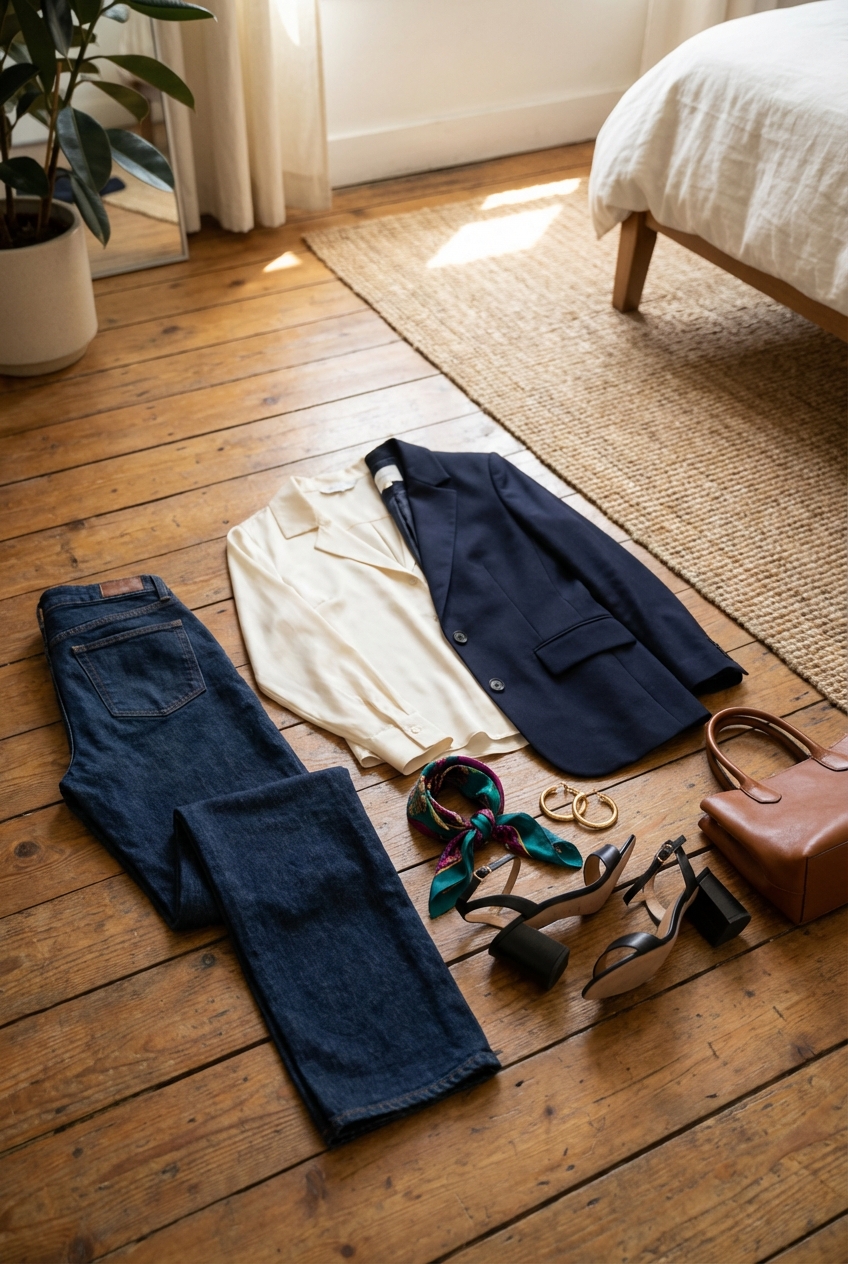
If I were styling a client for a “smart casual” evening event, I would use this formula:
- Base: High-waisted, dark wash, straight-leg jeans (100% cotton).
- Top: Ivory silk blouse or a fine-gauge black cashmere turtleneck.
- Layer: A camel hair coat or a structured navy blazer.
- Texture: A leather belt with gold hardware to bridge the gap between the denim and the luxury top.
The Power of Hardware and Accessories
Accessories are the hardware of your outfit—like the cabinet pulls in a kitchen. They may seem small, but they define the style. When wearing jeans, your accessories must be polished to offset the casual nature of the pants.
A belt is mandatory. Empty belt loops look unfinished. Choose a leather belt roughly 1 to 1.5 inches wide. The buckle should be metal (gold or silver) and in good condition. Avoid oversized logo buckles; they tend to look tacky rather than expensive.
Jewelry should follow the “less is more” principle but have significant visual weight. A chunky gold chain necklace or a pair of architectural earrings draws the eye up to your face and away from the casual vibe of the jeans.
Bag Structure
The shape of your handbag matters. A slouchy hobo bag reinforces the casual look. To dress up jeans, choose a structured bag with a defined bottom and clean lines. A top-handle bag or a rigid clutch signals elegance and intention.
Proportions and The Tuck
The way you wear your clothes is just as important as the clothes themselves. Proportions essentially dictate how the eye travels up and down your body. The goal is to follow the Rule of Thirds.
You never want to cut your body in half (50/50 split). A long top over jeans creates this 1:1 ratio, which can look frumpy. Instead, you want a 1:3 or 2:3 ratio. By tucking in your top, you define your waistline and lengthen the leg line (creating a 2/3 leg to 1/3 torso ratio).
The “French Tuck” Technique
If a full tuck feels too formal or exposing, use the French Tuck (or half-tuck). Tuck the front of your shirt or sweater loosely behind your belt buckle, leaving the back and sides untucked.
This technique defines the waist and reveals the belt (a key accessory) while maintaining a sense of ease. It creates a diagonal line at the hip, which is universally flattering and slimming.
Finish & Styling Checklist
Before you walk out the door, run through this quick stylist checklist. These are the final touches that separate a “nice outfit” from a “high-end look.”
1. The Steam Test: Is your top wrinkled? Denim can be rugged, but your silk or cotton top must be crisp. Wrinkles instantly downgrade the formality.
2. The Lint Check: Dark wash jeans are magnets for lint and pet hair. Use a lint roller immediately before leaving. Visible debris ruins the clean aesthetic.
3. The Ankle Gap: Check your mirror. Is there too much skin showing between your boot and your hem? Or is your pant dragging? Adjust your cuff or switch shoes if the proportions are off.
4. The Hardware Match: Are your metals cohesive? If your belt buckle is gold, try to wear gold jewelry. Mixing metals is advanced styling; matching is a safe bet for a polished look.
5. The Third Piece: Do you have a jacket, blazer, or structured cardigan? If not, do you have a statement accessory that takes its place?
FAQs
Can I dress up light wash jeans?
It is possible, but much harder. Light wash jeans naturally read as “beach” or “weekend.” To dress them up, pair them with very structured pieces in light neutrals—like a white blazer and nude pumps. Avoid wearing them with black, as the contrast can be too harsh.
What about skinny jeans? Are they still in style for dressing up?
Skinny jeans have moved out of the “trend” spotlight and into the “classic” category. However, for a modern, high-fashion look, a straight-leg or wide-leg cut is currently more elegant. If you love skinny jeans, balance the tight bottom with a voluminous top or an oversized blazer to play with scale.
How do I transition an outfit from day to night?
Start with dark jeans and a silk camisole under a cardigan for the day. For night, remove the cardigan, add a structured blazer, switch your tote bag for a clutch, and apply a bold lipstick. The dark denim works for both settings seamlessly.
Are cuffs acceptable on dressy jeans?
A large, thick cuff generally looks casual (like workwear). However, a small, single fold to hit the right ankle length is acceptable. Ideally, your “dressy” jeans should be hemmed to the perfect length so no cuffing is required.
Conclusion
Dressing up jeans is an exercise in balance and restraint. It requires you to respect the casual nature of denim while systematically counteracting it with structure, texture, and precise tailoring.
By building a capsule wardrobe focused on high-quality fabrics—rigid dark denim, crisp cotton, and fluid silk—you remove the guesswork from getting dressed. You stop wondering if you look “too casual” and start knowing that you look sophisticated.
Remember that confidence comes from fit. No amount of expensive accessories can fix a pair of jeans that cuts you off at the wrong spot or drags on the floor. Invest in the tailoring of your denim just as you would a suit, and you will find that jeans can be the most versatile, elegant item in your closet.
Picture Gallery


