
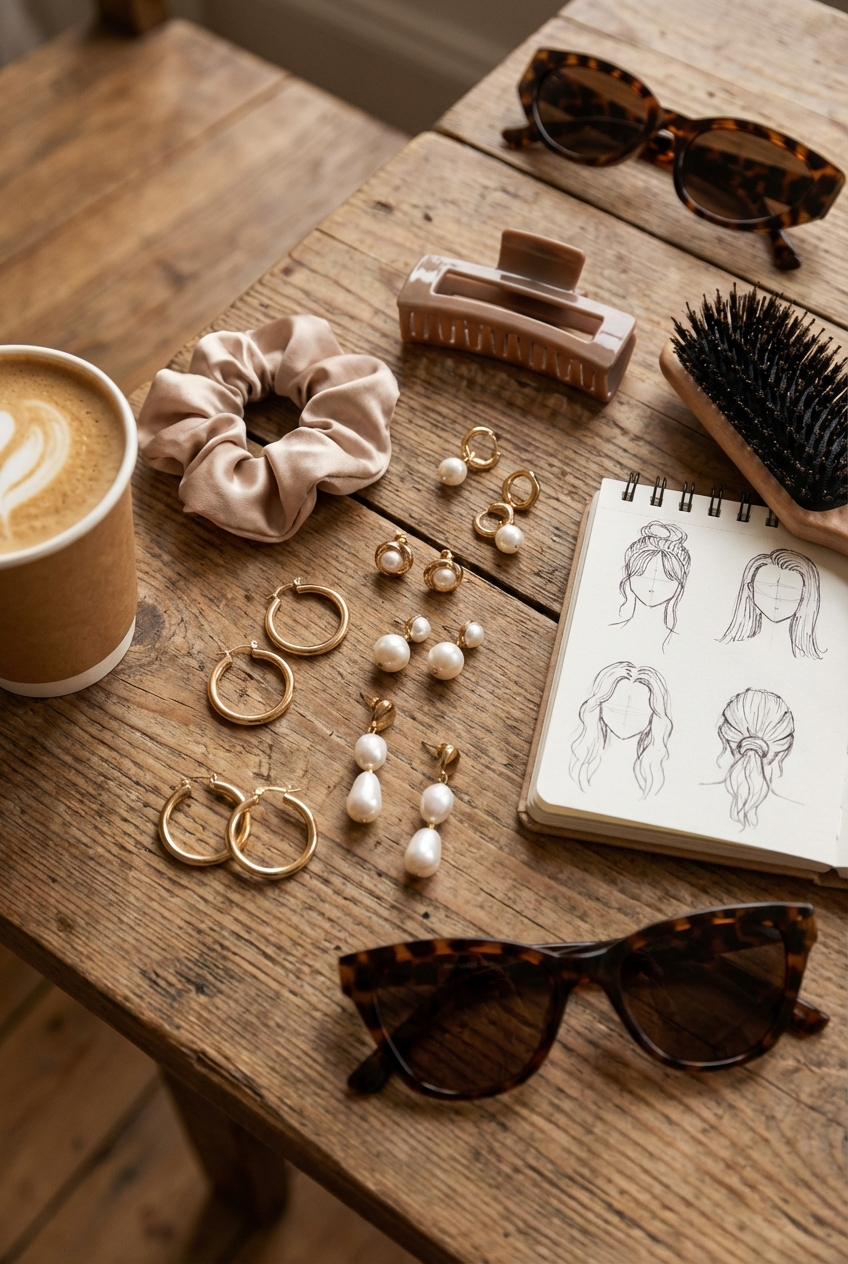
Choosing The Right Earrings For Your Hairstyle
When I first started working as a fashion stylist, I spent hours curating the perfect outfit for a client attending a high-profile gala. We nailed the dress, the shoes, and the clutch, but five minutes before she walked out the door, she threw her hair up into a severe bun and put on tiny pearl studs. The entire look fell flat. The dress was dramatic, but the styling from the neck up completely disappeared. That moment taught me that earrings and hair are not separate decisions; they are a relationship that defines the architecture of your face.
Accessories are the punctuation of your outfit, but your hair is the background against which those accessories sit. If the background is too busy, delicate pieces get lost. If the background is stark and open, bold pieces can either shine or overwhelm you. It is a delicate game of balance, scale, and proportion. Over the years, I have developed a set of reliable rules to ensure that my clients never have to second-guess their jewelry choices, whether they are running to a board meeting or walking down the aisle.
In this guide, we are going to break down exactly how to pair your earrings with your hairstyle to flatter your face shape and elevate your total look. We will cover everything from practical drop measurements for bobs to the weight distribution required for updos. If you are looking for specific examples of these combinations, we have curated a comprehensive Picture Gallery at the end of the blog post to serve as your visual mood board.
Understanding Scale, Texture, and “The Gap”
Before we dive into specific hairstyles, we need to establish the ground rules of jewelry proportion. In design, we often talk about negative space, and the same applies to the area between your earlobe and your shoulder. I call this “The Gap.” The size of this gap changes depending on how you wear your hair, and it dictates the length and volume of earring you can handle.
When your hair is down, you introduce texture and volume around the face. This usually means you need earrings with more presence—think polished metals or light-catching crystals—so they don’t disappear into the shadows of your hair. Conversely, when your hair is pulled back, you expose the structural lines of your jaw and neck. This is where you have the freedom to play with length, but you must be careful not to drag the face downward visually.
Designer’s Note: The 2-Inch Rule
In my experience, the most common failure point is an earring that hits a competitive length with the jawline or the hair ends. For most clients, I stick to the 2-inch rule for drop earrings. If an earring is longer than 2 inches, it becomes a statement piece that requires a simpler hairstyle to let it breathe. If it sits right at the jawline (often around 1.5 to 2 inches depending on your anatomy), it can widen the face. Always measure from the piercing to the shoulder to understand your personal “Gap.”
Short Hair and Pixie Cuts: The Spotlight Effect
If you have a pixie cut or very short hair, you have the ultimate jewelry canvas. With no hair to hide behind, your earlobes are on full display 100% of the time. This exposure is fantastic for showcasing intricate details that would otherwise get lost in long locks, but it also means there is no buffer. The earrings you choose will directly influence the perceived shape of your face.
For a pixie cut, you want to create balance without overwhelming your features. Since the hair is close to the scalp, oversized hoops or massive chandeliers can sometimes look unbalanced, as if the jewelry is heavier than the hair itself. I often recommend “ear climbers” or “cuffs” for my edgy clients with short hair. These travel up the ear rather than hanging down, adding visual interest that mimics the upward sweep of a short haircut.
However, if you do want a drop earring, look for linear shapes. A thin chain drop or a geometric bar earring creates a stunning line that elongates the neck. Because your neck is fully exposed, a linear earring draws the eye down gracefully. Just be mindful of the visual weight; a heavy, chunky earring on a pixie cut can look a bit aggressive unless that is the specific avant-garde vibe you are aiming for.
Common Mistakes + Fixes
Mistake: Wearing medium-sized hoops that flare out horizontally.
Why it fails: Without hair volume on the sides to balance them, wide hoops can make the ears look like they are sticking out or widen the face unnecessarily.
The Fix: Switch to “huggies” (small hoops that hug the earlobe) or large, thin wire hoops that feel airy. Avoid thick, chunky hoops that sit parallel to the ears.
The Bob and Lob: Managing the Shoulder Collision
The bob and the long bob (lob) are chic, timeless cuts, but they are notoriously difficult to style with earrings. The issue here is mechanical interference. If your hair hits right at the jaw or just above the shoulder, long earrings will constantly tangle with your hair strands or click against your collarbone. I have seen clients spend an entire dinner party untangling their crystal drops from their blowout.
For a classic chin-length bob, studs are your best friend, but they don’t have to be boring. I prefer oversized studs—think vintage buttons, large pearls, or geometric clusters—that sit flat on the lobe. These provide a pop of color and finish without interacting with the hair tips. If you want a drop earring, it must be shorter than your hair. If your bob is 2 inches below the ear, your earring should be no longer than 1 inch.
If you have a lob that clears the shoulder but covers the ears, you have slightly more room to play. However, you still want to avoid materials that grab. Rough textures, prong-set gems that aren’t smoothed down, and open filigree designs are Velcro for hair. Stick to high-polish metals like gold or silver, or smooth resin materials that allow the hair to glide over the earring without snagging.
What I’d Do in a Real Project
When styling a client with a bob for a photoshoot, I almost always reach for:
- Oversized architectural studs: Gold hammered squares or pearl clusters.
- Sleek ear jackets: The piece that peeks out from behind the lobe adds depth without length.
- Drop length limit: I physically hold a ruler to their ear. If the earring touches the shoulder when they tilt their head, it goes back in the box.
Long, Loose Waves: fighting for Visibility
Long, wavy hair is romantic and voluminous, but it is also an earring eater. I cannot tell you how many times a client has bought expensive diamond studs only to have them completely vanish once their hair was styled down. If you are wearing your hair in loose waves, the goal is visibility and snag-proofing.
You need earrings with surface area and light-reflecting capabilities. Small, matte earrings will disappear into the shadows of your hair. Instead, opt for elongated shapes that cut through the texture. A long, thin metal oval or a brightly colored tassel earring works well here. The movement of the earring should mimic the movement of the hair. Stiff, rigid earrings can look awkward poking out of soft waves.
Color contrast is also vital here. If you have dark hair, black onyx earrings will be invisible. Go for gold, silver, or bright gemstones. If you have blonde hair, you can get away with darker metals or deep jewel tones like emerald and sapphire. The rule of thumb is: if you can’t see the earring from five feet away in the mirror, it is too small for this hairstyle.
Designer’s Note: The “Tuck” Trick
If you are dead set on wearing a specific pair of earrings but your hair keeps hiding them, use the “tuck” trick. Tuck one side of your hair behind your ear and leave the other side flowing loose. This asymmetrical look is incredibly chic and guarantees that at least one earring gets its moment in the spotlight. For this look, I love using mismatched earrings—a statement drop on the exposed ear and a simple stud on the covered side.
Sleek High Buns and Updos: The Architectural Canvas
Pulling your hair up into a sleek high bun or a tight chignon is an instant facelift. It pulls the features upward and exposes the entire landscape of your neck and jawline. This is the “blank canvas” scenario where you can get away with the most dramatic, heavy, and intricate pieces in your collection. This is where high fashion truly comes into play.
Since the hair is pulled away, you don’t have to worry about tangling or volume competition. This is the moment for “Chandeliers.” These are earrings with a wide base that taper down, often featuring crystals or beads. The wideness of a chandelier earring balances the verticality of a high bun. It fills the negative space on the sides of the neck, making the neck look swan-like rather than bare.
Another excellent option for sleek updos is the “Statement Drop.” Think of a single large baroque pearl on a chain, or a sculptural piece of gold. The key here is that the earring becomes the focal point of the upper body. Because the hair is sleek and minimal, the earring provides the texture and complexity.
Real-World Constraint: Weight and Comfort
While updos allow for heavy earrings visually, your earlobes have physical limits.
- The Support Patch: When I style clients with heavy statement earrings for a gala, I always apply a small adhesive support patch to the back of the earlobe. This distributes the weight and prevents the piercing from stretching into a slit.
- Time Limit: If the earrings are over 15 grams each, I advise clients to put them on right before photos and take them off during the dancing portion of the evening.
Ponytails: Casual vs. Glamour
The ponytail is a chameleon. It can be a messy gym look or a sleek red-carpet style. Your earring choice dictates which direction the look leans. The most classic pairing for a ponytail is the hoop earring. There is something fundamentally right about the curve of a hoop contrasting with the straight line of a ponytail.
For a low, messy pony, I love a medium-sized gold hoop (about 1.5 to 2 inches in diameter). It feels effortless and cool. It says you tried, but not too hard. If you are doing a high, sleek ponytail (think Ariana Grande style), you can go bigger with the hoops or switch to a diamond tennis drop. The high pony lifts the eye, so a long linear drop continues that vertical energy.
Avoid tiny studs with ponytails unless you are going to the gym. A ponytail exposes the side of the face, and a tiny stud can leave the jawline looking undefined. You need something that frames the face, which is exactly what a hoop or a drop does.
Common Mistakes + Fixes
Mistake: Wearing formal chandelier earrings with a messy, low ponytail.
Why it fails: The vibes clash. The hair says “I just woke up,” but the earrings say “black tie.” It looks disjointed.
The Fix: If you want sparkle with a messy pony, choose “pave” hoops or geometric studs with diamonds. They bridge the gap between casual and dressy without looking like a costume.
Half-Up, Half-Down: The Best of Both Worlds
The half-up, half-down hairstyle is a favorite for weddings and romantic dates because it keeps hair off the face while maintaining length and softness. This style creates a natural “frame” around the eyes and cheekbones. Because the hair is pulled back from the temples, your earlobes are visible, but you still have the backdrop of hair behind the neck.
This styling requires a “Button” earring or a short drop. A button earring is larger than a stud—it covers the whole lobe and perhaps sits slightly below it—but doesn’t dangle freely. This works beautifully because it anchors the point where the hair is pulled back. Vintage clip-ons are often this shape and look incredible with half-up hair.
If you prefer a drop, keep it delicate. A heavy, thick earring can look confusing against the two layers of hair (the pulled-back layer and the loose layer). A simple pearl drop or a diamond tear-drop is elegant and harmonious. It acknowledges the femininity of the hairstyle without fighting it for attention.
Designer’s Note: Metal Tone Coordination
With half-up styles, your hair color near the ears is very dense. Make sure your metal tone pops.
- Red Hair: Rose gold or bright Silver looks stunning.
- Dark/Black Hair: High-karat Gold (22k or 24k) provides the necessary warmth and contrast.
- Grey/Silver Hair: Go for mixed metals or colored gemstones like ruby or sapphire to add warmth.
Finish & Styling Checklist
Before you rush out the door, run through this quick mental checklist. I use a version of this before sending any model down the runway or client to an event. It ensures that the look is cohesive and functional.
1. The Shake Test
Shake your head vigorously from side to side. Do the earrings hit your cheek? Do they get caught in your hair immediately? If yes, change them. You do not want to be adjusting your ears all night.
2. The Phone Check
If you are going to an event where you will be on the phone (or if it’s a work day), avoid massive 3D earrings that make holding a phone to your ear painful. Flat studs or huggies are best for heavy phone days.
3. The Neckline Scan
Look at your earrings in relation to your neckline, not just your hair.
- High Neck/Turtleneck + Updo: Studs or small drops. Long earrings will clang against the fabric.
- Off-the-Shoulder + Down Hair: Statement earrings. You have plenty of skin to fill.
- V-Neck + Ponytail: Hoops or linear drops to mimic the V shape.
4. The 80/20 Rule
If your hair is the statement (huge volume, intricate braids, flower accessories), your earrings should be the supporting actor (20% of the attention). If your hair is simple (sleek bun, simple bob), your earrings should be the star (80% of the attention). Never let them scream at each other.
FAQs
Can I wear gold earrings if my hair accessories are silver?
Mixing metals is very on-trend right now, but it needs to be intentional. If you have a silver barrette in your hair, you can wear gold earrings, but try to find a piece that perhaps incorporates both tones, or ensure the styles are similar (e.g., both modern and geometric). If the styles clash (vintage silver hair comb vs. modern gold hoops), it will look accidental.
My ears are sensitive to weight. How can I wear statement earrings with an updo?
Look for materials like hollow gold, resin, wood, or acrylic. These materials give you the “huge” look without the gram weight of solid metal or glass. Also, switch the backing to a “disc back” (a plastic disc attached to the earring back). This keeps the earring upright and distributes the pressure across a wider area of the earlobe.
Do I have to match my earrings to my face shape or my hairstyle?
Ideally, both. However, your hairstyle can actually alter your perceived face shape. For example, if you have a round face but wear a high volume updo, you have elongated your face visually. In that moment, you can get away with hoops that might normally widen a round face. Always style for the “total shape” created by your head and hair combined.
What is the most versatile earring for all hairstyles?
The Diamond (or cubic zirconia) Huggie. It is a small hoop that hugs the earlobe tightly. It has enough sparkle to be seen through long waves, it is structured enough for a sleek pony, and it is comfortable enough for a bob. It is the “little black dress” of the jewelry box.
Conclusion
Choosing the right earrings is about more than just grabbing the pair that matches your shoes. It is about understanding the architecture of your head and neck. Your hairstyle creates the context, and your earrings provide the focal point. Whether you are rocking a pixie cut that demands a bold cuff or softening a severe bun with a delicate pearl drop, the goal is always harmony.
Remember that these rules are guidelines based on balance and proportion, but fashion is ultimately about self-expression. Once you understand the rules of scale and “The Gap,” you can break them with intention to create looks that are uniquely yours. Don’t be afraid to experiment. Stand in front of the mirror, pull your hair up, let it down, and watch how the personality of your earrings changes with each shift.
If you are ready for some serious inspiration, scroll down to our Picture Gallery below to see these principles in action.
Picture Gallery


