
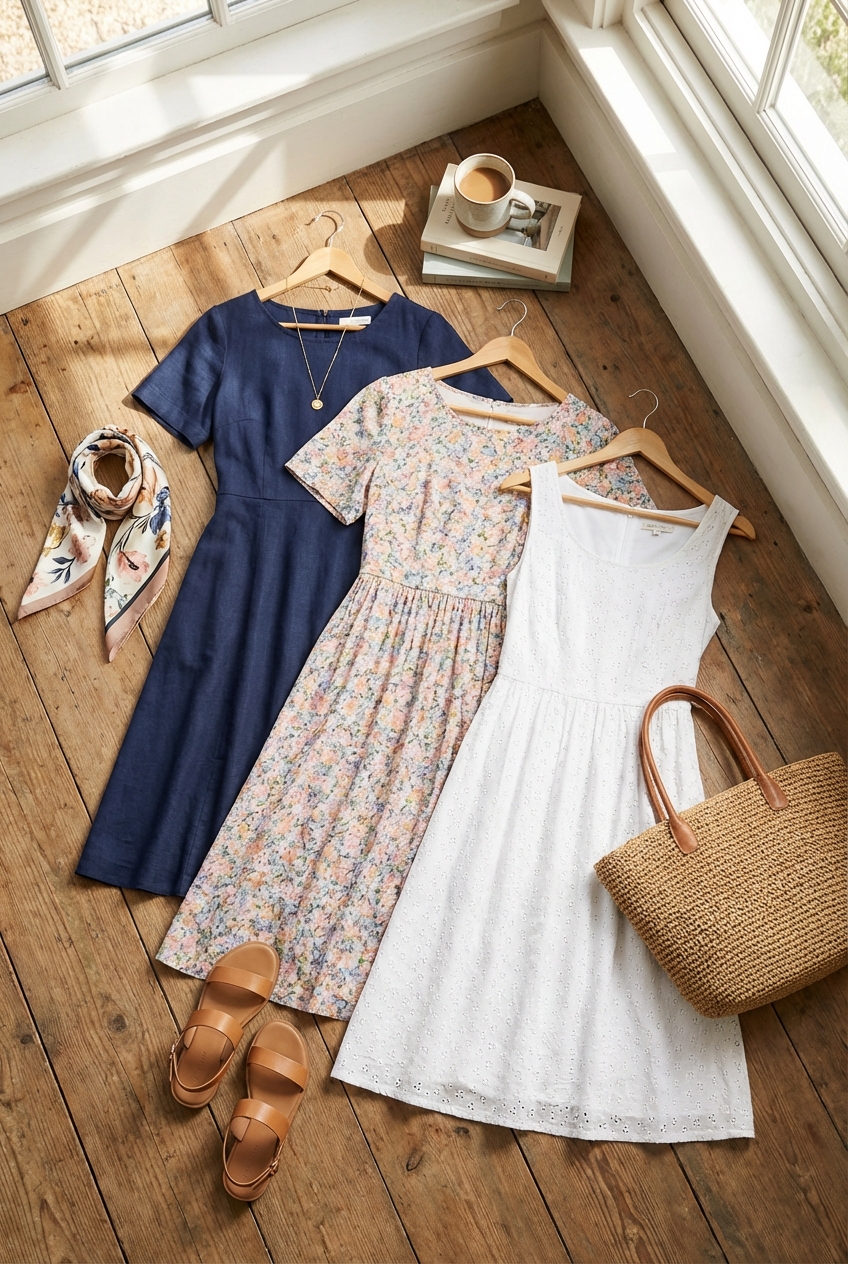
Classic A Line Dresses For Feminine Simplicity
There is a quiet power in the A-line silhouette that few other garments possess. It is the architectural backbone of a functional wardrobe, balancing structure with movement in a way that feels effortless yet completely polished. When I am styling a client for a busy season of events, this is almost always where we start.
The magic lies in the geometry. By fitting specifically at the natural waist and flaring gently out over the hips, the A-line dress creates a visual hourglass regardless of your actual body type. It frames the upper body while offering absolute comfort through the skirt, making it a pragmatic choice for women who need to move, sit, and work without constantly adjusting their clothes.
In this guide, I will break down how to select the perfect A-line dress based on fabric weight, hem length, and tailoring standards. If you are looking for visual inspiration, make sure to scroll to the Picture Gallery at the end of the blog post.
The Anatomy of a Flawless Fit
The success of an A-line dress relies entirely on the bodice. Because the skirt provides volume, the top portion of the dress must be tailored close to the body to prevent the silhouette from looking tent-like. The shoulder seam should sit exactly at the corner of your shoulder bone. If it droops, the entire dress looks ill-fitting; if it is too high, it will pull across the bust.
The most critical measurement is the natural waist. This is not necessarily where your pants sit. It is the smallest part of your torso, usually about two inches above the belly button. The waistband or narrowest point of the A-line dress must hit exactly here. If the waist of the dress sits too low, it creates a boxy shape that shortens your legs.
Designer’s Note:
When fitting clients, I often find that they buy dresses based on their hip measurement. With an A-line, you should actually buy based on your bust and waist measurement. The hip area is free-flowing, so it rarely matters if the size chart says your hips are “too big” for that size. Always fit the ribcage first; the rest is forgiving.
Fabric Weight and Structural Integrity
Not all fabrics can support an A-line shape. If the fabric is too flimsy, the dress will hang limp rather than flaring out. If it is too stiff, it adds unnecessary bulk. For a classic, high-end look, you need materials that have “memory”—fabrics that want to return to their shape.
For colder months or professional settings, look for wool crepe, gabardine, or heavy cotton blends. These fabrics have a dense weave that holds the triangular shape of the skirt without needing layers of tulle underneath. They provide a smooth line over the body and do not cling to undergarments.
For spring and summer, linen and cotton poplin are standard, but they wrinkle easily. I prefer silk shantung or a silk-cotton blend for my clients. These offer breathability but maintain that crisp, architectural line that defines the A-line style. Avoid thin jerseys or rayons unless the dress is cut on the bias, as these tend to collapse rather than flare.
Mastering Hemlines and Proportions
The length of your dress dictates the formality and the visual proportion of your body. In high-end fashion, we follow the “Rule of Thirds.” You never want a hemline to cut your leg exactly in half.
For a playful, daytime look, a hem hitting two inches above the knee works best for women under 5’6″. This elongates the leg. If you prefer a midi length, be very careful. The hem should never stop at the widest part of your calf muscle. This creates a stump effect.
The most universally flattering midi length is the “tea length,” which hits at the narrow part of the leg just below the calf muscle but above the ankle bone. This highlights the slimmest part of the leg and showcases your shoes beautifully.
Common Mistakes + Fixes:
Mistake: Wearing a midi A-line dress that is too long, making you look shorter.
Fix: Take the dress to a tailor and have them hem it up by one to two inches. The perfect spot is where your leg begins to taper in toward the ankle. Even a single inch makes a massive difference in visual height.
Necklines and Sleeve Considerations
Because the bottom half of an A-line dress has volume, the top half dictates the mood. A boat neck (bateau) creates a horizontal line across the collarbone, which balances the width of the skirt. This is a very classic, Audrey Hepburn-inspired look that widens the shoulders visually, making the waist look even smaller in comparison.
V-necks are ideal for breaking up the chest area and elongating the neck. If you have a larger bust, a deep V-neck A-line dress prevents the upper body from looking heavy. It draws the eye vertical, creating a leaner line down to the waist.
Sleeves should be fitted. A billowy sleeve paired with a billowy skirt can overwhelm the frame. I usually recommend a fitted three-quarter sleeve or a sleeveless cut. If you want a puff sleeve, ensure the waist is cinched very tightly to maintain structure.
Styling for Occasions: The Shoe Equation
The shoe you choose changes the physics of how the dress moves. Because A-line skirts have volume, you generally need a shoe that elongates the leg to balance that volume.
The Pointed Toe Pump:
This is the gold standard for A-line dresses. The pointed toe extends the line of the leg, which is helpful when wearing a midi length. A nude pump that matches your skin tone is the ultimate secret weapon for maximizing leg length.
The Structured Flat:
You can wear flats with A-line dresses, but avoid round-toe ballet flats if you are petite, as they can look a bit juvenile with this silhouette. Instead, opt for a loafer or a pointed flat. The structure of a loafer complements the architectural shape of the dress.
Boots:
In the fall, a knee-high boot under a midi A-line dress is incredibly chic. The key is to ensure the boot shaft disappears under the hem of the dress. You do not want a strip of skin showing between the boot and the dress, as this chops up your vertical line.
Tailoring: The Difference Between Good and Great
You rarely find a dress off the rack that fits perfectly in every dimension. In the luxury world, we view ready-to-wear sizes as a starting point, not a finished product. Budgeting an extra $40 to $80 for tailoring will make a $200 dress look like a $2,000 dress.
The most common alteration for an A-line dress is lifting the shoulders. If the waist hits you too low, lifting the dress at the shoulder seams raises the entire garment. This places the waistline in the correct spot and fixes armholes that are too low.
Another essential alteration is “taking in” the side seams of the bodice. The contrast between the fitted top and full skirt is what makes this look work. If the bodice has even an inch of excess fabric, you lose the impact of the shape. It should feel like a hug around your ribcage.
Finish & Styling Checklist
Before you head out the door or finalize a purchase, run through this mental checklist to ensure the look is polished and proportional.
Fit & Fabric:
- Does the shoulder seam sit squarely on the edge of your shoulder bone?
- Does the waistband hit at your natural waist (the smallest part), not your hips?
- Is the fabric opaque and substantial enough to hold the A-shape without collapsing?
- Is the zipper lying flat against your back, or is it buckling (a sign the torso is too short)?
Styling & Accessories:
- If the dress is a solid neutral color, have you added texture via a belt or statement jewelry?
- Does your hemline hit at a narrowing point of your leg (above the knee or above the ankle)?
- Are your shoes polished? Scuffed shoes are more noticeable with A-line dresses because the hem draws the eye downward.
- If wearing a jacket/blazer, is it cropped? A long blazer over an A-line skirt creates a bulky, unappealing silhouette.
What I’d Do in a Real Project:
If I were styling a client for a day-to-night event, I would choose a navy wool-silk blend A-line midi dress. I would have the hem tailored to exactly 3 inches above the ankle bone. I would pair it with a cognac leather belt to define the waist further and match that with cognac pointed-toe pumps. For evening, we would swap the leather belt for a thin metallic one and change into a strappy heel.
FAQs
Can I wear an A-line dress if I have a large bust?
Absolutely. The A-line is one of the best shapes for balancing a large bust because the volume of the skirt balances the top heavy volume. The key is to choose an open neckline, like a V-neck or scoop neck, rather than a high crew neck. This opens up the chest area and prevents a “shelf” look.
Do A-line dresses need a petticoat or slip?
Modern A-line dresses generally do not require petticoats if the fabric is high quality. However, wearing a silk or anti-static slip is non-negotiable for me. It prevents the dress from sticking to your legs when you walk, ensuring the fabric moves independently of your body.
How do I style a coat over an A-line dress?
This is a common struggle. You cannot wear a straight, narrow coat over a full skirt without bunching. You need a coat that mimics the dress shape—a trench coat or a “swing” coat that flares at the waist. Alternatively, wear a cropped jacket that stops at the waistline to avoid crushing the skirt volume.
Is this silhouette appropriate for the office?
Yes, it is often more appropriate than a pencil skirt because it is not restrictive. Look for conservative necklines and knee-length or midi hems. Avoid mini A-lines in corporate settings, as they can look too youthful.
Conclusion
The A-line dress remains a cornerstone of feminine style because it respects the female form without restricting it. It is a silhouette that says you care about presentation, but you also value your ability to move through the world with ease. By focusing on the structural details—heavier fabrics, precise waist placement, and intentional hemlines—you can curate a wardrobe of dresses that serve you for years, not just a single season.
True style is about understanding proportion. Once you find the A-line cut that hits your specific waist and length requirements, buy it in multiple fabrics. It is a formula that never fails.
Picture Gallery


