
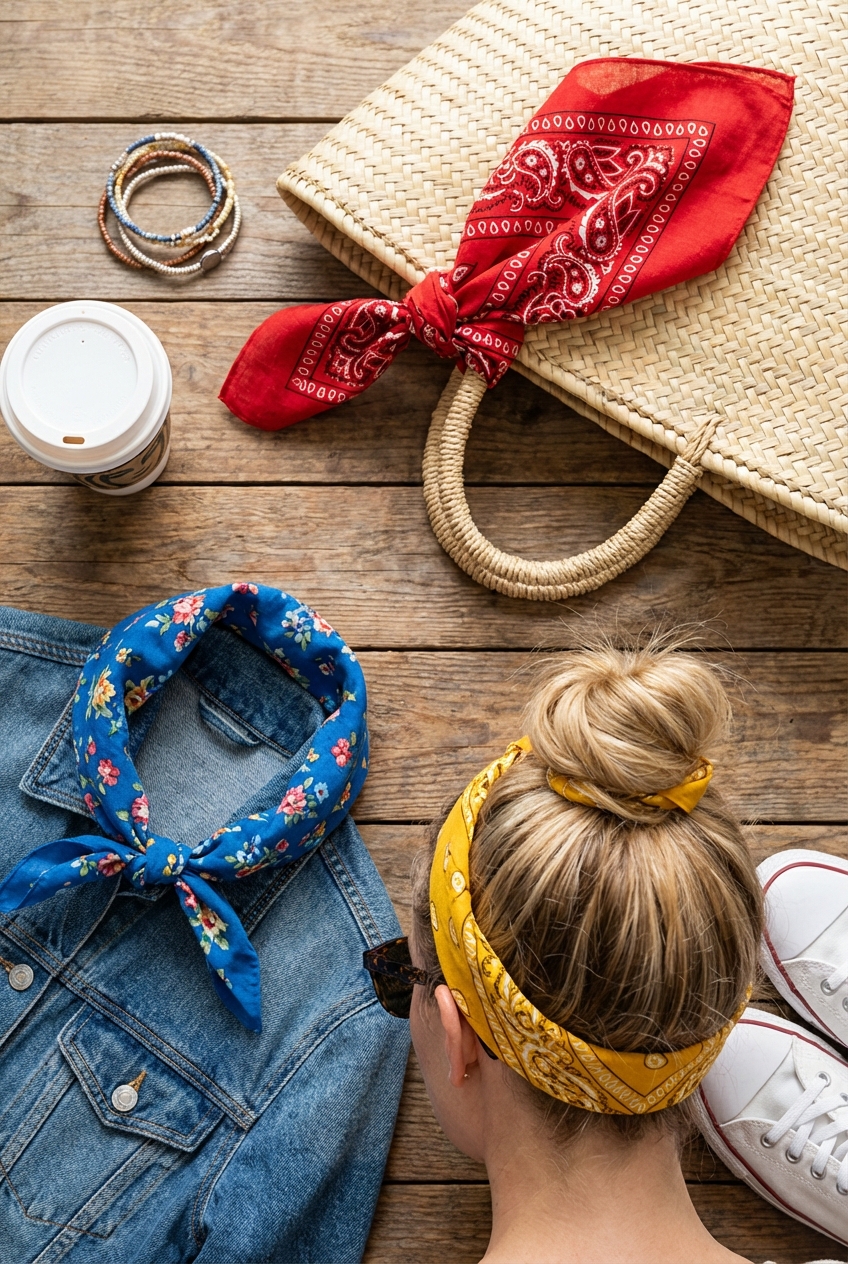
Creative Ways To Wear Bandanas As Accessories
Bandanas are often dismissed as purely utilitarian items or festival gear, but in the world of high-end styling, they are secret weapons for adding texture and color to a neutral wardrobe. I have used vintage silk scarves and classic cotton bandanas on countless editorial shoots to transform a flat outfit into something dynamic. The key lies not just in the pattern, but in how you manipulate the fabric to work with your body’s proportions.
When I style a client, we often look for that “third piece”—the element that bridges the gap between a top and a bottom. A bandana serves this function perfectly without the bulk of heavy jewelry or the commitment of a jacket. Whether you are aiming for a Parisian chic aesthetic or a rugged Americana vibe, the fold and the fabric choice dictate the level of formality.
However, wearing a bandana requires a bit of technical know-how to avoid looking like you are wearing a costume. It is about intention. I have curated a stunning Picture Gallery at the end of this blog post to inspire your next look.
The Elevated Neck Tie
The most classic way to wear a bandana is around the neck, but there is a massive difference between a cowboy knot and a chic French knot. In high-fashion styling, we focus heavily on the “bias fold.” Folding the fabric on the bias allows it to stretch slightly and drape softly against the collarbone, rather than sticking out stiffly.
To achieve a polished look, you must pay attention to the scale of the knot relative to your jawline. If you have a shorter neck, a thick roll will look cluttering. In that case, you want a tighter, flatter fold. If you have a longer neck, you can afford a looser drape that occupies more vertical space.
The Method: The Bias Fold
- Lay the bandana flat on a table.
- Take the top left corner and fold it toward the center.
- Take the bottom right corner and fold it toward the center.
- Continue folding both long sides inward until you have a long, thin strip.
- This technique hides the hemmed edges and creates a clean, streamlined silhouette.
Designer’s Note: Fabric Matters
In my years of styling, the biggest mistake I see is pairing the wrong fabric weight with the outfit. Cotton bandanas are stiff and matte; they work best with denim, linen, and heavy wool. Silk or satin bandanas have sheen and fluidity; these should be reserved for blazers, button-downs, and evening wear. Never wear a stiff, starch-heavy cotton bandana with a delicate silk blouse—the textures will clash aggressively.
The Structural Head Scarf
Wearing a bandana as a head accessory is practical for bad hair days, but it is also a deliberate style statement. The goal here is to ensure the scarf looks intentional and secure, rather than like you just stepped out of the shower. We look at face shape and hair texture to determine the placement.
For clients with rounder faces, I position the band further back on the hairline to elongate the forehead. For those with longer face shapes, wearing the bandana slightly lower across the forehead can balance proportions. The “Babushka” style (tied under the chin) has made a massive runway comeback, but it requires confidence and the right sunglasses to look modern rather than matronly.
Common Mistakes + Fixes
- Mistake: The bandana slips off the back of the head within an hour.
- Fix: Use texture spray or dry shampoo on the hair where the fabric will sit. For silk scarves, I always cross two bobby pins in an “X” shape behind the ear, catching the fabric underneath the hair.
- Mistake: The knot creates a bulky lump at the nape of the neck.
- Fix: Instead of a double knot, use a small clear elastic band to secure the ends, then tie a single knot over the elastic. This reduces bulk by 50%.
The Handbag Handle Wrap
This is a trick I use constantly to revitalize a client’s older luxury handbag. Wrapping a bandana or scarf around the top handle serves two purposes: it adds a unique pop of color, and it protects the leather from the oils and lotions on your hands. This is particularly important for bags with light-colored leather handles (vachetta) that darken over time.
The wrapping technique requires precision. You cannot simply wind it loosely; it must be a tight coil. The friction holds it in place. I recommend using a 22-inch square bandana for short handles and a longer “twilly” style scarf for shoulder straps.
What I’d Do in a Real Styling Session
1. Secure the Start: I tie a single knot at the base of the handle, leaving about 2 inches of “tail” hanging down.
2. The Coil: I wrap the fabric tightly around the handle, overlapping the previous wrap by about a quarter-inch each time. This ensures no leather peeks through.
3. The Finish: Once I reach the other side, I tie another knot, ensuring the remaining tail matches the length of the starting tail. Symmetry is crucial here for a high-end look.
The Wrist and Ankle Accent
Using a bandana on the wrist or ankle is a playful nod to 90s fashion, but it must be styled carefully to avoid looking juvenile. The rule of thumb here is “less is more.” If you have a bandana on your wrist, your other jewelry should be minimal but substantial. Think a chunky gold watch or a single architectural cuff.
For ankle styling, this only works with specific footwear. It looks fantastic with cropped denim and loafers or low-top sneakers. It generally clashes with boots because the bulk competes with the boot shaft.
Pro-Level Spacing Rules
- Wrist: The bandana should not be so tight that it leaves a mark, but not so loose that it drags into your food. You should be able to fit one finger comfortably between the fabric and your skin.
- Ankle: Keep the knot on the outside of the ankle bone. This prevents the knot from rubbing against your other leg when you walk.
- Visual Balance: If you are wearing a wrist wrap, keep your sleeves rolled up. You need to see skin between the bandana and the sleeve hem; otherwise, the arm looks shortened.
The Belt Loop Alternative
Standard bandanas (usually 20×20 or 22×22 inches) are rarely long enough to function as a full belt for an adult waist. However, we can use them as a “loop accent.” This is a subtle way to introduce pattern to a monochrome outfit, like an all-white linen set or a Canadian tuxedo (denim on denim).
Instead of trying to force the bandana around your waist, you tie it specifically to a single belt loop. This creates a vertical line that draws the eye down, elongating the leg. It adds movement as you walk, similar to a tassel on a bag.
Styling Checklist for Waist Accents
- Placement: Always tie it on the front-side belt loop (left or right), never directly center and never squarely on the hip. The off-center placement feels more organic.
- Knot Style: Use a “lark’s head” knot for a clean drape. Fold the bandana in half to create a loop, pass the loop through the belt loop, and pull the tails through the bandana loop.
- Color Coordination: Pick a bandana that contains the color of your pants. If you are wearing blue jeans, a bandana with navy or indigo elements ties the look together cohesively.
The Pocket Square & Structural Detail
For a sharper, more masculine edge, using a bandana as a pocket square in a blazer or denim jacket is a brilliant textural play. Traditional silk pocket squares can feel too stuffy for daytime wear. A cotton bandana offers a matte finish that creates a beautiful contrast against the sheen of a wool blazer or the roughness of a denim jacket.
The fold here should not be too precise. We want “sprezzatura”—a studied carelessness. The goal is a puff fold or a three-point fold that looks like you just shoved it in, even though we know you spent two minutes arranging it.
Real-World Lesson: Volume Control
A full-size bandana is often too much fabric for a standard breast pocket. It will create a bulge in the jacket that ruins the silhouette.
The Fix: If the pocket is shallow, I cut the bandana. Yes, I will actually cut a vintage bandana into a smaller 10×10 square to reduce bulk. If you aren’t willing to cut it, fold it into quarters and iron it flat before creating your pocket square fold. The iron compresses the fibers, allowing you to fit more fabric into a small space without the bulge.
Finish & Styling Checklist
Before you head out the door, run through this mental checklist to ensure your accessory looks polished rather than haphazard.
- Ironing: Is the bandana wrinkled? Unless it is a deliberate crushed texture, iron your cotton bandanas. A crisp fold looks expensive; a wrinkled one looks messy.
- Label Check: Have you cut off the care tag? Nothing ruins a chic silk tie look faster than a white polyester tag sticking out of the knot.
- Knot Security: If you are using silk, have you double-knotted it? Silk slips. Cotton grips. Adjust your tying method based on the friction of the fabric.
- Proportion: Step back five feet from the mirror. Does the bandana overwhelm your face? If you have petite features, switch to a smaller neckerchief size.
FAQs
Can I wear a bandana to a corporate office?
Yes, but the material is the deciding factor. Avoid traditional paisley cotton bandanas, which read as casual. Opt for silk or satin geometric prints tied tightly at the neck (like a flight attendant scarf) or wrapped around a top-handle bag. This looks authoritative and polished.
How do I wash my bandanas?
Cotton bandanas should be washed in cold water and air-dried to prevent shrinking and fading. Vintage bandanas become softer with age, which is desirable. Silk bandanas must be dry cleaned or hand-washed with pH-neutral detergent to maintain their sheen.
What is the best color for a versatile starter bandana?
Navy blue, classic red, and forest green are timeless. However, for a high-fashion approach, I recommend a neutral palette: cream, taupe, or black with white piping. These colors blend seamlessly with a capsule wardrobe.
My bandana feels too tight on my neck. What am I doing wrong?
You are likely rolling it too thick. The thicker the roll, the less length you have available for the knot. Try folding it flat (like a ribbon) rather than rolling it like a tube. This maximizes the circumference available for your neck.
Conclusion
Accessories are the punctuation marks of an outfit, and the bandana is perhaps the most versatile mark of all. It can be an exclamation point of color or a subtle comma of texture. By respecting the rules of scale, fabric weight, and occasion, you can elevate this humble square of cloth into a signature style element.
Remember that fashion is ultimately about comfort and confidence. If a headscarf feels too bold for you, start with a bag wrap. If a necktie feels too restrictive, try a wrist accent. Experiment with the folds and find the proportions that flatter your specific silhouette.
Picture Gallery


