
Desert Night Attire Dressing For Temperature Drops
There is a specific kind of magic that happens in the desert just before sunset. The light turns a dusty rose, the landscape glows, and the heat of the day finally breaks. It creates a seductive illusion that the warmth will linger, lulling you into a false sense of sartorial security. I remember my first high-end styling job in Joshua Tree; I was focused entirely on the aesthetic of flowing linens and open backs, completely ignoring the meteorological reality.
By 8:00 PM, the temperature had plummeted forty degrees. My client was shivering in a silk slip dress, and I ended up wrapping her in the heavy canvas drop cloths we brought for the equipment. It was a fashion disaster, but it taught me a permanent lesson about desert environments. The lack of humidity means the air cannot hold heat, creating a drastic shift the moment the sun dips below the horizon.
Dressing for this environment requires a strategic approach that balances high-fashion aesthetics with genuine thermal survival. You cannot simply throw a cardigan over a sundress and hope for the best. It requires a foundational understanding of fabric weights, layering ratios, and footwear that can handle both shifting sands and freezing ground temperatures. For visual inspiration on these looks, be sure to check out the Picture Gallery at the end of the blog post.
The Physics of Desert Layering
The concept of layering is often thrown around loosely in fashion, but in the desert, it is a precise science. You aren’t just layering for visual depth; you are layering to create trapped pockets of air that insulate the body. The goal is to maintain a streamlined silhouette while wearing three times as much clothing as you did at noon.
I always advise clients to follow the “Three-Zone Rule.” You need a moisture-wicking base near the skin, a thermal regulation layer in the middle, and a wind-blocking shield on the exterior. If you skip one, the system fails.
Fashion Expert’s Note: The most common mistake I see is people relying on denim jackets as their top layer. Denim is cotton; it creates no thermal seal and offers zero wind resistance. When the desert wind picks up at night, the cold cuts right through it. Always opt for leather, suede, or tight-weave wool instead.
The Base Layer Equation: Silk vs. Synthetics
When styling for a desert getaway, the layer touching your skin is the most critical variable. During the day, you might perspire, but at night, that moisture will freeze you if it doesn’t evaporate. This is why I strictly ban cotton base layers for evening transition outfits. Cotton absorbs moisture and holds it against the skin, creating a damp chill that no amount of outerwear can fix.
My go-to recommendation for a high-end look is always silk. Silk is a natural protein fiber that regulates body temperature incredibly well. A silk slip dress or a silk camisole acts as a perfect insulator. It is thin enough to go unnoticed under chunky knits but warm enough to make a difference.
If you are styling a look with trousers, consider silk-blend leggings underneath. They add zero bulk but provide a crucial barrier against the cold air that tends to settle near the ground. Avoid pure synthetics like cheap polyester, which will make you sweat without actually keeping you warm.
Outerwear That Elevates the Aesthetic
Your outerwear is the centerpiece of desert night attire. Because you will likely be wearing this piece for the entirety of the evening, it needs to be the strongest element of your outfit. We want drama, texture, and weight.
Shearling and Sherpa: Real shearling is the gold standard for desert nights. It offers a rustic, textural quality that fits the landscape perfectly while providing immense warmth. I look for vintage-inspired aviator silhouettes. The leather exterior blocks the wind, and the wool interior traps heat.
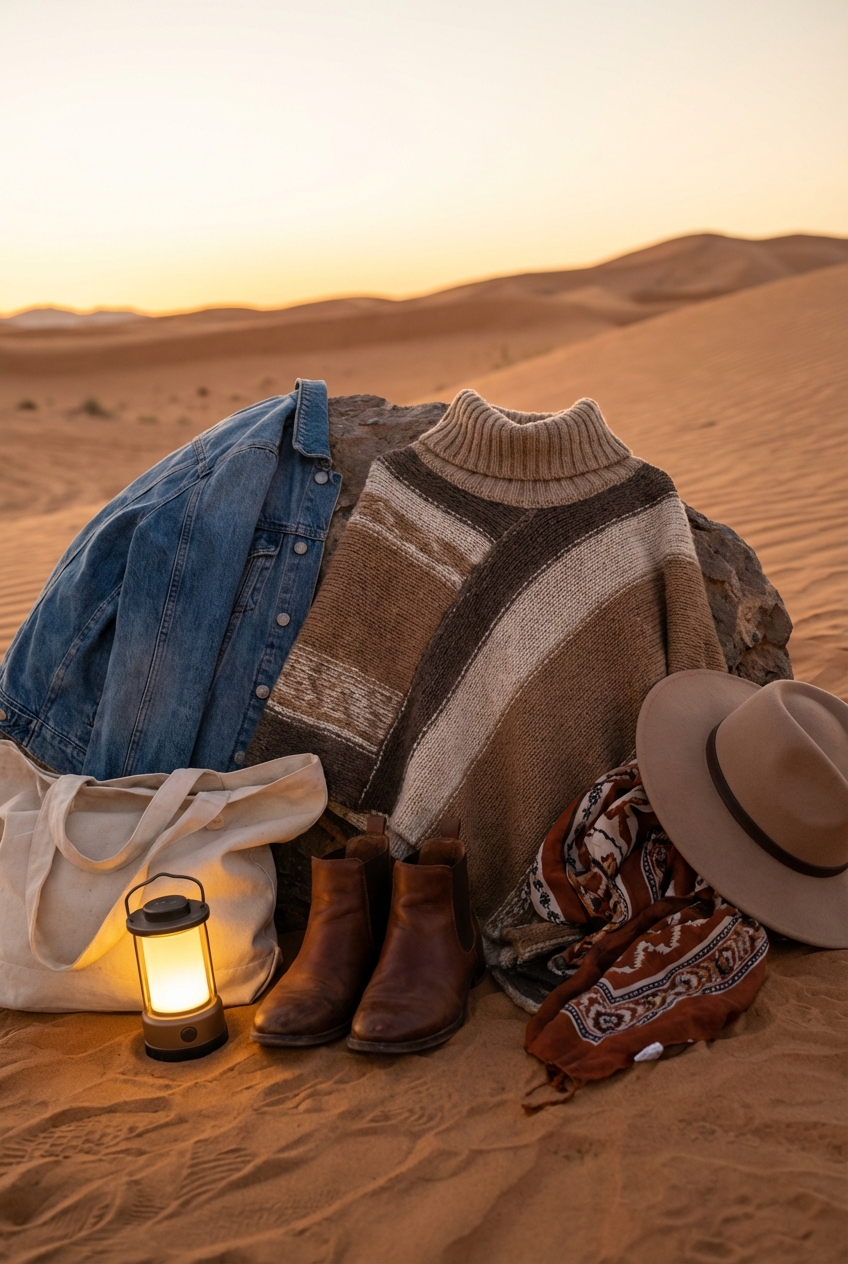
The Cape or Poncho: In a city setting, a poncho can sometimes feel unstructured. In the desert, it is the height of chic. A heavy cashmere or alpaca poncho allows you to wear a lighter outfit underneath. It also doubles as a blanket when you are sitting around a fire pit. Look for geometric patterns or earth tones like terracotta, sage, and sand to harmonize with the surroundings.
Common Mistakes + Fixes:
- Mistake: Wearing a cropped jacket that leaves the lower back exposed.
- Fix: Choose outerwear with a longer hemline. A mid-thigh coat or an oversized cardigan creates a “warmth cylinder” around your core.
- Mistake: Choosing a coat that is too fitted.
- Fix: Always size up one size for desert outerwear. You need room for that chunky cable-knit sweater underneath without looking stuffed.
Footwear Strategy: Sand, Stone, and Cold
Footwear is where functionality and fashion often clash in desert environments. The ground in the desert loses heat rapidly. If you are wearing thin-soled shoes, the cold will travel straight up through your feet, making your entire body feel freezing regardless of your coat.
First, let’s talk about heels. Stilettos are a non-starter. They sink into the sand and are unstable on rocky terrain. If you need height, you must choose a block heel or a wedge. However, the best choice is always a boot.
The Western Boot: This is the classic choice for a reason. A high-quality leather cowboy boot provides a thick sole and covers the ankle and calf. I prefer a shaft height of at least 10 to 12 inches. This protects you from low-lying brush and keeps the draft out of your trousers or skirts.
Sole Construction: Pay attention to the material of the sole. Leather soles are beautiful but slippery and cold. A rubber lug sole or a cork-infused sole provides insulation. If you must wear a leather-soled boot, I recommend adding a sheepskin insole. It adds a layer of fluff that isolates your foot from the frozen ground.
What I’d do in a real project:
- For a dinner on a patio: I would style a velvet maxi dress with knee-high suede boots. The velvet is heavy and warm; the boots seal the gap.
- For a bonfire gathering: I would choose leather trousers tucked into shearling-lined hiking boots. This ensures no skin is exposed to the draft.
Fabric Weights and Textural Contrast
Achieving a high-end look is about mixing textures. Desert fashion thrives on the contrast between rugged and refined. You want to mix coarse materials with soft ones. This not only looks expensive but serves a practical purpose.
Velvet: Velvet is my secret weapon for desert nights. It has a dense pile that blocks air flow much better than satin or chiffon. A jewel-toned velvet blazer or wide-leg trouser catches the firelight beautifully and feels incredibly cozy.
Leather and Suede: These skins are essentially windbreakers provided by nature. Suede is softer and more pliable, making it great for shirts or light jackets. Leather is stiffer and better for pants or heavy jackets.
Knits: You need heavy-gauge knits. Cashmere is lovely, but for the desert, I often prefer alpaca or mohair blends. They have a “halo” or fuzziness that traps more air. When styling, play with scale. If you are wearing tight leather pants, pair them with a massive, oversized knit. If you are wearing a flowing maxi skirt, pair it with a fitted turtleneck.
Accessories as Thermal Regulation
Accessories are not just decoration; they are your final line of defense against the temperature drop. We lose a significant amount of heat through our head and neck, so covering these areas is non-negotiable.
The Blanket Scarf: This is a non-negotiable item. I recommend a scarf that is at least 70 inches long and 30 inches wide. It can be wrapped around the neck or draped over the shoulders. Choose wool or cashmere.
Hats: A wide-brimmed felt hat is a desert staple. During the day, it blocks the sun. At night, the felt retains heat. Look for beaver felt or wool felt with a stiff brim. Avoid straw hats after sunset; they offer zero insulation and look out of place in the dark.
Jewelry Warning: This is a small detail that many overlook. Large metal statement necklaces or cuffs get extremely cold at night. Having a freezing piece of silver pressing against your collarbone is uncomfortable. For evening wear, I lean towards leather cuffs, fabric-wrapped jewelry, or warmer tones like gold which tend to be worn on chains that don’t have as much surface area contact with the skin.
Styling Checklist for Desert Nights
Before you head out for your evening under the stars, run through this quick styling audit. This ensures you won’t be the person shivering in the corner while everyone else enjoys the view.
- Base Layer Check: Are you wearing silk or a thermal blend against your skin? Avoid cotton t-shirts as a base.
- Hemline Audit: Is there a gap between your pants/skirt and your boots? If yes, add tights or taller socks to bridge the gap.
- The Third Piece: Do you have a substantial outer layer (Leather, Shearling, Heavy Wool)? A denim jacket is not enough.
- Sole Thickness: Are your shoes thick-soled? If they are thin sandals or flats, swap them for boots.
- Head & Neck: Do you have a scarf or hat accessible?
- Texture Mix: Do you have at least one rugged texture (leather/suede) and one soft texture (knit/velvet)?
FAQs
Q: Can I wear tights under jeans for warmth?
A: Yes, absolutely. In fact, I highly recommend it. A pair of thin opaque tights under denim adds almost no bulk but significantly increases warmth. Denim gets very cold very fast; the tights act as a buffer.
Q: What is the best color palette for desert evening wear?
A: I prefer to mimic the landscape. Deep terracottas, burnt orange, sage green, and midnight blue work beautifully. Black is always chic, but earth tones feel more harmonious with the environment. Metallics like copper and bronze look stunning by firelight.
Q: How do I dress for a formal desert wedding at night?
A: This is tricky. Opt for a long-sleeve maxi dress in a heavy fabric like velvet or heavy crepe. Bring a high-quality faux fur stole or a formal cape. Do not rely on a blazer belonging to your date. Ensure your dress is long enough to hide thermal shorts underneath if necessary.
Q: Are open-toed shoes ever okay at night?
A: Only if you are staying indoors or strictly on a heated patio. If you are stepping onto the sand or natural ground, open toes are a recipe for discomfort. Sand gets cold, and desert critters come out at night. Closed-toe is safer and warmer.
Conclusion
Dressing for the desert night is an exercise in duality. You are balancing the romantic, bohemian aesthetic of the day with the harsh, freezing reality of the night. It is one of the few environments where fashion must bow to function, but that doesn’t mean you have to sacrifice style.
By prioritizing natural fibers like silk and wool, investing in substantial outerwear, and understanding the mechanics of layering, you can curate a look that is as resilient as it is beautiful. The desert is unforgiving to the unprepared, but for the well-dressed traveler, it offers one of the most atmospheric backdrops in the world. Remember to layer intelligently, protect your extremities, and embrace the drama of heavy textures.
Picture Gallery


