
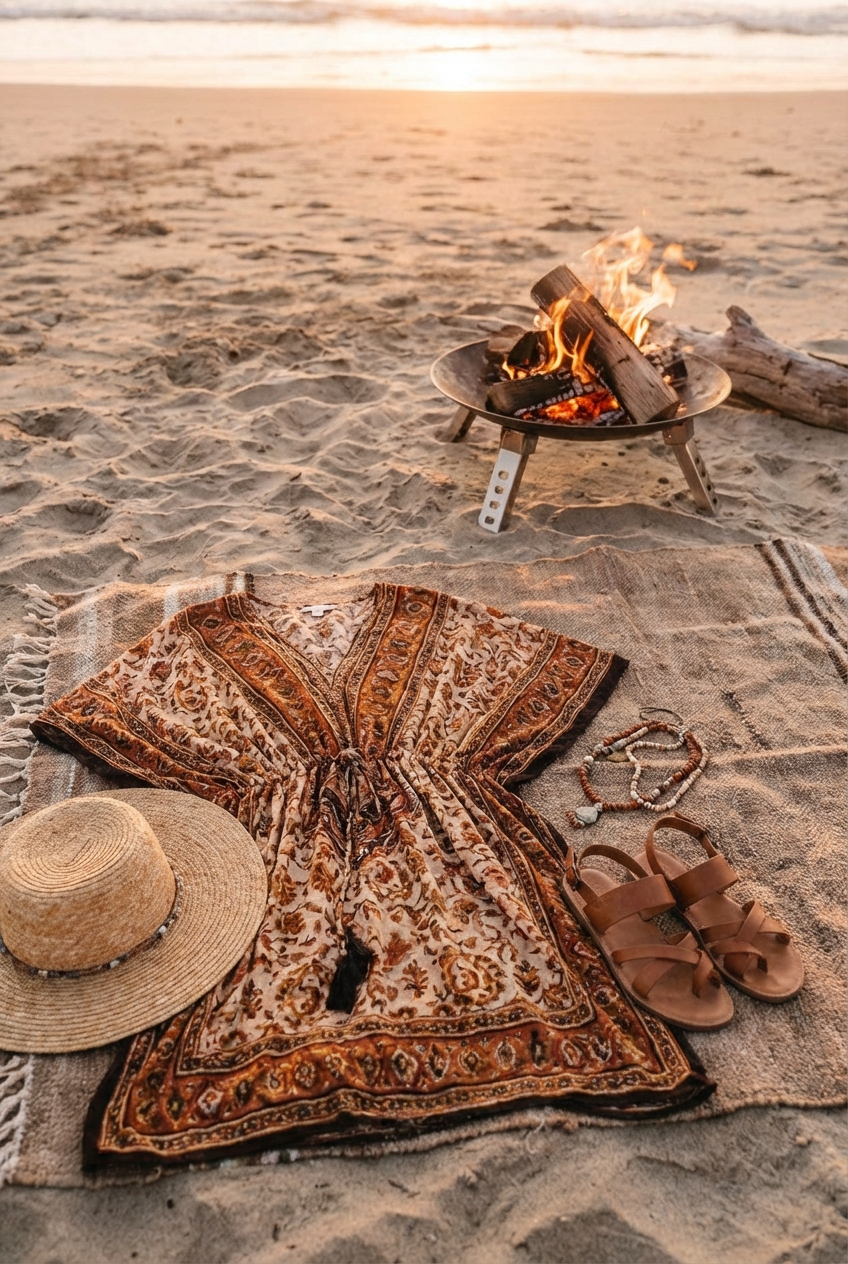
Effortless Beach Bonfire Looks With Flowy Kaftans Bohemian Elegance By The Shore
There is a specific kind of magic that happens when the sun dips below the horizon line and the first crackle of a bonfire breaks the silence of the twilight tide. As a stylist, I look forward to these evenings not just for the camaraderie, but for the unique fashion opportunities they present. The transition from the scorching midday sun to the cool, salty breeze of the evening requires a garment that is adaptable, elegant, and forgiving.
For years, I attempted to make rigid denim cutoffs and heavy sweatshirts work for these settings, only to feel constricted and unpolished. The turning point came during a trip to Tulum, where I witnessed the effortless sophistication of a floor-grazing kaftan paired simply with windswept hair. It was a lesson in functional luxury; the garment moved with the wind rather than fighting against it, providing warmth without bulk and style without effort.
In this guide, I am breaking down exactly how to construct the perfect beach bonfire ensemble centered around the kaftan. We will cover fabric weights, hemline physics, and the layering techniques necessary for coastal micro-climates. For those seeking immediate visual inspiration, I have curated a stunning collection of looks in the Picture Gallery at the end of the blog post.
The Architecture of the Perfect Kaftan
When selecting a kaftan for a beach bonfire, you are not simply choosing a dress; you are choosing a shelter against the elements that still allows for movement. The structure of the garment matters immensely. A kaftan that is too voluminous will become unmanageable in a strong coastal headwind, acting more like a sail than a dress. Conversely, a cut that is too narrow restricts the relaxed seating positions often required around a fire pit.
I always recommend looking for a “structured flow.” This means the garment fits securely at the shoulders and perhaps offers a subtle drawstring or gathering point just under the bust. This anchors the fabric to your body so you aren’t constantly adjusting it, while the lower half remains loose to trap pockets of warm air against your skin as the temperature drops.
Designer’s Note: One of the most common issues I see is arm mobility. Ensure the armholes or batwing sleeves are not cut so low that lifting your arm to toast a marshmallow pulls the hem of the dress up to your knees. Look for gusseted underarms or higher-cut dolman sleeves for maximum functionality.
Fabric Selection: Balancing Durability and Breathability
The material of your kaftan dictates its performance. In an interior space, we worry about how fabric reacts to light; on the beach, we worry about how it reacts to sand, salt, and humidity. High-end natural fibers are generally superior, but the weave is the deciding factor.
Linen is the gold standard for beachwear, but for a bonfire, you want a medium-weight linen (around 150-200 GSM). Ultra-lightweight linen can be too sheer and provide zero insulation against the damp evening air. A heavier linen has a beautiful drape that resists tangling around your legs in the wind. It also shakes free of sand almost instantly.
Avoid synthetics like polyester or cheap rayon blends. While they mimic the look of silk, they do not breathe. Sitting near a fire creates radiant heat; if your garment doesn’t breathe, you will become uncomfortably sweaty, only to freeze the moment you step away from the flame. Silk is beautiful but high-risk; salt spray can leave permanent water spots on satin finishes. If you must wear silk, choose a sand-washed finish or a raw silk noil which hides texture variances.
Common Mistakes + Fixes
- Mistake: Wearing loop-knit or open-weave crochet kaftans.
- The Issue: While trendy, these textures are magnets for driftwood splinters and sand burrs.
- The Fix: Opt for tightly woven poplin or voile. Save the crochet for the poolside lounge chair where the environment is controlled.
Hemline Logic: The Sand Clearance Rule
In high-end styling, millimeters matter. The length of your kaftan is the single most critical decision for a beach setting. A gown that puddles on the floor looks majestic in a photo studio, but on a beach, it becomes a damp, heavy trap that collects wet sand and debris.
I follow a strict “ankle-bone clearance” rule. Ideally, your kaftan should end 1 to 1.5 inches above your ankle bone. This length maintains the long, elegant vertical line of a maxi dress but ensures the hem swings freely above the sand as you walk. It prevents the “wicking effect,” where a hem touching damp sand draws moisture up the fabric, leaving you with a wet heavy skirt halfway up your calf.
If you prefer a shorter look, a midi length that hits mid-calf is exceptionally practical, especially if you plan on wading near the shoreline. However, be mindful of proportions. If you go shorter, the volume of the kaftan should be reduced slightly to avoid looking like you are wearing a tent.
Layering for Coastal Micro-Climates
Beach temperatures can drop by 15 to 20 degrees once the sun sets. The humidity in the air amplifies this chill. Your styling must account for thermal regulation without ruining the bohemian aesthetic. A stiff denim jacket often feels too rigid over a flowing kaftan, creating a jarring silhouette conflict.
What I’d Do in a Real Project:
I rely on “soft layering.” My go-to is an oversized cashmere or alpaca wrap. Unlike a fitted cardigan, a wrap can be draped over the shoulders, bundled around the neck, or used as a blanket for your legs. The texture of wool contrasts beautifully with the smoothness of linen or cotton.
If you need sleeves, opt for a chunky, open-front knit cardigan that falls below the hip. The weight of the knit will help hold the flyaway fabric of the kaftan down. Ensure the sleeves of the cardigan are roomy enough to accommodate the potentially billowy sleeves of the kaftan to avoid bunching at the biceps.
Footwear and Accessories: Functional Adornment
The wrong shoes can ruin a beach evening. Heels are obviously out of the question, but even standard flip-flops can be treacherous in soft sand, flipping sand up the back of your legs. The most chic and practical option is a slide with a wide upper strap.
Leather slides provide structure and protection. Look for a tan or cognac leather that mimics the natural tones of the sand. If you plan to be barefoot (which is often best), have a dedicated “shoe drop” bag. Nothing ruins a look faster than carrying sandy shoes in your hands all night.
For jewelry, think about the lighting. Firelight is warm, flickering, and golden. It reflects beautifully off gold, brass, and copper. Silver can sometimes look cold in this setting. I prefer statement earrings over long necklaces. Necklaces can get tangled in the wind or interfere with layers. A large hammered gold hoop or a textural drop earring frames the face and catches the firelight perfectly.
Color Theory for Twilight
When styling for an interior, we look at the room’s exposure. For a beach bonfire, your lighting source is the fire and the moon. This specific lighting environment changes how colors read. High-contrast prints can look busy and chaotic in low light.
Solids or large-scale ombrés tend to read more expensive and elegant. Earth tones—terracotta, sage green, deep ochre, and sand—are fail-safe choices that harmonize with the environment. They also have the practical benefit of camouflaging minor smudges or dust.
White is the quintessential beach color, but it comes with high stakes. If you choose white, ensure the fabric is opaque enough that backlighting from the fire doesn’t render it transparent. A white kaftan reflects the glow of the fire, acting as a natural reflector that illuminates your face beautifully in photos.
Designer’s Note: Handling the Elements
Wind is the invisible variable that most people forget to style for. A wrap-style kaftan is risky on a windy beach unless it has a secure internal tie. I have seen too many wardrobe malfunctions caused by a sudden gust catching a loosely tied wrap dress.
If you love the wrap look, secure the skirt portion with a small safety pin or a decorative brooch near the knee. This keeps the slit from flying open unexpectedly. Alternatively, choose a kaftan that pulls over the head or buttons down the front for security.
Hair is another factor. While loose waves look great in theory, salty wind creates tangles instantly. I recommend styling hair in a loose, low braid or a messy bun with a silk scrunchie. It keeps hair out of your lip gloss and away from the fire, while still maintaining that effortless vibe.
Finish & Styling Checklist
Before you head out to the dunes, run through this mental checklist to ensure your look is as functional as it is fashionable.
- Hemline Check: Does the dress clear the floor by at least one inch when you are barefoot?
- Opacity Test: Stand in front of a light source. Can you see your silhouette clearly? If so, add a slip or choose a different fabric.
- Wind Proofing: If wearing a wrap style, is it double-secured? Do you have a hair tie on your wrist just in case?
- Thermal Layer: Do you have a natural-fiber wrap (wool/cashmere) accessible for the temperature drop?
- Jewelry Assessment: Are your earrings secure enough to withstand wind? (Avoid heavy hook backs that can blow out).
- Fabric Volume: Sit down on a low chair or the floor. Does the fabric bunch uncomfortably, or does it pool elegantly?
FAQs
Can I wear a kaftan if I am petite?
Absolutely. The key is scale. Avoid massive, large-scale prints that overwhelm your frame. Look for a kaftan with a V-neckline to elongate the neck and a drawstring waist to define your figure. Ensure the length is tailored specifically to you; dragging fabric will make you look smaller.
What undergarments are best for kaftans?
Seamless, nude-toned undergarments are essential. Because kaftans often have lighter fabrics, lace textures can show through. If the kaftan has deep armholes, consider a bandeau bra or a decorative bralette meant to be seen.
How do I get the campfire smell out of my kaftan?
Do not wash it immediately if it isn’t dirty. Hang the garment outside in fresh air (out of direct sunlight) for 24 hours. If the smell persists, a light steam with a handheld steamer usually lifts the smoke particles from the fibers. Vodka spray (one part vodka, two parts water) is an industry trick for neutralizing odors on vintage fabrics.
Is black appropriate for a beach bonfire?
Black is chic, but it can feel severe against a coastal backdrop. If you love dark colors, try a deep navy, charcoal, or espresso brown. These shades offer the slimming effect of black but feel softer and more organic to the setting.
Conclusion
Mastering the beach bonfire look is about respecting the environment. It is about understanding that true elegance is found in comfort. When you aren’t shivering from the cold, tugging at a short hem, or tripping over a dress that is too long, you exude a natural confidence.
The flowy kaftan is the ultimate tool in this repertoire. It bridges the gap between the relaxed nature of the beach and the curated aesthetic of high-end fashion. By paying attention to fabric weight, hem length, and thoughtful layering, you can create a look that feels effortless because it actually is.
Enjoy the fire, the sound of the waves, and the company, knowing your style is perfectly attuned to the moment.
Picture Gallery


