
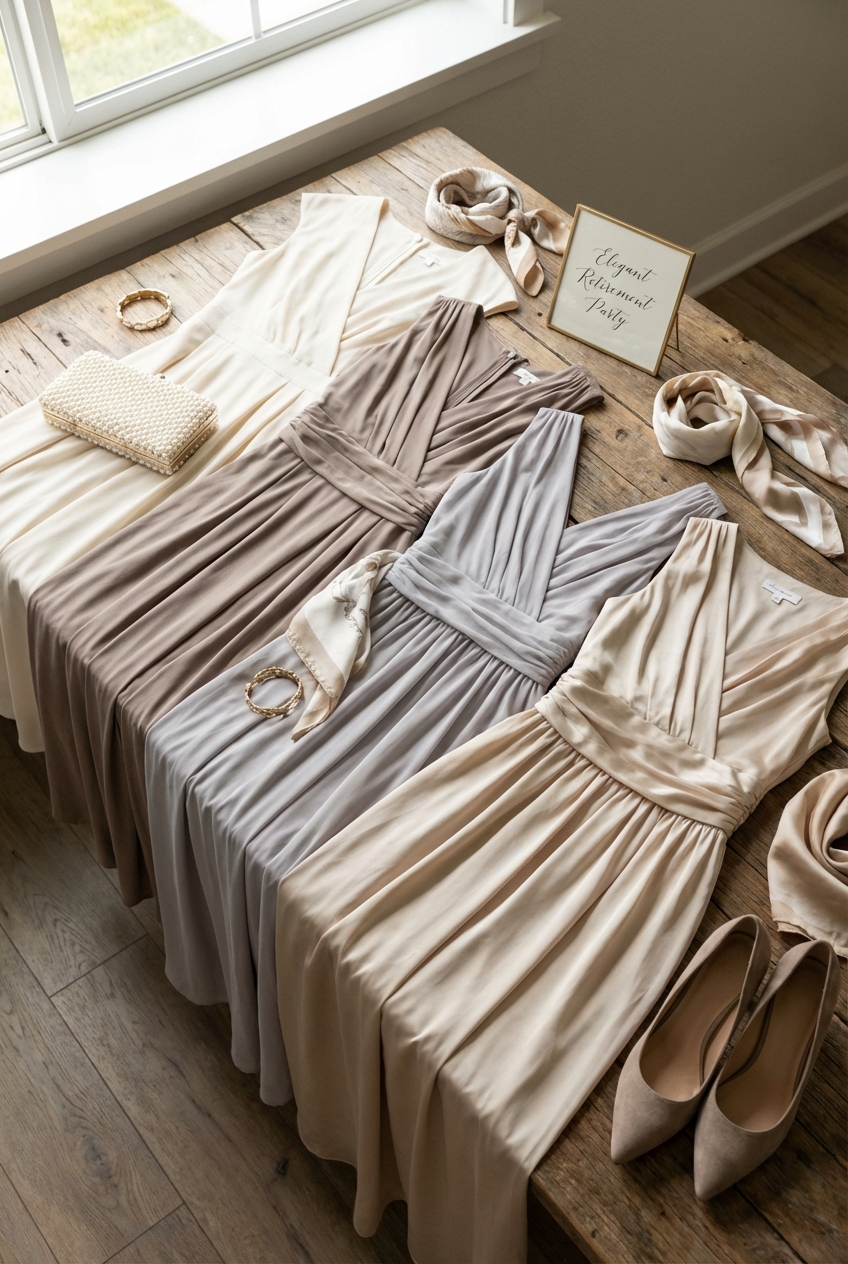
Elegant Retirement Party Dresses With Neutral Tones
Retirement marks one of life’s most significant transitions. It is a moment that sits right at the intersection of professional accomplishment and personal freedom. As a fashion stylist, I often work with clients who feel overwhelmed by this specific event. They want to look authoritative yet relaxed, celebratory but not bridal, and timeless without looking dated.
Neutral tones are my absolute secret weapon for these occasions. When executed correctly, a palette of champagne, taupe, charcoal, or ivory reads as incredibly expensive and sophisticated. It allows your personality and your smile to be the focal point rather than a loud print. However, pulling off a neutral look requires a keen eye for texture, tailoring, and undertones.
In this guide, I will walk you through exactly how to select and style the perfect neutral dress for a retirement celebration. We will cover fabric choices, the importance of lighting, and the specific tailoring tweaks that elevate a garment from “off the rack” to “custom couture.” If you are looking for visual inspiration, please note that a curated Picture Gallery is included at the end of this blog post.
The Power of Undertones and Fabric Selection
The biggest misconception about neutral dresses is that they are boring or “safe.” In high-end fashion, we view neutrals as the ultimate canvas for luxury. The success of a neutral dress relies almost entirely on selecting the right undertone for your skin and the right fabric weight for the season.
If you have cool undertones, you should lean toward neutrals like crisp white, silver-grey, or a cool taupe. These shades will brighten your complexion rather than washing you out. Conversely, if you have warm undertones, look for cream, camel, rich beige, or soft gold. Getting this wrong is usually why people feel they “can’t wear beige.”
Fabric quality is non-negotiable when wearing light colors. Dark colors can hide cheap fabric, but white and beige reveal everything. I always advise clients to look for natural fibers or high-quality blends. A silk wool blend, for example, offers structure and sheen without being too shiny.
Designer’s Note: The Transparency Test
A common issue with light neutral dresses is transparency under bright venue lights. Before buying, hold the dress up to a window or a strong light source. If you can see the outline of your hand clearly through the fabric, it will require a specialized slip or lining. In a professional setting, silhouette security is paramount.
Decoding the Dress Code by Venue
Retirement parties range from intimate luncheons to black-tie galas. Your dress choice must respect the venue while maintaining that neutral elegance. Context is everything in design, whether we are talking about interiors or your wardrobe.
The Country Club or Garden Luncheon
For daytime events, you want fabrics that move and breathe. A stiff satin gown looks out of place on a patio. Instead, opt for a structured linen sheath or a heavy silk crepe.
- The Silhouette: A wrap dress or a fit-and-flare midi style works beautifully here.
- The Palette: Soft oatmeals, buttery creams, and sandy beiges reflect natural light beautifully.
- Footwear: Block heels are essential for grass or uneven pavers.
The Evening Cocktail Reception
When the sun goes down, you can introduce more drama and structure. This is where you can play with darker neutrals like charcoal, pewter, or a deep chocolate brown, which is trending heavily right now.
- The Silhouette: A column dress or a tailored sheath with interesting sleeve details.
- The Texture: Look for subtle sheen, such as a hammered silk or a matte jersey.
- Details: This is the time for tasteful embellishments, perhaps a bit of beading in a matching tone.
The Formal Dinner or Gala
If the invitation implies formal attire, floor-length or tea-length is standard. However, you do not want to look like the mother of the bride. Avoid excessive lace or tulle.
- The Silhouette: An A-line gown or a sophisticated bias-cut slip dress with a matching structured jacket.
- The Material: Velvet in a taupe shade or a heavy satin back crepe communicates luxury.
Mastering the Fit: Tailoring Rules of Thumb
No matter how expensive the dress is, it will look cheap if it does not fit perfectly. In my styling practice, I budget 20% of the total outfit cost specifically for alterations. It makes that much of a difference.
The Hemline Rule
For a retirement party, the most flattering and professional length usually hits right at the knee or just below it (the midi length).
- Knee-length: Should graze the middle of the knee cap, not above it.
- Midi-length: Should hit the muscular part of the calf, roughly 2 to 3 inches below the widest part of your calf. Never let a hem cut across the widest part of your leg, as it visually shortens you.
Sleeve Lengths
Many women prefer coverage on the arms, but full long sleeves can sometimes feel too heavy or wintry.
- Three-Quarter Sleeve: This is universally the most flattering cut. It ends at the forearm, drawing the eye to the waist and highlighting your jewelry.
- Cap Sleeve: Be careful here. Ensure the sleeve is not cutting into the underarm. A “flutter” cap sleeve is much more forgiving than a tight band.
Common Mistakes + Fixes
Mistake: Relying on the size on the tag. Sizing varies wildly between brands.
Fix: Buy the size that fits the largest part of your body (bust or hips) and tailor the rest down. It is easy to take a dress in; it is nearly impossible to let it out without leaving needle marks, especially on satin or silk.
Texture and Layering: Avoiding the “Flat” Look
When you remove bright colors from the equation, texture becomes the most important design element. A head-to-toe beige outfit in a single flat fabric can look like a uniform. You need to mix materials to create visual interest.
If your dress is a smooth silk, pair it with a textured bouclé jacket or a pashmina with a subtle weave. If the dress has lace or embroidery, keep your wrap or jacket sleek and simple.
Visual Weight and Balance
Think about the “weight” of the outfit. A heavy wool dress needs a lighter shoe to avoid looking clunky. A floaty chiffon dress needs a structured blazer or a substantial shoe to anchor the look so you don’t look like you are floating away.
What I’d Do in a Real Project
If I were styling a client for her retirement dinner in a champagne satin dress, I would add a cashmere wrap in a slightly darker camel tone. The difference in texture (shiny vs. matte) and the slight shift in color creates depth. It looks intentional and curated rather than matched.
Accessories: The Metallic Anchor
Neutrals require metallic hardware to wake them up. Gold, silver, rose gold, and bronze act as the “lighting fixtures” of your outfit. They add the sparkle that makes the neutral tones look festive.
Gold vs. Silver
Generally, warm neutrals (cream, camel, brown) pair best with gold. Cool neutrals (white, grey, silver) pair best with silver or white gold. However, mixing metals is currently very chic if done purposefully.
Shoes and Bags
Please do not dye your shoes to match your dress. That is a dated practice. Instead, opt for a metallic shoe or a nude shoe that matches your skin tone (not necessarily the dress tone).
- Nude shoes: Extend the leg line, making you look taller.
- Metallic shoes: Add a festive touch and act as jewelry for your feet.
For handbags, a clutch or a small structured top-handle bag is appropriate. Avoid large totes or shoulder bags; you are off the clock, so you do not need to carry files or a laptop.
Practical Considerations for Comfort
You will likely be standing, mingling, hugging, and perhaps giving a speech. Your dress needs to perform well mechanically. It should not require constant tugging or adjusting.
The Sit Test
Before cutting the tags off, sit down in a hard dining chair for 5 minutes. Does the fabric wrinkle aggressively across the lap? Does the skirt hike up too high? Does the waistband dig in? If the answer is yes to any of these, it is not the right dress. You want to be present in the moment, not thinking about your waistband.
Undergarments
Neutral dresses often require nude undergarments. “Nude” means a tone close to your actual skin color, not white. White bras will show through white shirts. A tone that matches your skin absorbs the light and becomes invisible.
Also, consider shapewear not for slimming, but for smoothing. A lightweight high-waisted short can prevent fabric from clinging to legs or getting caught between thighs while walking.
Finish & Styling Checklist
Use this final checklist to ensure your look is polished and ready for the event.
- Lighting Check: Have you checked the dress transparency in sunlight and flash photography?
- Wrinkle Release: Have you steamed the dress? Irons can crush the pile of velvet or burn silk. A handheld steamer is the safest tool.
- The Anchor: Do you have one structured piece (a blazer, a stiff belt, or a structured bag) to balance soft fabrics?
- Mobility: Can you raise your arms to hug someone without the hemline rising dangerously high?
- Makeup Balance: Since your dress is neutral, have you added a pop of color to your lips or cheeks to avoid looking washed out?
- Shoe comfort: If the shoes are new, have you broken them in by wearing them with thick socks around the house for an hour?
FAQs
Can I wear white to a retirement party?
Yes, absolutely. Unlike a wedding, there is no rule against wearing white to a retirement party, especially if you are the guest of honor. It reads as fresh, new, and sophisticated. Just ensure the fabric is substantial enough to not look like summer resort wear.
How do I stop a neutral outfit from looking boring?
Texture is the answer. Mix silk, wool, leather, and cashmere. Also, use statement jewelry. A bold architectural necklace or a stack of gold bangles brings life to a simple beige sheath.
Is black considered a neutral for retirement parties?
Black is a neutral, but for a retirement party, it can sometimes feel a bit somber or “business as usual.” If you love black, choose a fabric like lace or silk that feels festive, or accessorize with bright metallics to lift the mood.
What is the best fabric for a summer retirement party?
Linen blends are fantastic because the blend (usually with rayon or cotton) reduces the wrinkling inherent to pure linen. Silk georgette is also wonderful as it breathes but offers great movement.
Conclusion
Choosing a dress for your retirement party is about defining how you want to enter this next chapter of life. A neutral palette offers a clean slate, a sense of calm, and an undeniable air of luxury. It says that you are confident enough to let your achievements and your presence speak louder than your clothing.
By focusing on the correct undertones, investing in tailoring, and paying attention to fabric quality, you can create a look that is both comfortable and commanding. Remember, this event is a celebration of your legacy. You deserve to look and feel your absolute best as you accept the accolades you have earned.
Picture Gallery


