
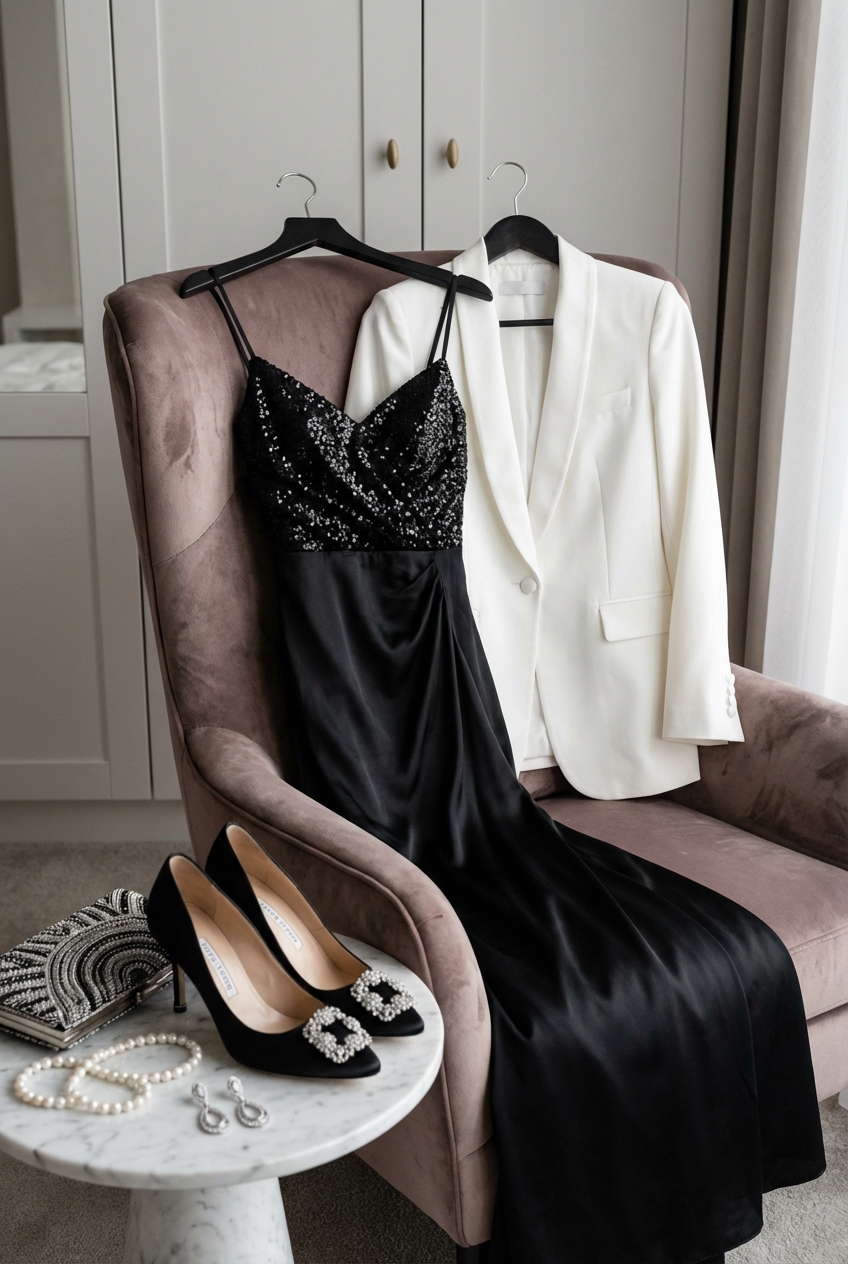
Glam Black And White Ensembles For Charity Balls
There is a distinct electric energy in the air during the weeks leading up to a major charity ball. As a stylist who has dressed clients for everything from the Met Gala to local philanthropic society events, I can tell you that the pressure to perform sartorially is real. While color trends come and go, the monochromatic palette of black and white remains the ultimate power move. It commands attention without screaming for it, offering a level of sophistication that technicolor gowns often struggle to achieve.
I recall a specific panic moment with a client attending the Save Venice ball. She had a custom emerald gown that was ruined in transit two days before the event. We pivoted to a vintage black velvet column dress and added a white oversized architectural silk bow to the back. She ended up making the “best dressed” list not despite the change, but because of it. That moment solidified my belief that black and white is not a safety net; it is a weapon of mass distinction.
However, executing this look requires precision. When you remove color from the equation, texture, fit, and proportion become the only things that matter. There is nowhere to hide poor tailoring or cheap fabric in a high-contrast ensemble. I have curated a stunning collection of visual inspiration in the Picture Gallery at the end of this post so you can see these concepts in action.
1. The Architecture of Contrast: Proportion and Placement
The most critical rule in styling a black and white ensemble is understanding where the eye travels. High contrast creates a focal point. If you wear a black dress with a white bodice, the eye will immediately be drawn to your upper body and face. This is classic “color blocking” applied to formal wear.
I always tell my clients to use the “60/30/10” rule, which is often used in interior design but applies perfectly to fashion. In this context, 60% of the outfit should be your dominant tone (usually black for slimming/grounding), 30% is the secondary tone (white for highlighting), and 10% is your skin or metallic accents.
If you opt for a 50/50 split—like a skirt and top combination—you risk cutting your body in half visually. This can shorten your torso or legs depending on where the waistline hits. Always aim for one color to dominate the vertical line of your body to maintain a long, elegant silhouette.
Designer’s Note: The Lighting Trap
In my years of styling, I have learned that ballroom lighting is tricky. It is often dim, warm, and yellow-toned. Pure white fabrics can sometimes pick up these yellow hues and look dingy in photos.
To combat this, I recommend choosing “winter white” or distinct ivory over stark, blue-toned bright white if the fabric is satin or silk. These warmer whites hold their own better under chandeliers and candlelight.
2. Fabric Selection: Texture is the New Color
When you strip away color, texture becomes the most important element of your look. A flat black cotton-blend dress next to a flat white wrap looks like catering staff uniforms, not high-society gala attire. You must introduce depth through material richness.
I look for fabrics that absorb light (velvet, crepe, matte jersey) paired with fabrics that reflect light (satin, silk charmeuse, taffeta). This interplay creates visual interest. For example, a black velvet bodice paired with a white Mikado silk skirt is breathtaking because the light hits the two fabrics differently.
Lace is another excellent vehicle for black and white styling. A black lace overlay on a nude or white lining highlights the intricacy of the pattern. However, be wary of cheap lace. Good lace has “eyelashes” at the edges and a distinct, raised texture. If it feels smooth and plastic-like to the touch, it will photograph poorly.
Common Mistakes + Fixes
Mistake: Wearing a thin, unlined black jersey dress.
Fix: High-end formal wear requires structure. Look for bonded crepe or heavy-weight viscose that has a “gram weight” substantial enough to smooth over the body without clinging to undergarments.
Mistake: White fabric that is too sheer.
Fix: Test your white garments with flash photography at home. If you can see the outline of the pockets or the hem allowance, it is too thin. You need lined heavy silk or brocade.
3. The Tuxedo Inspired Look for Women
Le Smoking, the tuxedo suit for women, is a perennial favorite for charity balls, but it requires aggressive tailoring to look “glam” rather than “corporate.” The key is in the fit of the shoulders and the length of the pant.
For a gala, an oversized blazer is rarely the right choice unless you are extremely tall and styling it with deliberate avant-garde intent. For most women, a fitted dinner jacket with a satin lapel is the goal. The sleeves should hit exactly at the wrist bone, allowing half an inch of shirt cuff or a bracelet to show.
The trousers must be long enough. A common error is hemming tuxedo trousers to ankle length, which looks too casual for a ball. They should have a “quarter break” or a “half break” over your shoe. This means the hem rests slightly on the top of the foot and covers the back of the heel.
What I’d Do in a Real Project
If I am styling a client in a tuxedo look:
- I forgo the traditional dress shirt. Instead, I use a silk camisole or a corset top to add femininity.
- I insist on a stiletto heel, never a chunky block heel, to keep the leg line sharp.
- I add a “femme fatale” element, like a red lip or a diamond lariat necklace, to balance the menswear structure.
4. Mastering the Hemline and Train
For charity balls, floor-length is generally the requirement unless the invitation specifically says “Cocktail.” However, “floor-length” is a vague term that leads to many tripping hazards.
The perfect hem for a full skirt should float about 1/2 inch to 3/4 inch off the floor while you are wearing your shoes. This prevents you from stepping on the dress while dancing, but it is low enough to hide your shoes when you are standing still.
If you are wearing a column dress or a mermaid silhouette, the hem can be slightly longer, perhaps 1/4 inch off the floor, to create a puddling effect. Be aware that this restricts your stride. You will need to take smaller steps (“geisha steps”) throughout the night.
Trains are dramatic and beautiful for the arrival photos, but they are a liability in a crowded ballroom. If your dress has a train longer than 12 inches, you absolutely need a bustle loop or a wrist loop installed. A good tailor can add a finger loop to the underside of the train so you can hold it up while navigating the buffet or the dance floor.
5. Accessorizing the Monochrome Palette
Accessories are where you can inject personality into a black and white ensemble. You have two main paths: metallic or a pop of color.
Option A: Metallics. Silver and diamonds (or crystals) are the natural partners for black and white. They maintain the cool, crisp aesthetic. Gold can work, particularly with warmer ivories, but silver tends to look more “deco” and architectural.
Option B: The Pop of Color. A single color accent can be stunning. Emerald green drop earrings or a ruby red clutch are sophisticated choices. Avoid neon colors or pastels; they tend to look jarring against high-contrast black and white. Deep, jewel tones are best.
Scale is crucial here. If your dress is a busy print (like a polka dot or zebra stripe), keep your jewelry bold but simple. A large metal cuff or stud earrings. If your dress is solid blocks of color, you can get away with more intricate, chandelier earrings or a statement necklace.
Designer’s Note: The Clutch Bag
Never bring a shoulder bag to a charity ball. It ruins the line of your shoulders and photographs terribly. You need a clutch.
Size check: It must fit your phone, a lipstick, a credit card, and a slim compact.
Hard vs. Soft: Hard-shell minaudieres look more expensive and jewelry-like than soft pouches.
6. Styling for Comfort and Longevity
Charity balls are marathons, not sprints. You will be standing for cocktails, sitting for dinner, and dancing afterward. Your ensemble needs to withstand 5 to 6 hours of wear.
The biggest issue with black and white dresses is makeup transfer. If you have a high white neck, you must set your makeup with a professional-grade setting spray. I also recommend applying hairspray to the inside of the collar; the alcohol helps create a barrier against foundation.
Undergarments are the foundation of the house. For black and white gowns, nude seamless underwear is non-negotiable. Even under black fabric, flash photography can sometimes reveal the texture of lace underwear. Smooth, laser-cut edges are your best friend.
Shoe Strategy
You do not need to wear 5-inch heels to be glamorous. A 3.5-inch heel is the sweet spot for elegance and endurance. If your dress is floor-length, no one will see your shoes. I often have clients wear a platform sandal. The platform creates height without the severe arch of a single-sole stiletto, making it much easier to stand for long periods.
Finish & Styling Checklist
Before you head out the door, run through this stylist-approved checklist to ensure your look is polished and secure.
1. The Sit Test
Put on your full ensemble and sit down on a hard chair. Does the waistband dig in? Does the slit ride up too high? Does the fabric wrinkle immediately? Adjust your undergarments or bring a wrap if coverage is an issue.
2. The Static Check
Black and white synthetics are magnets for static cling. Run a wire hanger over the skirt or use static guard spray. A dress clinging to your legs ruins the silhouette.
3. The Hemline Audit
Put on your exact event shoes. Have someone take a photo of you from the back. Ensure the hem is even and not dragging on the ground.
4. The Bra Situation
If you are going strapless, ensure your bra or bustier is not visible when you raise your arms. Use double-sided fashion tape to secure the neckline of the dress to your skin.
5. The Emergency Kit
Pack a tiny kit in your partner’s pocket or your clutch:
Safety pins (black and silver).
Double-sided tape.
Blister plasters.
A Tide to-go pen (essential for white fabrics).
FAQs
Can I wear a white dress to a charity ball, or does it look too bridal?
You can absolutely wear white, but the styling must be distinct from a wedding look. Avoid tulle skirts and veils. Opt for sleek, architectural silhouettes like a cape dress or a tuxedo gown. Accessorize with black gloves or a black clutch to firmly ground the look in “evening wear” territory, not “bridal.”
Is it appropriate to wear a short dress to a black-tie charity ball?
Generally, no. Black tie implies floor-length gowns. However, a “tea-length” dress (hitting mid-calf) can be acceptable if the shape is very formal (like a Dior “New Look” silhouette) and the fabric is extremely luxe. A mini dress is never appropriate for a charity ball.
How do I handle a black and white print without looking busy?
Scale is the secret. If you are petite, avoid massive, overwhelming prints. If you are tall, tiny micro-prints might get lost and look gray from a distance. Ensure the print has “breathing room” or negative space. Also, break up the print with solid accessories—a solid black belt or solid black shoes helps the eye rest.
What should I do if I spill red wine on the white part of my dress?
Do not rub it! Blot it gently with a clean cloth to absorb excess liquid. If you have club soda, dab a little on. If not, white wine can actually help neutralize red wine stains (a bartender trick). However, the best defense is to carry a stain remover pen. If the stain remains, own it and stay confident—attitude is 90% of the look.
Conclusion
Choosing a black and white ensemble for a charity ball is a decision to embrace timeless elegance over fleeting trends. It shows a confidence in your own style, proving that you do not need bright colors to capture the room’s attention. By focusing on architectural silhouettes, luxurious textures, and precise tailoring, you elevate a simple color palette into high fashion.
Remember that the goal of these events is to feel as good as you look. When your hem is the right length, your bodice fits securely, and your fabrics are breathable, you are free to focus on the cause, the conversation, and the celebration. Simplicity, executed perfectly, is the ultimate form of glamour.
Picture Gallery


