
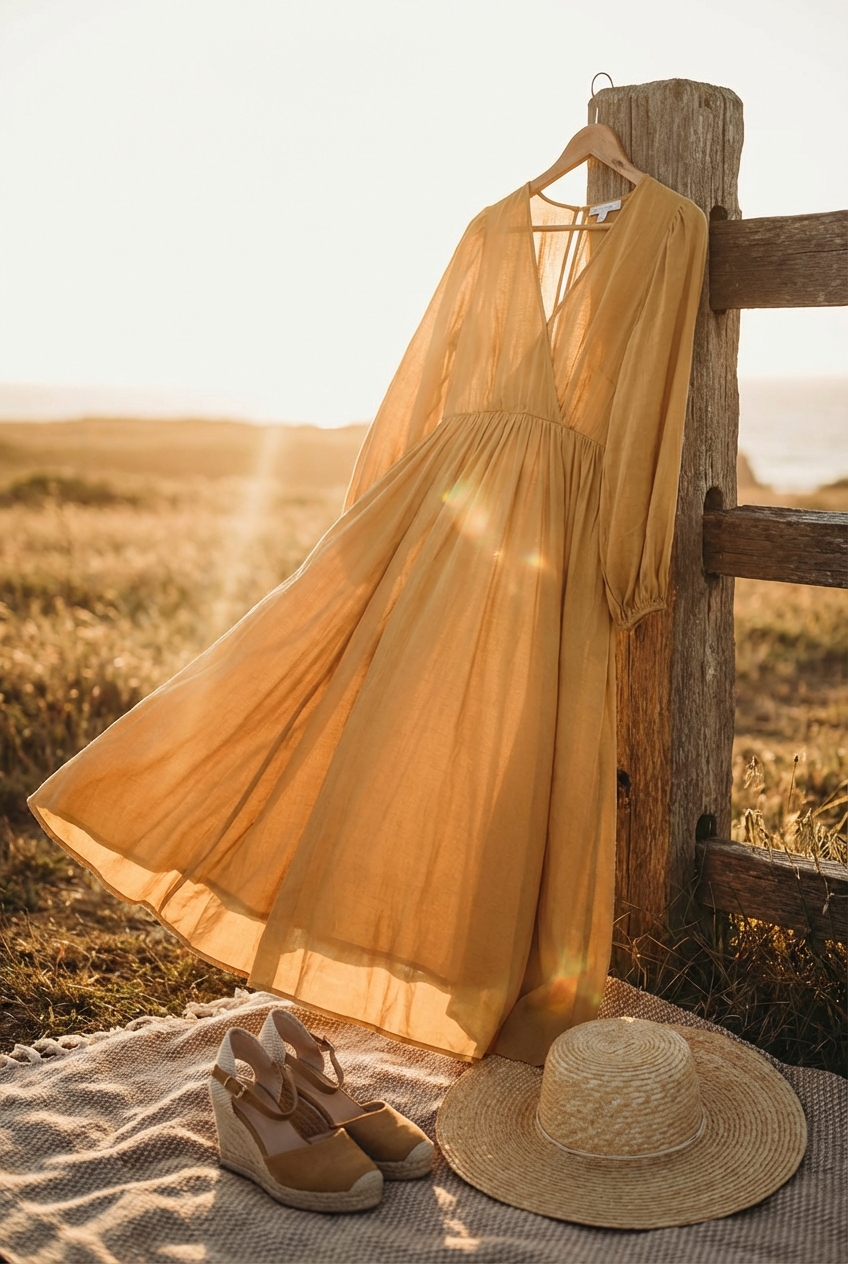
Glamorous Golden Hour Photo Dresses With Flowy Silhouettes Capturing The Magic Of Sunset Style
There is a specific window of time that every high-end editorial stylist circles on the call sheet with a red marker. It isn’t noon, when the sun creates harsh shadows under the eyes, and it certainly isn’t after dark. It is that fleeting, amber-hued window just before sunset known as the “golden hour,” where the light softens and turns the world into a romantic painting.
I remember my first major location shoot in Santorini. We had twenty minutes to capture the perfect shot, but the dress I had selected was too stiff; it absorbed the light rather than dancing with it. That panicked moment taught me that for sunset photography, the architecture of the garment is just as important as the location itself.
To help you nail your next session, I have compiled my top styling secrets for selecting gowns that work in harmony with low-angle natural light. If you are looking for visual inspiration, be sure to check out our curated Picture Gallery at the end of the blog post.
The Physics of Flow: Selecting the Right Fabric
When styling for still photography, movement is the primary goal. You are not just dressing for a static pose; you are dressing for the wind and the air. The fabric needs to act as an extension of your body, creating shapes that occupy more space in the frame.
The biggest mistake I see clients make is choosing heavy, structured fabrics like thick satin or velvet for outdoor shoots. These materials absorb light and hang heavily, looking static in photos. Instead, you want fabrics that possess a low gram weight and high translucency.
Chiffon and organza are the gold standards here. Chiffon offers a soft, fluid drape that ripples like water when tossed, while organza has slightly more structure, allowing it to hold a shape mid-air for a fraction of a second longer. This “hang time” gives the photographer a better chance of capturing the dress in full flight.
Designer’s Note: The “Light Test”
Before buying a dress for a golden hour shoot, hold the skirt up to a window. If the light is completely blocked, the dress will look dark and heavy when backlit by the sun. If the light filters through, creating a soft glow, you have found a winner. This translucency allows the sun to illuminate the fabric, creating that ethereal “halo” effect around your silhouette.
- Silk Chiffon: The ultimate luxury choice. It floats effortlessly but is delicate and prone to snagging.
- Polyester Georgette: A durable alternative that resists wrinkles better than silk, making it ideal for travel.
- Tulle: Creates volume without weight. excellent for dreamier, fairytale aesthetics.
Color Theory and The Kelvin Scale
Lighting changes the way we perceive color. During golden hour, the color temperature of natural light drops to around 3500K, which is very warm and orange. This acts as a giant filter over your entire image.
Understanding how your dress color interacts with this orange filter is crucial. If you wear a cool-toned blue, the warm light can sometimes neutralize it, turning it a muddy grey. Conversely, warm tones will vibrate and intensify.
My go-to palette for sunset shoots includes warm metallics, earth tones, and jewel tones. A champagne or gold dress will blend seamlessly with the light, creating a monochromatic, goddess-like aesthetic. Deep reds and burnt oranges will look incredibly rich and saturated.
Common Mistakes + Fixes
Mistake: Wearing stark white.
Why it fails: In direct golden light, white can blow out (lose detail) easily, or pick up unwanted color casts from the surroundings, like green from grass.
The Fix: Opt for ivory, cream, or oatmeal. These off-white shades have enough warmth to harmonize with the sunset without reflecting too much glare back into the camera lens.
Silhouette Architecture: Maximizing Drama
In fashion photography, we often talk about “creating shapes.” A tight bodycon dress creates a straight line. While sexy, it rarely offers the drama needed for a wide-angle landscape shot. You need a silhouette that can expand.
The A-line or full-circle skirt is non-negotiable for flowy photos. A full-circle skirt creates a perfect disc of fabric when spun, which looks magnificent on camera. It adds dynamic energy to the image, making it feel alive.
Look for dresses with high slits. A slit serves a dual purpose: it allows for freedom of movement, and it breaks up the mass of fabric. When the wind catches a dress with a slit, it separates the front and back panels, creating layers and depth rather than a single solid block.
What I’d Do in a Real Project
- The Hemline Rule: I always ensure the dress is floor-length plus two inches. You want the fabric to puddle slightly when you are standing still. If the dress stops at the ankles, it ruins the illusion of endless height.
- Waist Definition: Flowy does not mean shapeless. I always select dresses with a defined waistline (empire or natural) to anchor the fabric. Without this, a gust of wind can make the dress balloon out, swallowing your figure entirely.
- Sleeve Drama: If you are self-conscious about your arms or just want more movement, look for flutter sleeves or detachable cape sleeves. These act like wings in the wind.
The Mechanics of Posing with Fabric
Wearing a flowy dress requires active participation. You cannot simply stand there; you have to work the garment. This is a skill models practice for years, but you can learn the basics quickly.
The “Toss and Freeze” is the most common technique. This involves grabbing the fabric by the hem (fingertips only, don’t grab a fistful) and throwing it upward and outward. The key is to keep your face relaxed while your arms are exerting effort.
Another technique is the “Walk Away.” Walking away from the camera while looking back over your shoulder allows the train of the dress to drag behind you. This elongates the body and leads the viewer’s eye through the frame.
Designer’s Note: The Wind Assistant
On high-budget shoots, we have someone dedicated to throwing the dress. If you are shooting with a friend or partner, have them stand out of frame, hold the dress hem, throw it, and run back. It sounds silly, but it yields the best results. If you are solo, spin. Spin slowly to avoid dizziness, but fast enough to let centrifugal force lift the skirt.
Undergarments and Logistics
This is the unglamorous side of fashion that ruins photos if ignored. As mentioned earlier, the best dresses for golden hour are translucent. When the sun is behind you (backlighting), your dress essentially becomes an X-ray.
You must wear nude, seamless undergarments. Do not wear white; white glows under sheer fabric. Nude tones that match your skin blend in and disappear. High-waisted smoothing shorts are often better than standard panties because they create a smooth line from waist to thigh, avoiding visible panty lines.
Furthermore, consider the terrain. Sunset shoots often happen on beaches, fields, or cliffs. Navigating these in stilettos is a recipe for a twisted ankle. I always recommend styling the look barefoot or with flat, strappy sandals. If you need height, use a wedge that won’t sink into the sand or grass.
Common Mistakes + Fixes
Mistake: Visible bra straps.
Why it fails: Nothing breaks the spell of a romantic, timeless photo like a neon bra strap or the texture of lace showing through silk.
The Fix: Use silicone nipple covers or taping for support. Fashion tape is your best friend. Secure the neckline to your skin so you can move freely without risking a wardrobe malfunction.
Accessorizing for the Golden Hour
Accessories should complement the warmth of the light, not fight it. During golden hour, gold jewelry is the natural choice. It catches the sun and flares beautifully in the lens. Silver can look cold or dark in contrast to the warm surroundings.
Think about scale. Because the landscape and the dress are taking up so much visual weight, tiny delicate jewelry will get lost. I prefer statement earrings or a stack of bangles. These catch the light as you move your hands or turn your head.
Hats are a contentious topic in lighting design. While a wide-brimmed hat looks chic, it casts a shadow over your face. If the sun is high enough to cast shadows, skip the hat or tilt it far back on your head. If the sun is barely on the horizon, the hat can work as a silhouette prop.
Finish & Styling Checklist
Before you head out to chase the sunset, run through this final checklist. I use a similar list for my editorial clients to ensure we don’t miss the shot due to a wardrobe error.
- Steam the dress: Wrinkles show up significantly more in high-contrast lighting. Steam it right before you leave.
- Check the transparency: Stand in front of a bright light in your mirror. If you can see everything, so will the camera. Adjust undergarments accordingly.
- Pack safety pins: If a strap breaks or a hem is too long for the terrain, a safety pin is a lifesaver.
- Bring a change of shoes: Wear comfortable slides for the hike to the location and switch to your photo shoes (or bare feet) on set.
- Bug spray: Sunset is prime time for mosquitoes. Apply spray before you put on the dress to avoid staining the fabric.
FAQs
Q: What is the best color for a beach sunset shoot?
A: I recommend shades that contrast with the blue water but compliment the sand. Coral, blush pink, terracotta, and metallic gold are stunning. Avoid varying shades of blue, as you might blend into the ocean background too much.
Q: How do I keep a long dress clean during an outdoor shoot?
A: Ideally, you don’t. A little dirt on the hem is the price of a great photo. However, you can bring a sheet to stand on while you are setting up the lighting and testing poses. Remove the sheet only when you are ready to shoot.
Q: Can I wear a printed dress for golden hour?
A: You can, but proceed with caution. Small, busy prints can look muddy in soft light. Large, bold floral prints or ombré gradients tend to photograph better because the pattern remains distinct even when the dress is moving.
Q: What if it is cloudy?
A: A cloudy “golden hour” produces a giant soft-box effect. It is actually very flattering for skin, though you lose the dramatic flares. In this case, you can get away with brighter, cooler colors like emerald green or royal blue, as the light won’t filter them out.
Conclusion
Capturing the perfect golden hour photo is about harmonizing three elements: the light, the location, and the styling. When you choose a dress with a flowy silhouette, you are giving yourself a prop that interacts with the environment. You are introducing movement and emotion into a still image.
Remember that confidence is the best accessory. If you feel comfortable in the fit and secure in your undergarments, it will show in your posture. Wear the dress; don’t let the dress wear you. Embrace the wind, welcome the chaotic movement of the fabric, and trust that the warm glow of the sun will do the rest of the work.
With the right preparation and a respect for the physics of fabric, you can elevate a simple photo session into a high-fashion editorial moment. Now, go catch that light.
Picture Gallery


