
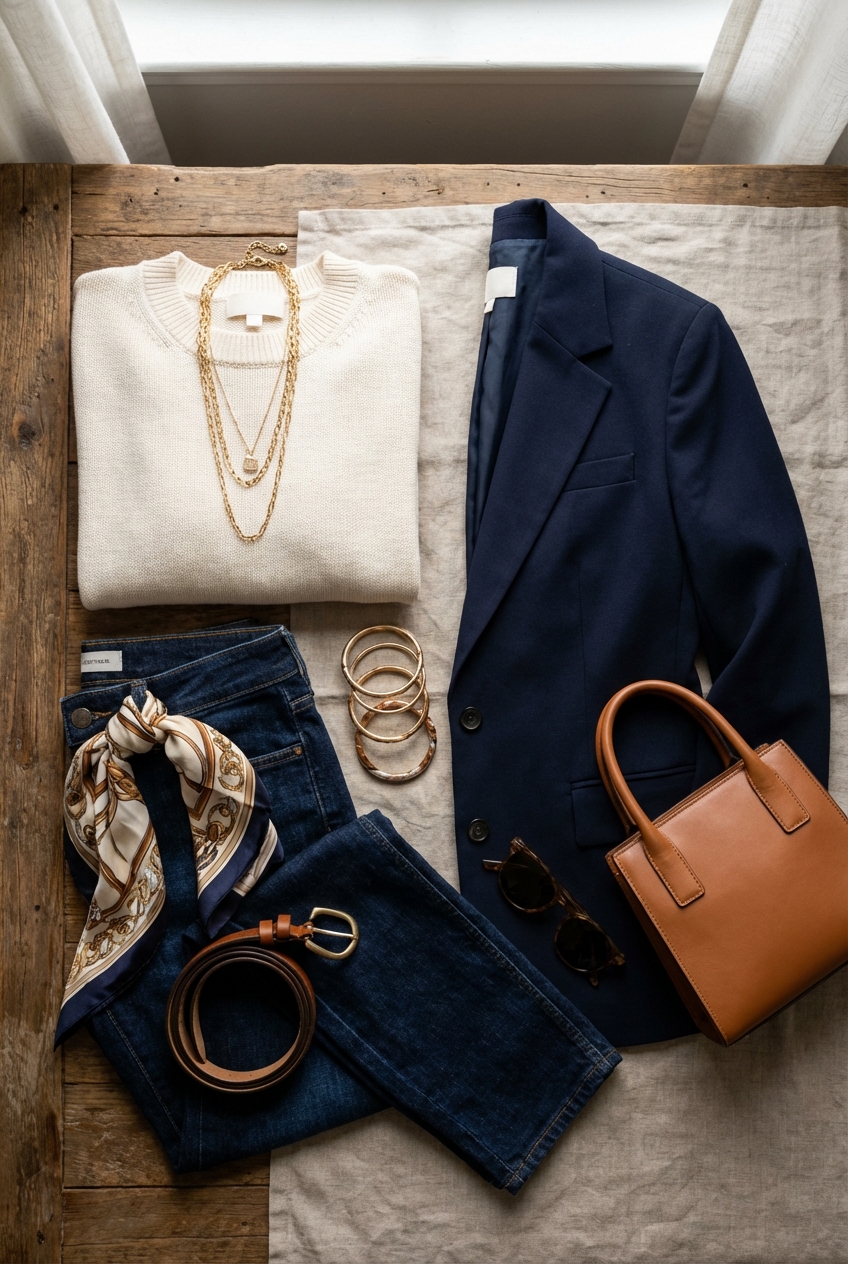
How To Layer Accessories In A Capsule Wardrobe
Building a capsule wardrobe is often celebrated for its simplicity and efficiency. However, the biggest fear many of my clients have when downsizing their closet is the risk of boredom. They worry that wearing the same thirty pieces will inevitably feel repetitive or uninspired.
The secret to keeping a curated closet feeling fresh and luxurious lies entirely in the accessories. Accessories are the variable in the equation of personal style. They allow you to take a foundational look, like a white tee and denim, and steer it toward polished professionalism, weekend ease, or evening elegance.
Mastering the art of layering these pieces requires an understanding of balance, proportion, and texture. For a visual guide on how to combine these elements seamlessly, please refer to the Picture Gallery at the end of this blog post.
1. Establishing the Jewelry Foundation
Jewelry is the most intimate layer of your outfit. In a capsule wardrobe, you need a “base layer” of jewelry that you rarely take off, mixed with “hero pieces” that change the tone of the look. The goal is to create dimension without looking cluttered.
The Rule of Lengths and Visual Weight
When layering necklaces, spacing is everything. You never want your chains to hit at exactly the same point, as this creates a tangled visual mess.
- The Base: Start with a 16-inch chain. This usually sits right at the hollow of the throat. A simple pendant or a thin chain works best here.
- The Mid-Layer: Add an 18 to 20-inch chain. This should have slightly more weight, such as a thicker link or a coin pendant.
- The Anchor: If you are going for a bold look, finish with a 24-inch or longer piece. This draws the eye down and elongates the torso.
Mixing Metals
Gone are the days when you had to strictly stick to silver or gold. Mixing metals adds a modern, nonchalant vibe to a capsule wardrobe. The trick is to have one piece that contains both metals to bridge the gap. A watch with a two-tone band or a ring with mixed settings acts as the unifying element that makes the rest of the stack feel intentional.
Designer’s Note: The Wrist Gap
One area where people often struggle is the bracelet stack. If you are wearing a bulky sweater, skip the bracelets; they will just create lumps under your sleeves. Save your arm candy for when your wrists are exposed. A good rule of thumb is to leave one inch of skin visible between your bracelet stack and your sleeve hem to keep the look airy, not suffocating.
2. The Soft Layer: Scarves and Fabric Texture
In a capsule wardrobe, where color palettes are often neutral (blacks, whites, beiges, navys), scarves are your primary tool for introducing texture and pattern. They act as a soft layer that bridges the gap between your clothing and your face.
Selecting the Right Weight
The material of the scarf must make sense with the rest of the outfit. A common mistake is pairing a heavy, chunky cable-knit scarf with a fine silk blouse. The weight difference is too jarring.
- For Silk and Cotton tops: Layer with cashmere blends, silk squares, or fine gauge wool.
- For Heavy Coats and Knits: You need volume. Chunky wool, shearling, or oversized pashminas hold their own against heavy outerwear.
The Third Piece Rule
Stylists often use the “Third Piece Rule.” This states that every outfit needs three key elements to look finished: a top, a bottom, and a third piece. In summer or indoors, a lightweight scarf can act as that third piece, replacing a jacket.
Common Mistakes + Fixes
Mistake: Wearing a scarf that swallows the neck, making you look like you have no neck at all.
Fix: Leave breathing room. If you wrap a scarf tightly, ensure your hair is up. If your hair is down, leave the scarf draped loosely in a “U” shape to expose the collarbone and neck.
3. Defining Silhouette with Belts
Belts are arguably the most functional accessory in a capsule wardrobe because they physically alter the silhouette of your clothing. They can turn a shapeless shift dress into a fitted work ensemble or add polish to a pair of relaxed jeans.
Scale and Loop Size
Nothing ruins a look faster than a belt that is the wrong width for the loops.
- Standard Jeans: Usually require a 1.5-inch belt.
- Trouser Shorts/Slacks: Often look better with a slimmer 1-inch belt.
- Waist Cinching: For wearing over blazers or dresses, a 2-inch width or wider is ideal as it acts as a corset-style anchor.
Hardware Coordination
While you can mix jewelry metals, I prefer to match belt hardware to bag hardware. It creates a vertical line of cohesion. If your bag has gold clasps, a belt with a gold buckle ties the top and bottom of your outfit together subtly.
What I’d Do in a Real Project
If I am styling a client who has a shorter torso, I avoid contrasting belts. For example, if she is wearing black trousers and a white top, a black belt is the best choice. It blends into the trousers and extends the leg line. A brown belt would cut her in half visually.
4. The Anchor: Handbags and Practicality
Your handbag is the anchor of your daily existence. In a capsule wardrobe, you typically rely on three shapes: a structured tote, a crossbody, and a clutch. Layering a bag isn’t about wearing multiple bags (though that is a trend); it is about how the bag sits against the layers of your clothing.
Strap Length and Bulk
When wearing heavy layers, like a trench coat over a sweater, a shoulder bag can be frustrating. It slips off the shoulder and bunches the fabric.
In cooler months or with heavy layers, opt for a crossbody bag with an adjustable strap. You need to lengthen the strap by at least 2 to 3 inches to accommodate the bulk of a coat. The bag should hit at your hip bone. If it hits at your waist, it adds width to your midsection.
Texture Contrast
Use your bag to add a texture that doesn’t exist elsewhere in the outfit.
- Outfit: Matte cotton tee and denim.
- Bag: Croc-embossed leather or patent leather. The shine elevates the matte fabrics.
- Outfit: Silk slip dress and leather jacket.
- Bag: Suede or velvet. The softness balances the harshness of the leather jacket.
5. Footwear as the Final Layer
We often think of shoes as purely functional, but in a high-end capsule approach, they are the punctuation mark of the sentence. The visual weight of your shoe must balance the layers on top.
Balancing Volume
If you are wearing a heavy oversized sweater and a thick scarf, a delicate ballet flat will make you look top-heavy. You need a shoe with “visual weight” to ground the look. A loafer with a lug sole, a boot, or a chunky sneaker provides that balance.
Conversely, if you are wearing a slip dress and a light cardigan, a heavy combat boot creates a deliberate contrast (grunge aesthetic), but a strappy sandal creates a seamless, elegant line.
The Tights Equation
Layering tights is a crucial skill for extending a capsule wardrobe into winter.
- Sheer (10-20 Denier): Adds a touch of formality. Good for evening.
- Semi-Opaque (40-50 Denier): The workhorse. Professional and slimming.
- Opaque (80+ Denier): Casual, warm, and creates a solid block of color like leggings.
Designer’s Note: The Nude Shoe Myth
Many women buy nude pumps thinking they match everything. However, if you are wearing dark winter layers, a nude shoe can look like you forgot to put shoes on. Match the intensity of your shoe color to the intensity of your outfit’s palette. Dark layers usually require dark or metallic footwear to feel grounded.
6. Headwear and Eyewear: The Face-Framing Layers
The accessories closest to your face have the most impact on your first impression. Sunglasses and hats are not just practical; they frame your features and dictate the attitude of the outfit.
Sunglasses as Concealer
A high-quality pair of acetate sunglasses is the quickest way to look “expensive” with zero effort. In a capsule wardrobe, I recommend one tortoiseshell pair (warmer tone) and one black pair (cooler tone).
The shape should contrast your face shape. Round faces benefit from angular, square frames. Square faces benefit from aviators or rounded styles.
Hat Etiquette and Styling
Hats can be intimidating. The key is to commit.
- The Beanie: Keep it casual. Wear it slightly back on the head so your hairline is visible. This frames the face rather than hiding it.
- The Fedora/Brimmed Hat: This is a statement piece. When wearing a brimmed hat, keep earrings minimal. A stud or a small hoop is enough. Large earrings plus a brimmed hat can look like a costume.
Common Mistakes + Fixes
Mistake: Wearing sporty sunglasses with a formal wool coat.
Fix: Keep sporty, wraparound styles for activewear. For wool coats and blazers, stick to classic shapes like Wayfarers, Cat-eyes, or Aviators.
Finish & Styling Checklist
Before you walk out the door, run through this mental checklist to ensure your accessories are enhancing your look, not complicating it.
- The Focal Point Check: Look in the mirror. Where does your eye go first? If it jumps between your earrings, your belt, and your shoes, remove one item.
- The Hardware Scan: Do your metals clash in an unintentional way? If you have silver shoe buckles, a gold bag chain, and rose gold earrings, it might feel disjointed. Try to match two out of three.
- The Comfort Test: Move your arms. Does your bracelet stack catch on your sweater? Does your necklace strangle you when you sit down? Adjust lengths now.
- The Texture Balance: Do you have a mix of textures? Ideally, you want a mix of hard (metal/leather) and soft (fabric/knit).
- The Proportions: Does your bag hit at the right spot on your body? Adjust the strap if you are wearing a thick coat.
FAQs
Q: Can I really mix silver and gold jewelry?
A: Absolutely. The modern way to wear jewelry is to mix metals. The key is to have one “bridge” piece that contains both metals, or to layer them intentionally (e.g., a gold chain and a silver chain of different lengths). It feels curated and personal rather than matched sets.
Q: How many accessories are too many?
A: Coco Chanel famously said to take one thing off before leaving the house. I prefer the “Rule of 13.” Count every visible item (shoes, belt, earrings count as 2, necklace, glasses, etc.). If you are over 13 items total, you might look cluttered. For a capsule wardrobe, simpler is usually better.
Q: Where should I spend the most money in my accessory budget?
A: Invest in shoes and handbags. These items take the most wear and tear. Cheap leather or faux leather degrades quickly and can lower the value of your entire outfit. You can get away with less expensive jewelry and scarves, but bad shoes are hard to hide.
Q: How do I choose a signature accessory?
A: Look at what you naturally gravitate toward. If you play with your hair a lot, maybe earrings aren’t for you, and rings are better. If you talk with your hands, bracelets are a great signature. Choose one category to invest in heavily and make that your trademark.
Conclusion
Layering accessories in a capsule wardrobe is about maximizing the potential of your foundational garments. It transforms a limited number of clothes into limitless outfit combinations. By paying attention to scale, texture, and the balance of visual weight, you can ensure that your streamlined closet never feels boring.
Remember that accessories are the tools you use to tell your style story each day. They offer the flexibility to adapt to your mood, the weather, and the occasion without needing to buy a whole new outfit. Start with your base jewelry, add texture with scarves or belts, and ground the look with purposeful footwear.
Picture Gallery


