
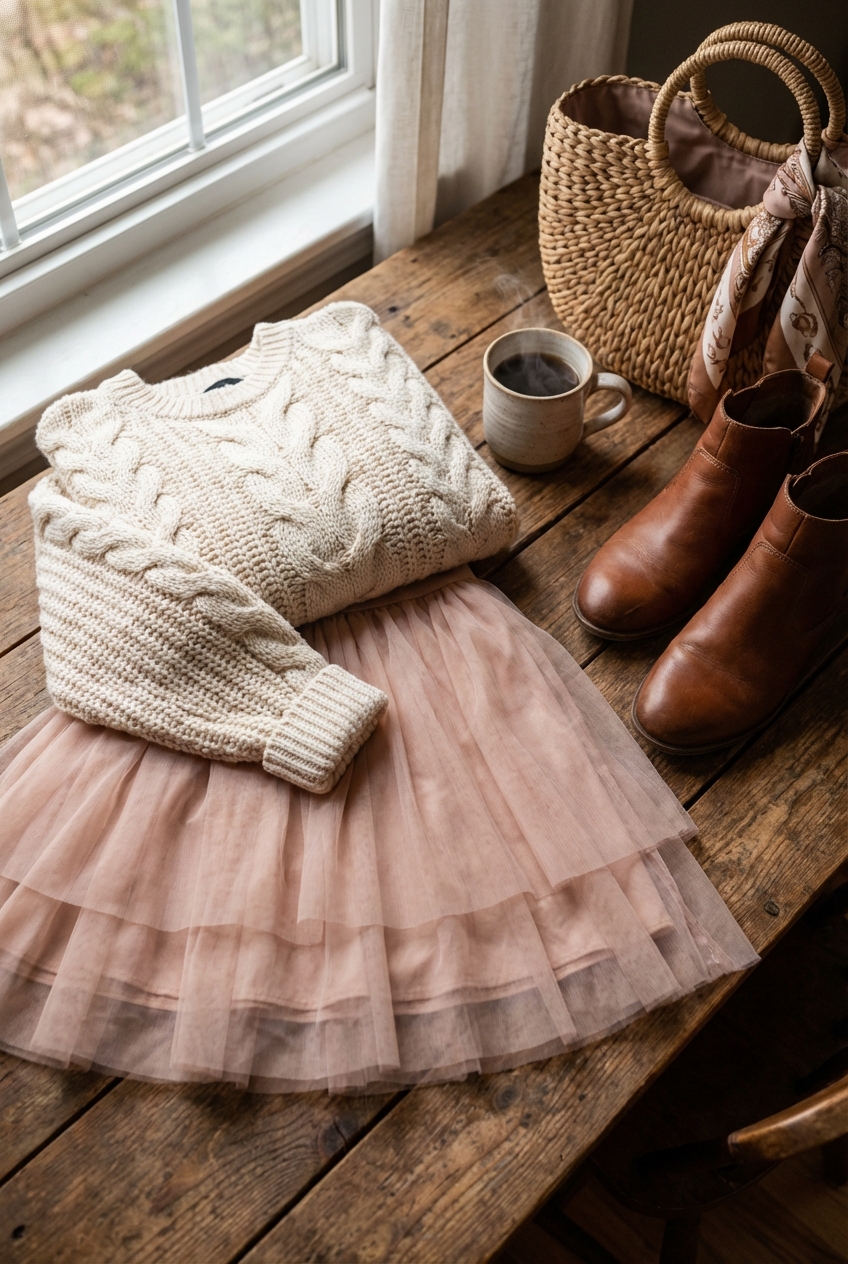
How To Layer Chunky Knits With Tulle Skirts A Perfect Blend Of Cozy And Chic
There is something undeniably magical about the juxtaposition of heavy, structured wool against the ethereal lightness of tulle. I vividly remember styling a holiday editorial shoot in Aspen where the temperature was dropping rapidly, yet we needed to capture a look that felt whimsical and romantic. The solution wasn’t a stiff gown or a standard suit, but a massive, oatmeal-colored cable knit sweater thrown over a charcoal tulle maxi skirt. It was the perfect marriage of practicality and fantasy.
This combination works because it plays with tension. You have the “rough” texture of the knitwear competing with the delicate, ballet-inspired vibe of the skirt. For many of my clients, this look can feel intimidating at first glance because it involves a lot of fabric volume. However, when you understand the mechanics of proportion and texture, it becomes one of the most comfortable and stylish uniforms for the colder months.
In this guide, I am going to break down exactly how to execute this pairing without looking like you are drowning in fabric. We will cover the importance of knit gauge, the right skirt length for your height, and the footwear that ties it all together. If you are looking for visual inspiration to guide your shopping, you can find our curated Picture Gallery at the end of this blog post.
1. Balancing Volume and Establishing Proportions
The most critical rule in high-end styling is managing volume. When you pair a chunky knit with a voluminous skirt, you are effectively doubling the bulk on your frame. If you do not create a visual break or a structural anchor, the outfit can easily consume you.
The goal is to maintain the “Rule of Thirds.” In fashion, this usually means defined ratios like 1:2 or 2:1. For this specific look, you want your torso to occupy the top third and your legs (and skirt) to occupy the bottom two-thirds. This elongates the leg line even when you are fully covered in fabric.
Designer’s Note: The “Triangle” Mistake
I often see clients wear an A-line knit over an A-line skirt. This creates a triangle shape that widens the figure from the shoulders down to the floor. To prevent this, ensure your sweater has a slightly more tailored fit through the shoulders or tapers at the hem. If the sweater is oversized, the skirt should have softer, drapier tulle rather than stiff, horizontal volume.
Common Mistakes and Fixes
- Mistake: Wearing a tunic-length sweater untucked over a midi skirt.
- Fix: This cuts your legs in half visually. Always employ a tuck, a belt, or choose a cropped hemline to restore your waistline.
- Mistake: Choosing a skirt with too many stiff layers for everyday wear.
- Fix: Save the “cupcake” style tulle for galas. For day-to-day chic, choose soft tulle with a polyester or silk blend lining that falls closer to the body.
2. Selecting the Right Knit: Gauge and Texture
Not all chunky knits are created equal. The “gauge” of a knit refers to the number of stitches per inch; a lower gauge means a thicker, chunkier fabric. For this look, we generally want a low-gauge sweater, but the material composition matters immensely for how it hangs on the tulle.
I prefer natural fibers like merino wool, cashmere, or alpaca blends. These fibers have a natural weight that helps the garment settle against the body. Synthetic acrylic blends often have a “bounce” or stiffness to them that can make the sweater stick out awkwardly, adding unnecessary width to your midsection.
When selecting your sweater, pay attention to the hem. A ribbed hem is your best friend because it naturally cinches slightly, making it easier to manipulate into a tuck. A split hem (where the sides are open) is also fantastic for this look because it allows the tulle to peek through the sides, creating vertical lines that slim the silhouette.
What I’d Do in a Real Project
If I am styling a client who is petite (under 5’4″), I avoid exaggerated cable knits. The texture is too large for their frame. Instead, I choose a fisherman’s rib or a cashmere bouclé. It provides the “cozy” texture without the massive bulk of a cable pattern. For taller clients, I lean into the drama of a giant cowl neck or aggressive cable pattern to balance the length of the skirt.
3. Navigating Tulle Layers and Hem Lengths
Tulle skirts range from single-layer overlays to multi-layered petticoat styles. For the “Chunky Knit x Tulle” aesthetic, you want a skirt that sits somewhere in the middle. You need enough layers to create that romantic opacity, but not so many that you look like a costume.
The length of the skirt is the second variable. The most universally flattering length for this combination is the “tea length” or midi length, which hits right at the thinnest part of the calf. This allows you to show off your boots, which helps ground the look.
If you opt for a maxi skirt, ensure it kisses the top of your shoes but doesn’t drag. Tulle is a magnet for debris. From a practical standpoint, a floor-sweeping tulle skirt is a nightmare for city walking. I always advise hemming tulle skirts to hover at least 1.5 to 2 inches off the ground to account for the “bounce” of the fabric while walking.
Pro-Tip: The Lining Check
Always check the lining of the skirt. Cheap tulle skirts often have short, mini-skirt linings which ruin the seamless, high-end look. Look for a lining that extends all the way to the hem or stops just a few inches short to show off the sheer transparency at the bottom.
4. The Art of the Tuck and Waist Definition
Because both garments are voluminous, defining the waist is non-negotiable. However, fully tucking a thick sweater into a delicate waistband is often physically impossible—it creates a lumpy roll around your midsection that ruins the line of the skirt.
The “French Tuck” is the standard solution. Grab just the front two inches of your sweater hem and tuck it loosely behind the waistband of the skirt. Blouse the rest of the sweater out so it drapes over the waistband. This reveals the waistline at the center of your body, which tricks the eye into seeing a defined shape, while the back remains loose and cozy.
Belt It Like a Pro
Another technique I use on set is the “hidden belt” trick.
- Put on your dress or skirt.
- Put on your chunky sweater.
- Place a thin belt over the sweater at your natural waist and tighten it.
- Pull the sweater up through the belt until the belt is completely hidden by the overhang of the knit.
This turns any long sweater into a cropped silhouette without any bulk tucked into the skirt. It is a game-changer for thick wools that are too heavy to tuck.
5. Footwear: Grounding the Ethereal
The shoe choice dictates the entire vibe of this outfit. Because tulle is so inherently feminine and “sweet,” I almost always recommend contrasting it with tougher or heavier footwear. This creates that “fashion editor” look rather than looking like an adult ballerina.
Combat boots are my top recommendation. A leather lace-up boot adds weight to the bottom of the outfit, anchoring the floating tulle. Dr. Martens or sleek lug-sole Chelsea boots work perfectly here. The juxtaposition of grit and grace is what makes the outfit modern.
If you need a dressier option, opt for a suede knee-high boot. The suede texture complements the softness of the knit and the tulle, creating a cohesive, tactile experience. Avoid delicate stilettos or ballet flats with this specific combination. The sweater is heavy; if your shoes are too dainty, you will look top-heavy.
Practical Constraints: Winter Weather
For clients in snowy or rainy climates, leather boots are a necessity. Tulle does not fare well with water, so having a boot with a slight platform or lug sole keeps the hem of your skirt out of puddles. This is a practical design choice that also happens to look incredibly chic.
6. Color Stories and Monochromatic Styling
While contrasting colors (like a cream sweater with a black skirt) are classic, monochromatic styling elevates this look to a luxury level. Wearing a single color from head to toe elongates the figure and reduces the visual “noise” of the volume.
Imagine a soft grey cashmere turtleneck paired with a dove grey tulle skirt and grey suede boots. The interest comes from the texture difference—fuzzy vs. sheer vs. suede—rather than color blocking. This is an excellent strategy for petites who are worried about being overwhelmed by the fabric.
If you do want to mix colors, stick to the “sandwich method.” Match your sweater color to your shoes, and let the skirt be the contrasting filling. For example, a black sweater, champagne tulle skirt, and black boots. This bookends the outfit and keeps the eye moving vertically.
Jewel Tones for Evening
For holiday parties or evening events, deep jewel tones are stunning. A forest green chunky knit with a matching green tulle skirt feels festive but sophisticated. It is a confident departure from the standard cocktail dress and keeps you warm in drafty venues.
Finish & Styling Checklist
Before you head out the door, run through this quick mental checklist to ensure your look is polished and purposeful.
- Waist Check: Is your waist visible in some capacity? Use a French tuck or the hidden belt trick if the sweater is drowning you.
- Hemline Audit: Is the skirt dragging? Ensure you have at least 1-2 inches of clearance or are wearing boots with enough lift.
- Texture Balance: Do you have a mix of textures? Ideally, you want fuzzy (knit), sheer (tulle), and smooth/tough (leather boots).
- Static Guard: Tulle is notorious for static cling, especially in dry winter air. Spray the lining of your skirt and your tights with an anti-static spray.
- Underlayers: If it is freezing, wear fleece-lined tights. The volume of the tulle will hide the thickness of the tights completely.
FAQs
Can I wear this look to the office?
Yes, but it depends on the skirt volume. Opt for a skirt with less “poof”—perhaps just two layers of tulle with a solid lining. Pair it with a more fitted mock-neck sweater rather than an oversized cable knit. Keep the colors neutral (navy, black, camel) to maintain professional polish.
What kind of coat do I wear over this?
This is the trickiest part. You generally have two options: a cropped jacket (leather moto or denim) that hits at the waist, or a long, tailored wool coat that covers the entire skirt. Avoid mid-length pea coats, as they will cut across the widest part of the tulle and make you look boxy.
I am plus-size; will this make me look larger?
Not if you focus on fit. The key is a sweater that fits your shoulders perfectly and isn’t too tight across the bust. Use the hidden belt trick to define your waist. A V-neck sweater is also very effective as it opens up the neckline and draws the eye to the center.
How do I clean a tulle skirt?
Always check the care label, but generally, hand washing in cold water is safest. Never iron tulle directly—it will melt. Use a steamer from a distance to release wrinkles. If you don’t have a steamer, hang it in the bathroom while you take a hot shower.
Conclusion
Layering chunky knits with tulle skirts is a testament to the versatility of modern wardrobes. It breaks the old rules that separated “daywear” from “evening wear” and “winter warmth” from “spring lightness.” It allows you to shop your own closet, repurposing that holiday skirt for a casual Tuesday coffee run or elevating your favorite lounge sweater for a dinner date.
The secret lies in the confidence of the pairing. Once you master the proportions—keeping the waist defined and the footwear grounded—you will find that this outfit formula is remarkably forgiving and universally flattering. It is cozy enough for a curled-up afternoon with a book but chic enough to walk into any high-end boutique.
Fashion should always be about how it makes you feel. This combination offers the physical comfort of a blanket with the emotional lift of dressing up. Experiment with your textures, play with your color palette, and don’t be afraid to add a little volume to your life.
Picture Gallery


