
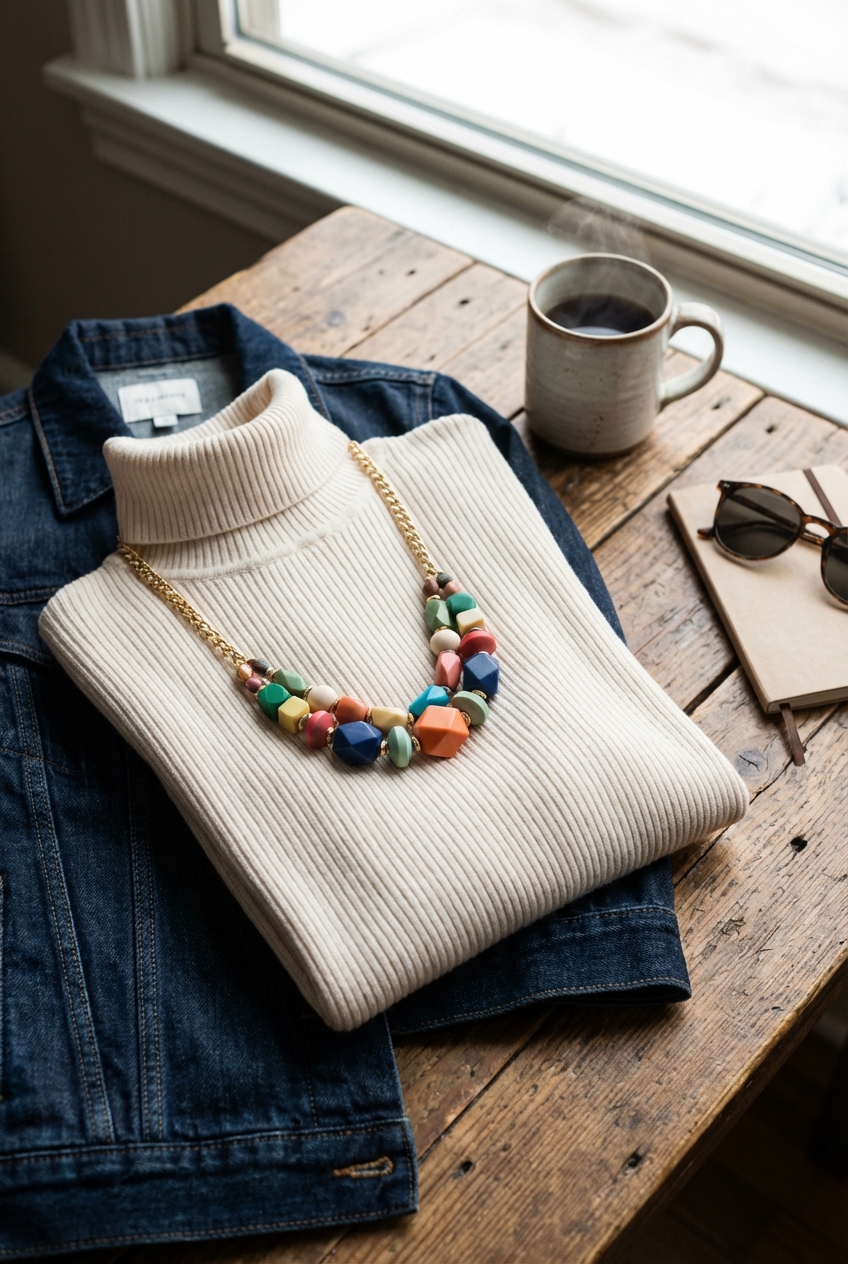
How To Pair Bold Necklaces With High Neck Tops
The high neck top is a staple in any sophisticated wardrobe. Whether it is a sleek cashmere turtleneck, a structural mock neck, or a high-cut blouse, these pieces provide a beautiful canvas for styling. However, they can also present a unique challenge. When you remove the skin exposure of a V-neck or scoop neck, you lose a natural focal point. This is where bold jewelry becomes not just an accessory, but a necessity for balancing your silhouette.
I recall a specific fitting with a client who was attending a gallery opening in New York. She had a stunning black architectural top with a very high neckline, but she felt the look was too severe. She kept trying to pair it with delicate chains that simply disappeared into the fabric. The moment we swapped those out for a substantial, structural gold collar, the entire outfit shifted from “austere” to “avant-garde.” The jewelry didn’t just sit on the clothes; it completed the architecture of the look.
Mastering this pairing requires understanding scale, weight, and visual lines. It is about creating intent rather than just adding decoration. In this guide, I will walk you through the exact formulas I use to style high necklines, ensuring you look polished rather than cluttered. For visual inspiration on how these combinations come together, make sure you look at the Picture Gallery at the end of the blog post.
The Architecture of Scale and Proportion
The first rule of thumb in high-end styling is managing volume. A high neckline creates a large block of solid color on your torso. If you leave this blank, it can sometimes widen the appearance of the upper body or shorten the neck. Your goal with a bold necklace is to break up that solid block and reintroduce a vertical line.
When working with high necks, scale is your best friend. A delicate pendant will look like a mistake, appearing as though it is strangling the neckline. You need pieces that hold their own against the fabric. Think of the fabric as a wall and the necklace as the art; you wouldn’t hang a postage stamp on a large living room wall.
The Rule of Thirds
When positioning a necklace over a high neck, I often use the rule of thirds. Visually divide the space from your collarbone to your natural waist into three sections.
- The Top Third: This is for chokers or collars that sit right at the base of the neck, mimicking a jeweled neckline.
- The Middle Third: This is usually the danger zone where necklaces hang awkwardly over the bust line. Avoid lengths that terminate exactly at the fullest part of the chest.
- The Bottom Third: This is for long pendants or opera-length chains that draw the eye downward, elongating the torso.
Mastering the Classic Turtleneck
The turtleneck is perhaps the most common high neck item in our closets, and it is arguably the easiest to style if you follow the “Opposites Attract” theory regarding texture. If you are wearing a chunky cable knit, a bold necklace needs to be solid and substantial, like a thick resin piece or heavy metal links.
If the turtleneck is a thin, ribbed merino wool or a bodysuit, you have more flexibility. Here, you can play with layered chains or bib necklaces that lie flat against the chest. The smooth fabric acts as a perfect backdrop, allowing intricate details to pop.
Stylist’s Note: The Weight Test
One lesson I learned the hard way early in my career involved a silk jersey turtleneck and a very heavy vintage gemstone necklace. The weight of the necklace actually pulled the fabric down, distorting the neckline and causing the shirt to sag.
The fix: Always check the structural integrity of your top. If the fabric is flimsy, the necklace must be self-supporting (like a stiff wire choker) or lightweight (like resin or hollow gold). If the fabric is sturdy, you can go as heavy as you like.
Elongating with Opera Lengths and Pendants
For clients concerned that a high neckline makes them look “boxy” or short-necked, the long pendant is the ultimate corrective tool. By introducing a V-shape or a long vertical line with jewelry, you mimic the lengthening effect of a V-neck shirt without exposing any skin.
I recommend looking for chains that are at least 24 to 30 inches long. At this length, the necklace creates a deep V that draws the eye toward the center of the body. This is incredibly slimming and elegant. A large, singular pendant at the bottom of a long chain acts as a visual anchor. It stops the eye from wandering and gives the outfit a center of gravity.
Measurement Specifics
When I am pulling items for a shoot, I stick to these general measurements for high necks:
- The Anchor Pendant: Chain length of 28–32 inches. The pendant itself should be at least 2 inches in diameter to be visible.
- The Lariat: These are adjustable and fantastic for high necks. I usually style the “drop” to end about 2 inches above the navel.
- The Layered Look: If layering, start the shortest chain at 18 inches (sitting below the collar of the shirt) and graduate down in 2-inch increments.
The Statement Collar and Bib Necklace
While long necklaces elongate, statement collars (also known as bibs) frame the face. This creates a regal, almost armor-like aesthetic. This look works exceptionally well with mock necks, which hit slightly lower than a full turtleneck.
The key here is where the necklace sits relative to the seam of the collar. You generally have two options. First, you can wear a tight choker that sits on the skin above the mock neck. This is risky and only works if you have a longer neck. Second, and more commonly, you wear a bib necklace that sits flush against the fabric, covering the collarbone area completely.
Common Mistakes + Fixes
Mistake: The “Floating” Necklace.
This happens when a necklace is just slightly too loose, so it sits halfway on the collar of the shirt and halfway on the fabric below it. It looks messy and unintentional.
The Fix: Use a necklace extender or a safety pin at the back. Either cinch it tight so it sits high up like a part of the garment, or lengthen it so it clears the collar seam entirely and sits flat on the chest.
Material Contrast: Metal, Resin, and Stone
The material of your jewelry dictates the “vibe” of the outfit. High neck tops cover a lot of skin, so the material you choose for your necklace becomes the primary source of light reflection and texture.
Metal on Matte
If you are wearing matte fabrics like cotton, wool, or cashmere, high-shine metals are your best option. Polished gold or silver reflects light, breaking up the dullness of the fabric. I particularly love hammered gold paired with black wool; the texture contrast is rich and expensive-looking.
Matte on Shine
If your high neck top is satin, silk, or a metallic knit, you want to avoid super shiny jewelry. It can look cheap or like a disco ball. Instead, opt for matte stones, wood, resin, or oxidized metals. These absorb light and ground the outfit.
The Snag Factor
Real World Constraint: We must talk about prongs. If you are wearing a delicate knit sweater, avoid bold necklaces with prong-set stones or rough metal edges. They will snag the fabric instantly. For knits, stick to bezel settings (where the metal completely surrounds the stone edges) or smooth metal chains. Save the prong-set crystal bibs for scuba fabrics or tightly woven cottons.
Styling Monochromatic vs. High Contrast
Color theory plays a massive role in how bold your necklace feels. You can use your jewelry to either blend in for texture or stand out for drama.
The Monochromatic Approach
Wearing a gold chain over a camel turtleneck, or a gunmetal piece over a charcoal top, creates a textual shift without a color break. This is incredibly chic and safe for office environments. It says “fashion” without screaming it. It adds dimension to the outfit without breaking the vertical line of color, which keeps you looking tall.
The High Contrast Pop
If you want the necklace to be the headline, you need high contrast. Turquoise over black, coral over navy, or bright silver over deep burgundy. When doing this, ensure the necklace is the only loud thing in your outfit. Keep the pants or skirt neutral. If you have a loud shirt and a loud necklace, the viewer won’t know where to look.
What I’d Do in a Real Project
If I were styling you for a specific event, here is the mental checklist I run through. You can use this for your own closet.
- Assess the Event: Is it a dinner where you will be seated? If so, the necklace is crucial because it’s all people will see. I would choose a shorter, chunky statement piece that sits near the face.
- Check the Hair: With a high neck and a bold necklace, things get crowded. I almost always advise putting hair up in a sleek bun or ponytail. If you have short hair, slick it back. You want to expose the jawline to let the necklace breathe.
- Earring Audit: If the necklace is bold and the neck is high, the earrings must be minimal. I usually pull simple diamond or gold studs. Never wear chandeliers with a bold necklace and a turtleneck; it shortens the distance between ear and shoulder visually.
- Torso Length: If a client has a shorter torso, I avoid thick bib necklaces that cover the whole chest. I stick strictly to V-shaped long pendants to create room.
Finish & Styling Checklist
Before you walk out the door, run through this final quality control check to ensure your outfit looks styled, not just thrown together.
- The Gap Check: Does the necklace sit flat? If it is tilting or flipping because of the bulky fabric underneath, change the necklace or tighten the clasp.
- The Noise Test: Move around. Does the necklace clink loudly against buttons or zippers? Metal-on-metal noise can be distracting.
- The Hair Clearance: Does your hair get caught in the clasp or the chain? If wearing your hair down, ensure the chain is smooth (like a snake chain) to avoid tangles.
- The Color Harmony: Does the metal tone of the necklace clash with hardware on your bag or belt? While mixing metals is trendy, keeping them uniform (all gold or all silver) looks more high-end with bold statement pieces.
- The Comfort Factor: Is the necklace too heavy for an 8-hour day? A heavy piece on a high neck can sometimes feel constricting. If you are sensitive, opt for chunky resin or wood which gives size without weight.
FAQs
Can I wear a choker with a turtleneck?
Yes, but it must be substantial. A thin velvet choker will disappear. A thick gold cuff or a rigid wire choker looks structural and modern. Place it high on the neck of the shirt, or if the shirt neck is loose, on the skin just above it.
Does this look work for petite women?
Absolutely, but watch the width. A very wide bib necklace can overwhelm a petite frame. Stick to “long and strong” pieces—necklaces that are bold in weight but vertical in shape. This adds height.
Can I layer multiple necklaces over a high neck?
Yes, layering is a great way to create a “bold” look from smaller pieces. The trick is spacing. Ensure there is at least an inch or two of space between each chain so they don’t look like a tangled mess. Use a necklace detangler clasp to keep them separated behind your neck.
What if my top has a pattern?
If your high neck top is patterned (like a floral or plaid), avoid intricate, multi-colored necklaces. Stick to solid metal (a big gold chain) or a solid color that matches one of the colors in the print. This calms the pattern down rather than fighting it.
Conclusion
Pairing bold necklaces with high neck tops is one of the most effective ways to elevate your style during the cooler months. It turns a functional garment into a fashion statement. By paying attention to scale, material contrast, and the vertical lines of your body, you can wear even the most daring jewelry with confidence.
Remember that fashion is about balance. The high neck provides the coverage and the canvas; the bold necklace provides the personality and the focal point. Don’t be afraid to experiment with weight and length until you find the combination that feels right for your frame. Start with a simple long pendant or a gold chain, and as you get comfortable, move into architectural collars and mixed materials.
Picture Gallery


