
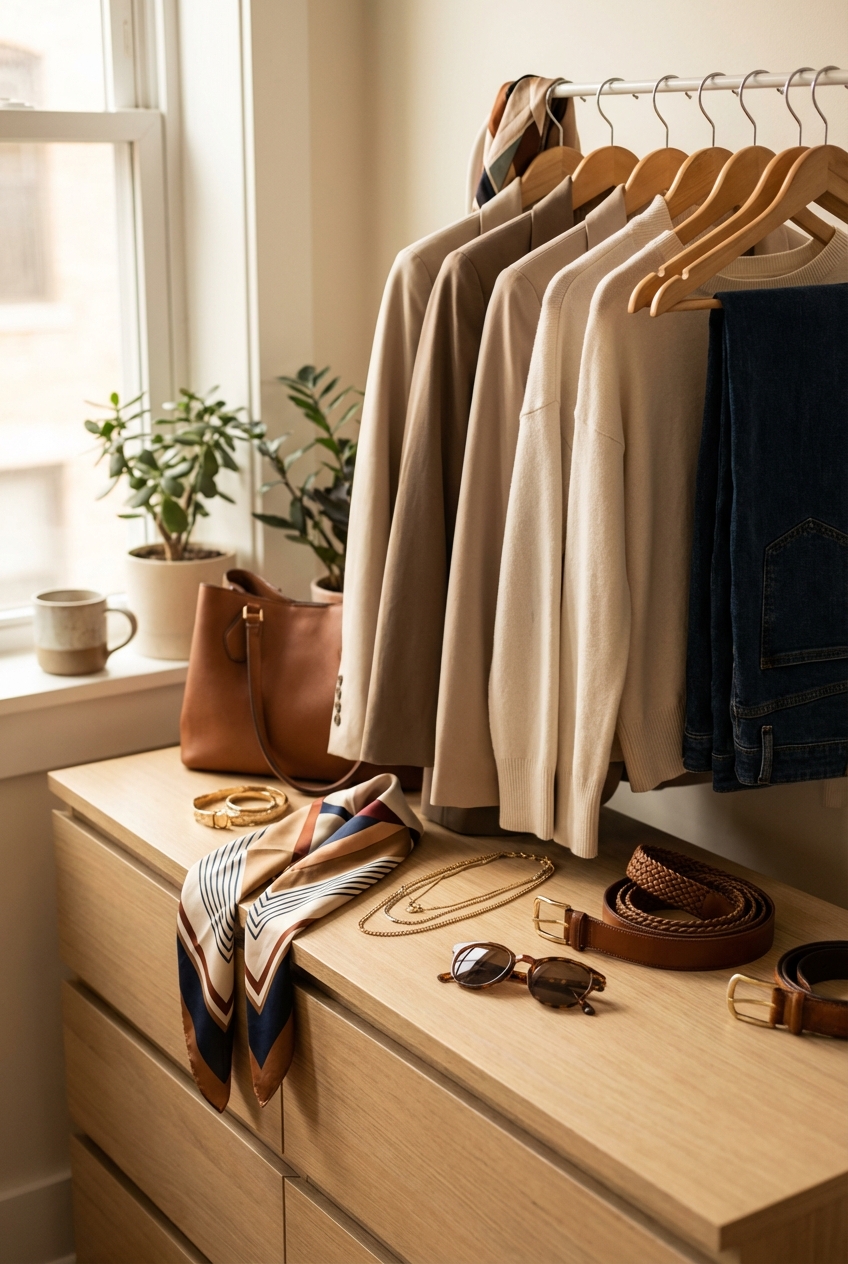
How To Style Accessories In A Capsule Wardrobe
Many of my clients come to me with a common frustration: they have successfully purged their closets and invested in high-quality basics, yet they still feel like they have “nothing to wear.” They own the perfect white tee, the tailored blazer, and the vintage-wash denim, but the reflection in the mirror feels lackluster.
The missing link is rarely the clothing itself; it is almost always the styling. Accessories are the punctuation marks of an outfit. Without them, even the most expensive capsule wardrobe reads like a run-on sentence—functional, perhaps, but lacking rhythm, personality, and impact.
In this guide, I will walk you through the precise formulas I use to elevate a minimal closet from basic to bespoke using only a handful of key items. For those who need visual examples of how these combinations come together, I have curated a stunning Picture Gallery at the end of the blog post.
1. The Rule of Three: Balancing Your Visual Weight
When working with a streamlined capsule wardrobe, the “Third Piece Rule” is the industry standard for creating a finished look. This rule states that every outfit needs three key elements to feel complete: a top, a bottom, and a third element that adds depth.
In summer or warmer climates, that third piece cannot always be a jacket or cardigan. This is where accessories become the structural pillar of your style. A substantial belt, a statement necklace, or a silk scarf acts as that crucial third piece.
Designer’s Note:
One lesson I learned early in my styling career is that visual weight matters more than the number of items. If you are wearing a voluminous linen dress (one piece), a tiny delicate chain necklace gets lost. You need “heavy” accessories—like a chunky cuff or a structured leather bag—to balance the volume of the fabric.
Common Mistakes + Fixes
- Mistake: Adding too many delicate items that create visual clutter without impact.
- Fix: Choose one “hero” accessory per outfit. If you wear chandelier earrings, skip the necklace and opt for a bracelet instead.
2. The Essential Jewelry Edit: Metals and Proportions
In a capsule wardrobe, your jewelry box should be as curated as your clothing rack. The goal is not to have endless options, but to have the right options that work with every neckline in your arsenal.
I recommend establishing a “daily uniform” of metals. While mixing metals is currently on-trend, sticking to a dominant metal (gold or silver) simplifies your daily decision fatigue. For a versatile capsule, you generally need three core necklace lengths: a 16-inch choker style, an 18-20 inch pendant, and a 24-30 inch long chain for layering over knitwear.
Pro Tip: The Neckline Formula
- Crew Necks: Require a “bib” style necklace or a long pendant that hits below the bust line to elongate the torso.
- V-Necks: Best suited for delicate pendants that sit one inch above the fabric edge, mimicking the V shape.
- Boat Necks: Avoid necklaces entirely. This neckline shines with statement earrings or a bold cuff bracelet to draw the eye outward.
3. Footwear as the Anchor: Color and Silhouette
Shoes are often an afterthought, but in high-end styling, we start from the ground up. For a capsule wardrobe, you need functionality, but you also need shoes that dictate the “vibe” of the outfit. A slip dress with sneakers is a day look; the same dress with strappy heels is a wedding guest look.
To maximize versatility, follow the “Two-Tone Rule.” Your shoe capsule should include one pair that matches your skin tone (to elongate the leg) and one pair that matches your hair color or dominant wardrobe neutral (black, navy, or cognac). This “bookending” technique creates immediate visual harmony.
What I’d Do in a Real Project:
If I am building a 30-piece capsule for a client, I allocate 5 spots to shoes.
- The White Leather Sneaker: Clean, minimal, non-negotiable for modern dressing.
- The Black Loafer or Mule: The professional flat that works for lunch meetings.
- The Ankle Boot: Ideally with a 2-inch block heel for walkability.
- The Nude Pump or Sandal: For occasions requiring elevation.
- The Statement Flat: A leopard print, metallic, or red shoe that acts as an accessory on its own.
4. The Power of Belts: Structure and Texture
If you take nothing else away from this guide, let it be this: buy better belts. A high-quality leather belt is the fastest way to make high-street denim look like designer vintage.
In a capsule wardrobe, clothes are often worn on repeat. A belt changes the silhouette of a garment entirely. You can belt an oversized blazer to create an hourglass shape, or belt a loose midi dress to shorten the hemline and define the waist.
The Hardware Harmony Rule
Pay attention to the buckle. If your bag has gold hardware and your loafers have a gold horse-bit detail, a silver belt buckle will create visual friction. It doesn’t need to match perfectly, but the tones should be complementary. If you mix metals, ensure you have a “bridge piece”—like a two-tone watch—that ties the silver and gold together.
Common Mistakes + Fixes
- Mistake: Wearing a belt that is too wide for the belt loops, causing the fabric to bunch.
- Fix: The standard width for jeans is 1.5 inches. For dresses or blazers, you can go up to 2–3 inches. Always measure the loop before investing in a luxury belt.
5. Handbags: Function Meets Form
The handbag is the workhorse of the capsule wardrobe. Unlike shoes, which rotate daily, you might carry the same bag for weeks. Therefore, durability and neutrality are paramount.
However, “neutral” does not have to mean boring. Texture is your best friend here. If your capsule is heavy on smooth cottons and denim, choose a bag with grain—like a pebbled leather tote or a croc-embossed shoulder bag. This textural contrast adds richness to simple outfits.
The Scale Equation
The size of your bag should correspond to your frame and the occasion. A massive tote bag worn for a dinner date looks clumsy. A tiny clutch worn while running errands looks impractical.
I suggest owning three categories:
- The Structured Tote: Large enough for a laptop, rigid enough to stand on its own. Slouchy bags can look messy; structure reads “expensive.”
- The Crossbody: Hands-free, medium size. Look for a strap that is adjustable so it can sit at your hip or waist depending on your height.
- The Evening Clutch: This is where you can play. Metallic finishes or velvet textures work beautifully here and require zero matching to your daily wardrobe.
6. Soft Accessories: Scarves, Hats, and Eyewear
Soft accessories are the secret weapon for transitional weather styling. They allow you to wear your summer tanks into autumn and your spring trenches into winter.
A silk scarf is perhaps the most underutilized tool in modern wardrobes. Tied around the neck, it adds color near the face, which is vital if your capsule is full of black, grey, and beige. Tied onto a bag handle, it refreshes an old accessory. As a belt, it adds a bohemian flair.
Designer’s Note on Sunglasses:
Treat sunglasses like makeup. They frame your face. An oversized black frame creates an immediate “fashion editor” look, while a wire-rim aviator feels relaxed and sporty. If you are not wearing makeup, a great pair of sunglasses and a bold lip color is a complete look.
Finish & Styling Checklist
Before you walk out the door, run through this mental checklist to ensure your accessories are working for you, not against you.
The “One Step Back” Check:
- Is there a focal point? Your eye should be drawn to one specific area (ears, waist, or shoes). If your eye is darting around, remove one accessory.
- Are the metals cohesive? If mixing silver and gold, is it intentional (50/50 balance) or accidental?
- Does the shoe match the activity? There is nothing less stylish than a woman who cannot walk comfortably in her shoes.
- Is the bag proportional? Does the strap length cut you off at a flattering point (waist or hip), or is it dragging the eye down?
- Is there texture? If you are wearing jeans and a tee, add a leather belt or a suede shoe to break up the flat fabrics.
FAQs
Should my shoes and bag always match?
No, this is an outdated rule. In modern high-end styling, we prefer them to “go” rather than “match.” If you are wearing black shoes, a black bag is safe, but a camel or burgundy bag is much more interesting. The goal is coordination, not uniformity.
Is it worth investing in designer costume jewelry?
Generally, no. As an expert, I advise clients to spend their budget on materials, not logos. A solid 14k gold chain from a non-branded jeweler will last a lifetime and hold value. A brass logo necklace from a fashion house will tarnish in two years. Invest in real gold, sterling silver, or heavy gold vermeil.
How do I stop accessories from feeling like clutter?
If you can’t see them, you won’t wear them. Store your jewelry on a velvet tray in a drawer, not in boxes. Keep your bags stuffed with tissue paper on a shelf so they hold their shape. When accessories look beautiful in storage, styling them feels like shopping in a boutique.
Can I wear black accessories with a navy outfit?
Absolutely. Black and navy is a sophisticated, very French color combination. The trick is to make it look intentional. Ensure the black is a true, deep black and the navy is distinct. Use different textures (e.g., navy wool trousers with a black patent leather belt) to define the separation.
Conclusion
Mastering the art of accessorizing is what graduates you from simply “wearing clothes” to “having style.” In a capsule wardrobe, where variety is limited by design, accessories provide the infinite variables needed to keep your look fresh, personal, and appropriate for any occasion.
Remember that accessories are investments. A cheap dress can look expensive with a great bag and shoes, but an expensive dress can look cheap with poor accessories. Prioritize quality materials—leather, silk, precious metals—and care for them diligently. By following the rules of proportion, balance, and intentionality outlined here, you will find that your limited wardrobe feels limitless.
Picture Gallery


