
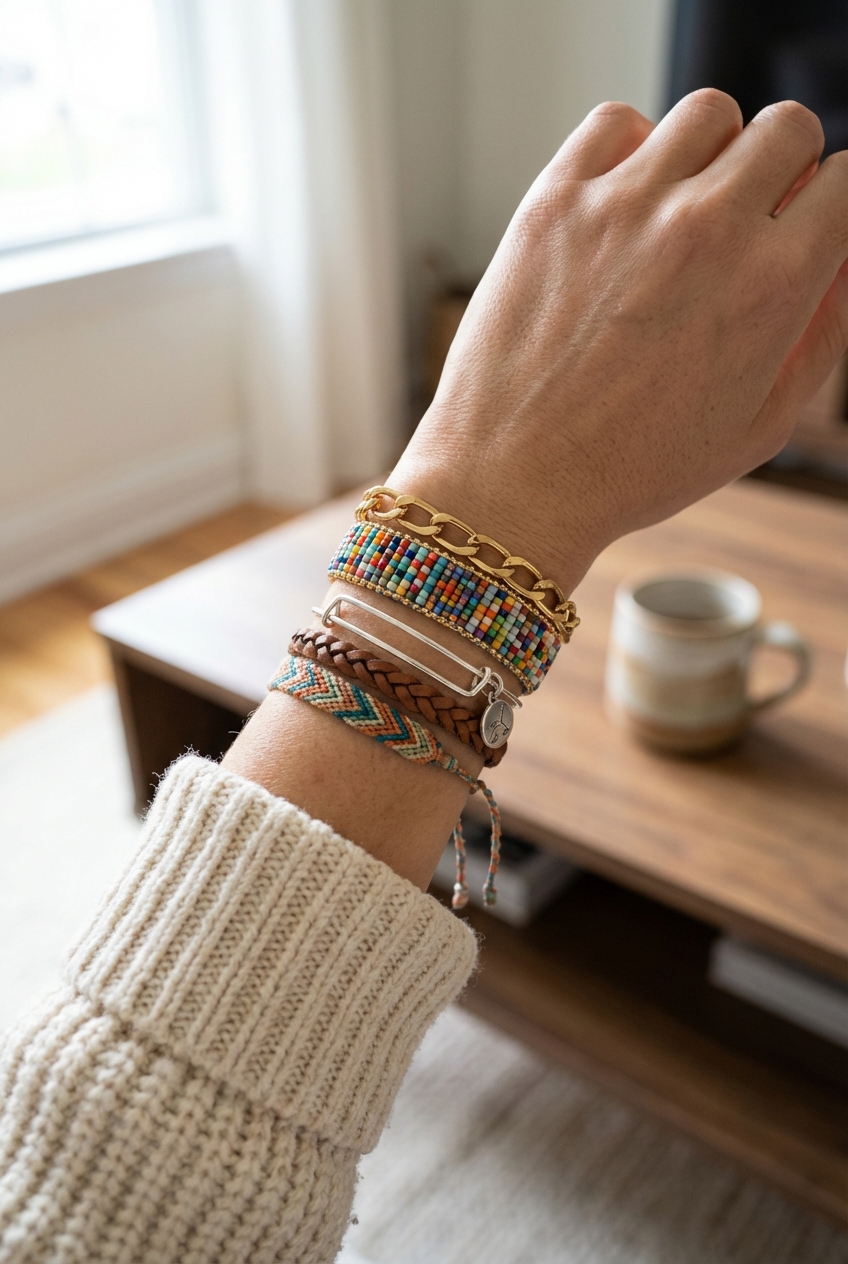
Layered Bracelets Mixing And Matching Arm Candy
There is a distinct art to dressing the wrist that goes beyond slapping on a single bangle and running out the door. As a stylist, I view the forearm as one of the most underutilized canvases in fashion. It is a space where personal history, investment pieces, and current trends can collide to tell a story about who you are and where you are going.
A perfectly curated bracelet stack—often referred to as “arm candy”—can elevate a simple white t-shirt and jeans into a deliberate, chic ensemble. The secret lies not in how much you spend, but in understanding the visual weight and balance of the pieces you choose to combine. It is about creating a composition that feels organic rather than cluttered.
In this guide, I will break down the exact formulas I use when styling clients for editorials and events. We will cover mixing metals, balancing textures, and the crucial spacing rules that keep a stack from looking messy. For visual inspiration on how to execute these combinations, make sure you look at the Picture Gallery at the end of the blog post.
The Foundation: Understanding Metals and Finishes
The old-school rule that you cannot mix silver and gold is officially dead, and frankly, it has been for years. Mixing metals adds depth and a modern edge to your jewelry game. However, doing it successfully requires a strategy.
If you are new to mixing, start with a dominant metal. Choose one finish to make up about 70% of your stack. For example, if you wear a large gold watch, let gold be the hero and weave in silver or rose gold as accents.
The bridge piece is your best friend in this scenario. This is a single bracelet that contains both metals, such as a two-tone cable bracelet or a chain with mixed links. This piece physically connects the two disparate tones and makes the mix look intentional rather than accidental.
Designer’s Note: The Finish Matters
One area where people often stumble is mixing the actual finish of the metal, not just the color. High-shine polished gold creates a very different vibe than hammered, matte, or brushed gold. While you can mix them, it is often safer to keep the finish consistent even if the metal colors vary. This maintains a cohesive “language” across your wrist.
Scale and Proportion: The Heavy-Medium-Light Formula
Visual weight is the most critical element of a successful bracelet stack. If you wear three chunky cuffs of the same size, your arm will look weighed down and clunky. Conversely, five hair-thin chains can tangle and get lost, looking more like a mistake than a style choice.
I teach my clients the “Heavy-Medium-Light” formula. This creates a balanced silhouette that guides the eye up and down the arm.
- The Heavy: This is your anchor piece. It could be a menswear-inspired watch, a thick cuff, or a substantial chain link. This sets the tone.
- The Medium: These pieces bridge the gap. Think standard bangles, beaded bracelets (6mm to 8mm beads), or a classic tennis bracelet.
- The Light: These are the whisper-thin chains or delicate cords. They add movement and sparkle without adding bulk.
Common Mistakes + Fixes
Mistake: Placing two “Heavy” pieces right next to each other.
The Fix: Buffer them with a “Light” or “Medium” piece. If you have a chunky watch and a thick bangle, place a delicate chain or a thin cuff between them. This prevents the heavy items from clanking against each other and damaging the finishes.
The Rule of Odd Numbers
In design, whether we are talking about landscaping, interior vignettes, or jewelry, odd numbers are more visually pleasing to the human eye. Even numbers create symmetry, which can feel rigid and stagnant. Odd numbers create a central focal point and force the eye to move around the composition.
When building your arm candy, aim for stacks of three, five, or seven. A stack of three is the most manageable for daily wear. It usually consists of a watch (the anchor), a bangle (structure), and a chain (movement).
Going up to five pieces moves you into “statement” territory. This is where you can introduce more personality pieces, like a bracelet with charms or a pop of color. Just remember that as the number of pieces increases, the individual scale of those pieces should generally decrease to avoid looking bulky.
Incorporating Texture and Color
If your stack consists entirely of polished metal, it can sometimes look flat or sterile. Introducing different textures brings warmth and character to the look. This is especially important for daytime or casual styling.
Consider adding elements like leather, enamel, beads, or fabric. A leather wrap bracelet adds a masculine, gritty texture that contrasts beautifully with the sparkle of a diamond tennis bracelet. This juxtaposition of “high and low” elements is a hallmark of high-end styling.
Gemstones are another way to break up the monotony of metal. You do not need massive diamonds to make an impact. Turquoise, onyx, or malachite beads add significant visual interest. When adding color, try to pick one accent hue and stick to it, or choose colors that exist in the same tonal family (like blues and greens) to keep the look sophisticated.
Real World Project Checklist: Texture Mixing
When I style a client for a photoshoot, I look for three distinct textures to include in a single stack:
- Hard/Shiny: The base metal (gold, silver, platinum).
- Soft/Organic: Leather, silk cord, or wood beads.
- Reflective/Faceted: Gemstones, diamonds, or crystals.
Integrating Your Timepiece
For many women, the watch is the most expensive and permanent item on their wrist. Therefore, the stack must respect the watch. You never want your bracelets to overpower your timepiece or, worse, damage it.
The placement of the watch is debated, but generally, the watch sits comfortably just above the ulna bone (the wrist bone) on the arm. Bracelets can go on either side, but I prefer placing the stack on the “elbow side” of the watch.
Placing bracelets between the watch and the hand can be uncomfortable. They tend to slide under the heel of the hand when you type or rest your arms on a table. Keeping the stack above the watch allows the timepiece to act as a stopper, keeping the bracelets contained on the forearm.
Protection Protocol
Be mindful of materials touching your watch case. Diamonds are the hardest substance on earth and will scratch stainless steel or gold watch casings. If you are wearing a diamond tennis bracelet next to a luxury watch, ensure there is a “bumper” bracelet in between—something soft like leather or a smooth metal bangle without sharp edges.
Practical Sizing and Comfort
A beautiful stack is useless if it is annoying to wear. The fit of your bracelets is just as important as the style. If they are too tight, they pinch and interrupt blood flow. If they are too loose, they clang against surfaces and you risk them slipping off your hand.
How to Measure:
Use a flexible measuring tape to measure the circumference of your wrist just below the wrist bone.
- Snug Fit: Add 0.25 to 0.5 inches to your wrist measurement. Good for thin chains and watches.
- Comfort Fit: Add 0.75 to 1 inch. This is ideal for beaded bracelets and chunky chains.
- Loose Fit: Add 1.25 inches. This is usually reserved for wide bangles that need to move up and down the arm.
The “Typing Test”
I always tell my clients to perform the “typing test.” Sit at a desk and type on a keyboard. If your bracelets are digging into your wrist or making so much noise that it distracts your coworkers, your stack is not functional.
In professional settings, opt for bracelets that lay flat against the skin (like flat curb chains) rather than round beads or bulky charms that create pressure points on the underside of the wrist.
Styling Checklists & “What I’d Do”
To summarize the high-end approach to layering, here is how I would tackle a bracelet stack for three different scenarios.
Scenario 1: The Corporate Office
- Anchor: A mid-sized luxury watch (metal or leather strap).
- Accent 1: A simple, thin metal cuff or bangle (no charms).
- Accent 2: A delicate chain with a small bar or station detail.
- Why: It is quiet, professional, and adds polish without distraction.
Scenario 2: Weekend Brunch
- Anchor: A chunky gold chain link bracelet.
- Accent 1: A beaded bracelet with color (turquoise or coral).
- Accent 2: A braided leather cord or woven friendship-style bracelet.
- Accent 3: A personalized charm bangle.
- Why: It feels relaxed, playful, and expressive. The mix of high and low materials works perfectly here.
Scenario 3: Evening Date Night
- Anchor: A diamond or crystal tennis bracelet.
- Accent 1: A sleek, high-shine gold cuff.
- Accent 2: A second tennis bracelet with a different stone cut or size.
- Why: It maximizes sparkle and catches the low light of a restaurant. We remove the watch for evening wear to make it feel more like “jewelry” and less like “timekeeping.”
Finish & Styling Checklist
Before you leave the house, run through this quick mental checklist to ensure your arm candy is on point.
- Check the Clasp: Are all clasps secure? Turn them to the underside of your wrist so they aren’t visible.
- The Shake Test: Shake your arm. Does everything stay relatively in place, or is one bangle sliding all the way to your elbow? Adjust sizing if necessary.
- Color Harmony: Do the metals clash with your rings? While mixing metals is great, try to tie your rings into the bracelet story.
- Sleeve Length: Ensure your sleeves don’t fight the stack. A 3/4 sleeve or rolled sleeve is ideal. If you are wearing long sleeves, wear the stack over the fabric for a bold fashion statement.
- Hair Check: If you have bracelets with prongs (like tennis bracelets), run them gently over a piece of fabric to ensure they won’t snag your sweater or stockings.
FAQs
Can I wear a bracelet stack on both arms?
Generally, I advise against “full” stacks on both arms unless you are going for a very specific maximizing bohemian look. It can look like shackles if both wrists are heavily weighed down. A good rule of thumb is to have a “major” arm (watch + stack) and a “minor” arm (perhaps one single ring or one very thin bracelet).
How do I stop my necklaces and bracelets from tarnishing when layered?
Oils and perfumes are the enemy. Put your jewelry on after you have applied lotion and perfume and let it dry. For storage, keep pieces in individual cloth pouches or anti-tarnish strips. When metals rub against each other constantly, plating can wear off faster, so rotate your stacks.
Is it okay to mix fake jewelry with real jewelry?
Absolutely. This is a trade secret of the fashion world. A high-quality costume piece can look incredibly chic next to a real Cartier Love bracelet or a Rolex. The key is condition. Ensure the costume jewelry is not chipped, tarnished, or turning your skin green. If the condition is good, mix away.
Which hand should I wear my stack on?
Traditionally, the watch is worn on the non-dominant hand to prevent damage. Most people build their stack around the watch. However, there are no hard rules. If you are right-handed but prefer the look on your right arm, go for it. Just be aware that the jewelry will experience more wear and tear on your dominant hand.
Conclusion
Layering bracelets is one of the most personal ways to express your style. It is a collection that grows with you over time, incorporating gifts, travel souvenirs, and investment milestones.
By following the principles of scale, odd numbers, and texture mixing, you can create a look that feels curated by an expert rather than thrown together by chance. Remember that comfort is the ultimate luxury. If your stack irritates you, you won’t wear it with confidence. Start with three pieces, experiment with textures, and find the weight that feels right for your lifestyle.
Picture Gallery


