
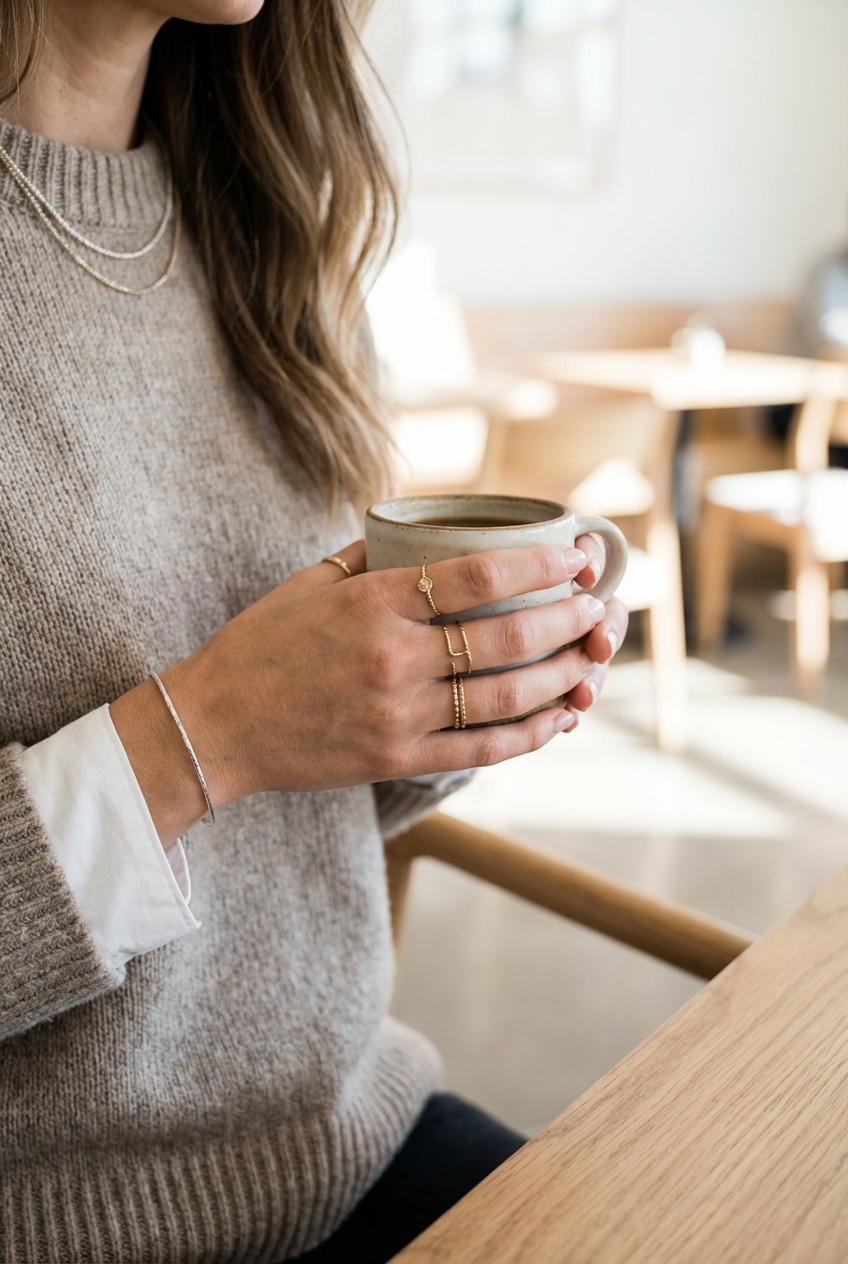
Minimalist Jewelry Understated Pieces For Everyday Wear
True style often whispers rather than shouts. In my years styling high-profile clients for everything from board meetings to galas, I have found that the most impactful accessories are usually the simplest. Minimalist jewelry is not about wearing nothing; it is about wearing pieces that enhance your presence without distracting from it.
I remember working with a client who felt she needed statement necklaces to look “finished.” We stripped back her look to a single, high-quality gold herringbone chain and a pair of diamond huggies. The transformation was immediate; she looked expensive, polished, and effortlessly confident.
This guide is designed to help you build a capsule collection of jewelry that you never have to take off. If you are looking for visual inspiration on how to stack and style these pieces, be sure to check out the Picture Gallery at the end of the blog post.
Understanding Materials and Longevity
When you commit to minimalist jewelry, you are often committing to daily wear. Because you are wearing these pieces 24/7, the material quality is the single most important factor. You cannot achieve a high-end look with base metals that tarnish after three showers.
I always advise clients to invest in solid gold for their “forever” pieces. Solid 14k gold is the industry standard for everyday wear because it blends durability with that rich, warm tone. While 18k gold has a higher purity and a deeper yellow color, it is softer and more prone to scratching, making it risky for rings or bracelets.
If solid gold is outside your current budget, gold-filled is your next best option. Unlike gold plating, which is a microscopic layer over brass, gold-filled jewelry has a thick layer of gold mechanically bonded to the base. It can last for decades if treated well. Avoid standard gold vermeil for rings, as the plating will eventually rub off with constant hand washing.
Designer’s Note: The “Green Finger” Mistake
I see this happen constantly. A client buys a “minimalist” ring from a fast-fashion retailer because it looks trendy. Two days later, their finger is green, and the ring smells like copper.
- The Fix: Check the hallmark. If it does not say 14k, 585, or 925 (sterling silver), put it back. For daily wear rings, save up for the real thing. It is better to have one real ring than ten fake ones.
The Neck Stack: Chains and Pendants
The neck is a prime focal point for minimalist styling. The goal here is to add a glint of light near the face. For a solo piece, a “floating” diamond or a simple gold disc on a whisper-thin chain is unbeatable. This draws the eye to the collarbone without overwhelming the neckline of your clothing.
If you prefer layering, spacing is critical. A common issue is chains that tangle or sit on top of one another. To prevent this, you need to vary both the length and the weight of your chains. A 16-inch delicate cable chain pairs beautifully with an 18-inch slightly thicker box chain.
Texture plays a huge role here. Since you aren’t using color or massive gems, the weave of the chain provides the visual interest. I love mixing a smooth snake chain (liquid gold effect) with a textured rope chain. This contrast makes the look intentional rather than accidental.
Common Mistakes + Fixes
Mistake: Wearing two chains of the same length and weight.
Fix: Apply the “Two-Inch Rule.” Ensure there is at least a 2-inch difference between your necklaces (e.g., 16 inches and 18 inches).
Mistake: Ignoring the clasp heavy side.
Fix: If your necklace keeps spinning so the clasp is in the front, the pendant is too light. Add a slightly heavier charm or choose a chain with a counterweight near the clasp.
The Curated Ear: Huggies and Studs
Gone are the days when minimalist earrings meant just a single pearl stud. The modern approach is the “curated ear,” which involves utilizing multiple piercings to create a constellation effect. However, the pieces themselves remain tiny and understated.
Huggies are the workhorse of the minimalist wardrobe. These are small hoops (usually 6mm to 10mm) that sit flush against the earlobe. They are comfortable enough to sleep in and won’t get caught in hair or scarves. I recommend a hinged clicker mechanism for security.
For second or third lobe piercings, tiny studs are essential. Look for flat-back studs (labrets) rather than traditional butterfly backs. Flat backs are infinitely more comfortable for sleeping and talking on the phone. A 2mm diamond or gold ball in the upper lobe complements a small hoop in the main piercing perfectly.
What I’d Do in a Real Project
If I were styling a client with three lobe piercings, here is the exact formula I would use:
- First Lobe: A 10mm pavé diamond huggie hoop.
- Second Lobe: A 3mm solid gold ball stud.
- Third Lobe: A tiny 2mm bezel-set diamond stud.
- Result: A graduated look that draws the eye upward and elongates the jawline.
Rings: The Art of Stacking
Hand jewelry is tricky because it has to be functional. You type, wash dishes, and carry bags. Minimalist rings should never impede movement or snag on clothing. The trend right now is ultra-thin bands, ranging from 1mm to 1.5mm in width.
You can wear these singly for a barely-there look, or stack three to five of them for impact. When stacking, mix your textures. A hammered finish band, a smooth polished band, and a twisted rope band stacked together create a sophisticated texture story while remaining monochromatic.
Don’t ignore the thumb or pinky. A signet ring on the pinky is a classic choice that feels very current. For the thumb, a simple plain band is surprisingly elegant and adds an edge to a conservative outfit. Just ensure thumb rings are comfortable when you grip things.
Pro-Level Rules of Thumb
- Sizing: If you stack three or more rings on one finger, you must size up by half a size. The wider surface area tightens the fit.
- Proportion: Leave at least one finger bare on each hand. If you have rings on every finger, it crosses the line from minimalist to bohemian.
- Stone Setting: For everyday rings, choose bezel settings (metal surrounding the stone) over prong settings. Prongs catch on sweaters; bezels do not.
Bracelets: Permanent Jewelry Aesthetic
The concept of “permanent jewelry”—chains welded onto the wrist without a clasp—has exploded in popularity. It is the ultimate commitment to minimalism. You can achieve this look without the welding by choosing bracelets with very small, unobtrusive clasps.
The tennis bracelet is a classic that has been rebranded for the minimalist. The modern version features smaller diamonds (or white sapphires) in a very fine setting. It provides a line of sparkle that works with jeans and a t-shirt just as well as evening wear.
If you prefer cuffs, look for solid metal bangles that are oval-shaped rather than circular. Circular bangles bang against desks and keyboards. Oval cuffs follow the natural shape of the wrist and stay in place, making them much more practical for the modern working woman.
Designer’s Note: The Noise Factor
One of the fastest ways to ruin a minimalist aesthetic is noise. Clanking bangles are distracting.
- The Lesson: If you are stacking bracelets, mix a metal chain with a solid cuff. The chain acts as a buffer and softens the sound. Avoid stacking two hollow metal cuffs together.
Investment Strategy: Cost Per Wear
Minimalist jewelry often comes with a higher price tag due to the materials, but the cost per wear is incredibly low. A trendy plastic necklace might cost $30, but if you wear it three times, that is $10 per wear. A $300 solid gold chain worn daily for two years costs you roughly $0.41 per day.
When building your collection, start slow. Do not try to buy a full suite at once. Buy one high-quality piece that you absolutely love. Wear it for a month. See how it feels. Does it catch on your clothes? Is the clasp annoying?
Once you trust a brand’s quality, move to the next category. I usually advise clients to start with earrings, as they are the most visible during face-to-face interactions and Zoom calls. A necklace is the second priority, followed by rings and bracelets.
What to Look For in Descriptions
- “Solid Gold”: The gold is gold through and through. Best option.
- “Gold Vermeil”: Sterling silver base with thick gold plating (at least 2.5 microns). Good for earrings.
- “Gold Filled”: Thick layer of gold bonded to base metal. Good for chains.
- “Hollow”: Common in hoops. Makes them lightweight, which is good for comfort, but they can dent easily.
Finish & Styling Checklist
Before you walk out the door, run through this quick mental checklist to ensure your jewelry is enhancing your look, not cluttering it.
- The Focal Point: Have I chosen one area to highlight (ears, neck, or hands), or is everything competing?
- The Metal Mix: If mixing silver and gold, is it intentional? (e.g., a watch with two-tone metal connecting the look).
- The Clutter Check: Can I move my hands freely? Do my earrings touch my collar? If yes, edit down.
- The Shine Factor: Are my pieces clean? Minimalist jewelry relies on shine. If it’s dull, it looks dirty.
- The Occasion: Is this practical for my day? If I’m typing all day, maybe skip the chunky bracelets.
FAQs
Can I mix silver and gold metals?
Absolutely. The old rule of not mixing metals is dead. The trick to making it look high-end is to have one “bridge” piece that contains both metals, like a two-tone watch or a ring with mixed bands. This ties the silver and gold elements together intentionally.
How do I clean my jewelry at home?
For solid gold and diamonds, simplicity is best. Soak the pieces in a bowl of warm water with a few drops of mild dish soap. Use a soft-bristled toothbrush (a baby toothbrush is perfect) to gently scrub behind settings and inside chains. Rinse and pat dry with a lint-free cloth.
Should I sleep in my jewelry?
While you can sleep in solid gold chains and huggies, it increases wear and tear. Chains can stretch or kink. However, if you choose flat-back studs and short chains, sleeping is generally fine. Always remove rings, as fingers swell overnight.
What is the best chain length for a solitary pendant?
For most necklines, an 18-inch chain is the sweet spot. It sits just below the collarbone, visible with a button-down shirt or a v-neck. If you have a larger neck or prefer a looser fit, go for 20 inches. 16 inches is more of a choker style on many women.
Conclusion
Adopting a minimalist approach to jewelry is not about restriction; it is about refinement. It is the decision to wear pieces that feel like a second skin—items that make you feel polished even when you are wearing sweatpants. By focusing on quality materials like solid gold and genuine stones, and paying attention to the specific measurements that fit your body, you build a signature look that transcends trends.
Start with the basics. Find that perfect pair of huggies or that singular gold chain that catches the light just right. Let your jewelry be the subtle detail that tells the world you value quality over quantity.
Picture Gallery


