
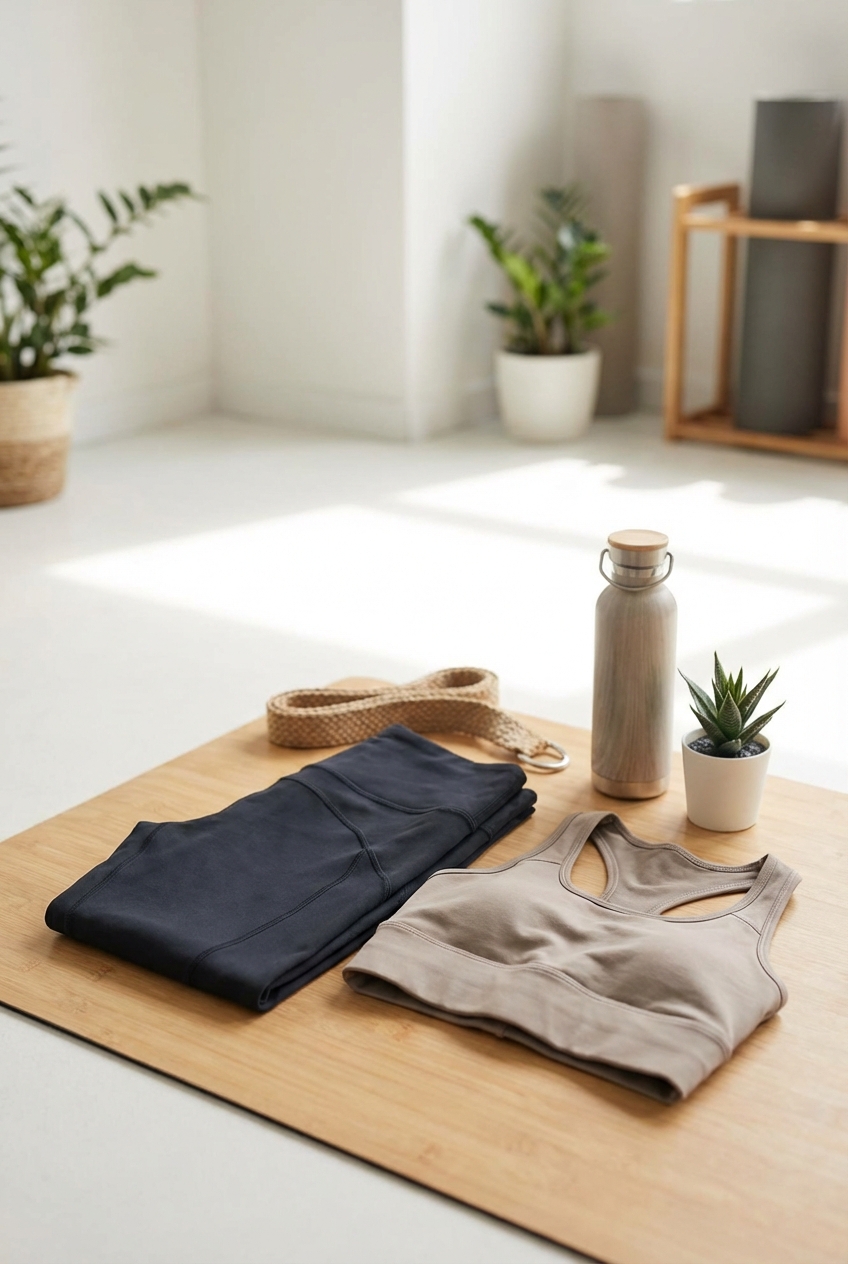
Minimalist Yoga Studio Styles With Sculpted Leggings
Introduction
There is a distinct psychology to dressing for a workout. When you slide into a pair of high-compression, sculpted leggings, you feel held in, streamlined, and ready to move with intention.
That same philosophy must extend to the environment where you practice. A cluttered, chaotic room disrupts the mental clarity we seek in yoga, just as an ill-fitting outfit ruins a good mood. As a fashion expert who treats home design as an extension of a wardrobe, I believe your wellness space should be as curated as your closet.
Designing a minimalist home studio isn’t just about emptying a room; it is about creating a backdrop that highlights the human form and quiets the mind. If you want to see exactly how these elements come together, make sure to browse the inspiring Picture Gallery at the end of the blog post.
The Palette: Curating a “Quiet Luxury” Backdrop
In fashion, we often talk about “quiet luxury”—neutral tones, high-quality materials, and a lack of flashy logos. Your yoga studio walls should follow this same rule.
The goal is to create a seamless envelope that doesn’t compete with your visual focus. If your activewear wardrobe is mostly black or deep navy, a warm “greige” (gray-beige) wall color creates a stunning, gallery-like contrast.
If you prefer pastel or soft-toned leggings, consider a monochromatic look with white-on-white textures. This blurs the boundaries of the room, making small spaces feel infinite.
Designer’s Note: The 60-30-10 Rule
When painting a minimalist space, stick to the classic design ratio.
- 60% Main Color: Your walls (e.g., Benjamin Moore’s “Swiss Coffee” or Farrow & Ball’s “Ammonite”).
- 30% Secondary Color: Your flooring and large furniture (light oak or concrete).
- 10% Accent Color: This is where your yoga mat and props come in. Let your equipment be the “jewelry” of the room.
Common Mistake: The “Clinical White” Trap
Many people assume minimalism means painting everything stark, brilliant white.
The Fix: Always choose a white with warm undertones. Stark white can feel like a hospital under artificial light, which is the opposite of relaxing.
Flooring and Texture: Grounding the Space
In a yoga studio, the floor is the most critical surface because you are constantly in contact with it. Just as you wouldn’t wear scratchy wool directly against your skin, you shouldn’t practice on a surface that feels hostile.
Hardwood is the gold standard for a fashion-forward studio. Wide-plank white oak offers a timeless, airy aesthetic that pairs beautifully with sleek, technical fabrics.
If you are renting or dealing with cold tile, natural cork flooring is an incredible alternative. It is sustainable, sound-absorbent, and warm to the touch.
Real-World Project Tip: Rug Sizing
If you use an area rug to define the zone, size matters.
- Ensure the rug is large enough that you don’t fall off the edge during a flow.
- A standard 5×7 rug is usually too small for a yoga zone once you add a mat.
- Aim for an 8×10 rug to create a luxurious border of at least 24 inches around your yoga mat.
What I’d Do in a Real Project:
For clients with slippery floors, I overlay a thin, non-slip jute rug underneath the rubber yoga mat. This adds an organic, “wabi-sabi” texture that softens the high-tech look of sculpted leggings without sacrificing stability.
Lighting: Mood Setting and Silhouette
Lighting is the “makeup” of interior design. Bad lighting can make a room feel cheap and flat, while good lighting adds depth and drama.
In a yoga space, you never want direct, downward-facing recessed lighting (can lights) directly above your mat. Looking up into a bright bulb while in Savasana is jarring.
Instead, layer your lighting to create a glow that flatters both the architecture and your silhouette.
The Lighting Strategy Checklist:
- Ambient Light: Use dimmable cove lighting or uplighting that bounces off the ceiling.
- Task Light: A floor lamp in the corner with a linen shade provides a soft diffusion.
- Kelvin Temperature: Stick to 2700K to 3000K bulbs. Anything higher (4000K+) looks blue and energetic, which kills the zen vibe.
Designer’s Note: The “Golden Hour” Trick
If you are photographing your progress or streaming classes, place your light source at eye level, not overhead. This eliminates harsh shadows under the eyes and highlights the muscle definition your sculpted leggings are accentuating.
Mirrors: Form, Function, and Illusion
A large mirror is essential for checking your alignment, but it also serves a major spatial function. In small rooms or converted spare bedrooms, a mirror doubles the perceived square footage.
However, a cheap, wavy mirror will distort the image and ruin the aesthetic. You need high-quality glass with a substantial weight.
Placement Rules:
- Width: The mirror should be at least 30 inches wide to capture your full wingspan.
- Height: A floor-leaning mirror (minimum 65 inches tall) is chicer than a wall-mounted one. It feels more like a boutique dressing room.
- Safety: If you lean a mirror, you must anchor it to the wall with a strap, especially if you do inversions nearby.
Common Mistake: The “Funhouse” Effect
Buying frameless stick-on mirror tiles is a design crime. The seams will cut your reflection in half and make the wall look disjointed.
The Fix: Invest in one large, singular pane. If budget is tight, look for “b-stock” mirrors at glass shops or thrifted large frames you can paint matte black.
Storage: Hiding the Visual Noise
Sculpted leggings represent clean lines and smooth surfaces. Your studio storage needs to mimic this. Nothing kills a minimalist vibe faster than a pile of purple blocks, straps, and foam rollers in the corner.
We need “visual silence.” This means everything has a home, and preferably, that home is behind a closed door or inside a beautiful vessel.
Chic Storage Solutions:
- Woven Baskets: A tall, structured seagrass basket can hold rolled mats vertically. This looks intentional and sculptural.
- Floating Credenza: If you have the space, a wall-mounted cabinet keeps the floor clear (crucial for minimalism) while hiding ugly props.
- The “Capsule” Approach: Just as you edit your wardrobe, edit your props. Do you need four different mats? Keep only what you use daily out in the open.
Designer’s Note: Color-Coordinating Props
If your props must be visible, buy them in the same color family as your room. A cork block looks beautiful against a wood floor. A black mat disappears on a dark charcoal floor. Avoid neon props unless they are a deliberate accent.
Biophilic Accents: Bringing Life to Minimalism
Minimalism should not feel dead or sterile. It needs a pulse. In fashion, we add a silk scarf or a leather bag to add texture; in interiors, we add plants.
Biophilic design (design connecting us to nature) reduces cortisol levels. However, a jungle of tiny, messy plants creates clutter.
Go for “architectural” plants with strong lines that mimic the structure of a pose.
Top Plant Picks for Minimalist Studios:
- Snake Plant (Sansevieria): Vertical, structural, and almost unkillable. It cleans the air and requires very little light.
- Ficus Audrey: The minimalist cousin to the Fiddle Leaf Fig. It has a cleaner trunk and velvety leaves.
- XXL Monstera: Use one giant leaf or stem in a vase rather than a bushy plant for a very high-end, editorial look.
What I’d Do in a Real Project:
I always use planters in matte finishes—concrete, terracotta, or matte white ceramic. Glossy pots can catch the light and create distracting glares. The planter should blend into the floor or wall, letting the green of the plant be the star.
Finish & Styling Checklist
Before you roll out your mat, run through this final styling checklist to ensure the space feels cohesive and high-end.
- Scent Scape: Minimalism involves all senses. A stone diffuser with Hinoki or Eucalyptus oil adds an invisible layer of luxury.
- Cable Management: Hide the cords for your speaker or smart device. Use paintable cord covers that run along the baseboard.
- Textural Contrast: If your floor is hard and your walls are smooth, add a boucle or sheepskin throw over a nearby chair to soften the room.
- Negative Space: Leave at least one wall completely empty. Your eyes need a place to rest during balance poses.
- Mat Placement: Center your mat relative to the architecture (e.g., centered on a window or under a ceiling beam), not just randomly in the middle of the room.
FAQs
Q: Can I create a minimalist studio in a carpeted bedroom?
A: Yes, but balance is key. Carpet absorbs energy and can make balancing difficult. I recommend placing a large, rigid bamboo mat or a specialized plywood yoga board over the carpet. Visually, if the carpet is beige/neutral, you are fine. If it is patterned, cover the area with a large, solid-colored canvas drop cloth rug for an industrial-chic look.
Q: How much space do I actually need?
A: You don’t need a whole room. A standard yoga mat is 24″ x 68″. You need at least 2 feet of clearance on all sides to extend your arms without hitting a wall. A 7′ x 7′ footprint is usually sufficient for a functional home practice.
Q: My leggings and gear are colorful. Will that ruin the minimalist look?
A: Not at all. In a neutral, minimalist room, you become the art. Wearing bright, sculpted leggings in a greige room creates a dynamic, high-fashion contrast. The room supports you; it doesn’t compete with you.
Q: What is the best way to clean a yoga space to keep it minimal?
A: Dust is the enemy of minimalism. Use a microfiber dry mop on hard floors daily. For mats, a simple spray of water with a drop of tea tree oil keeps things fresh without adding chemical smells.
Conclusion
Creating a minimalist yoga studio is deeply similar to building a capsule wardrobe. It requires editing, investing in quality basics, and focusing on silhouette and form.
When you strip away the visual noise in your home, you create space for mental clarity. The sleek lines of your sculpted leggings should find their match in the clean lines of your surroundings.
Whether you have a dedicated room or just a curated corner, the principles remain the same: calm colors, intentional lighting, and freedom of movement. It is about crafting a space that makes you feel expensive, grounded, and capable the moment you step onto the mat.
Picture Gallery


