
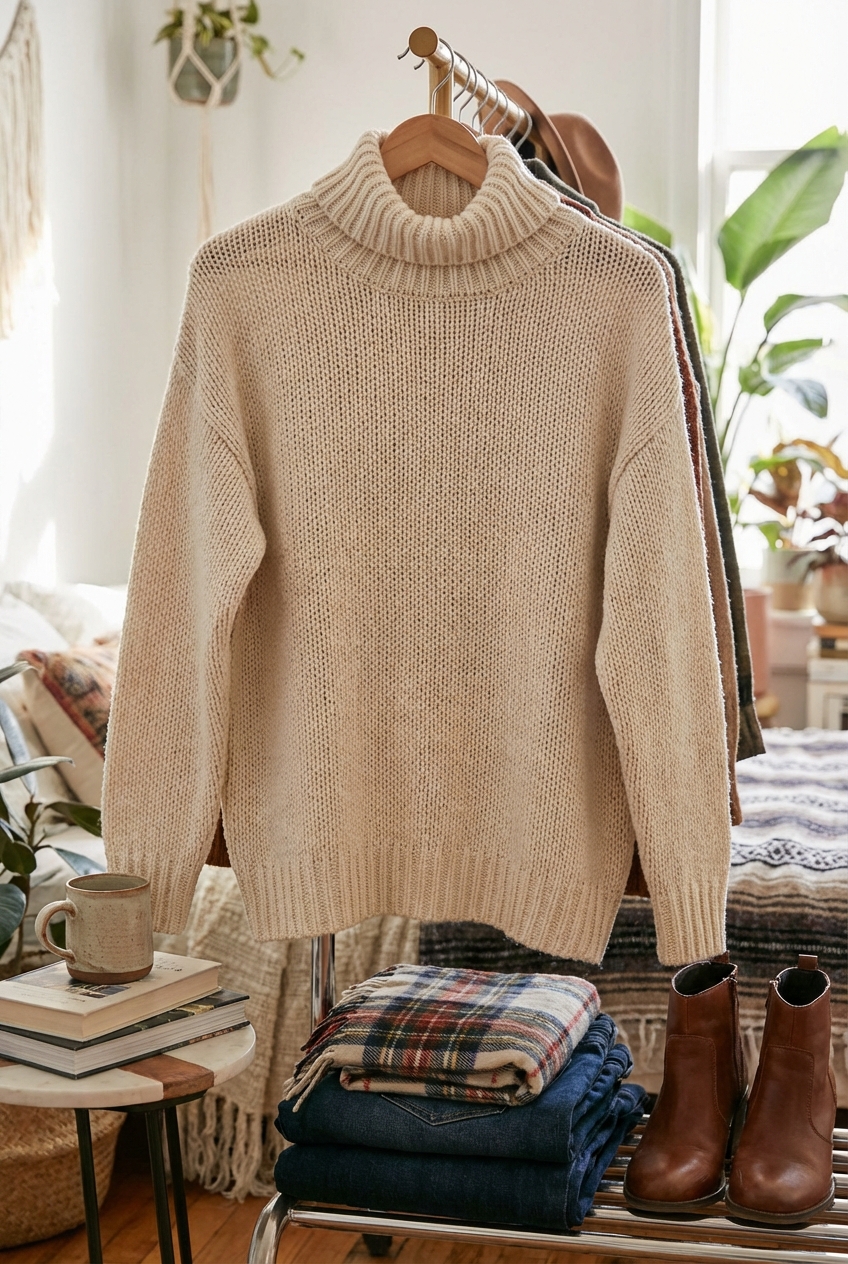
Oversized Turtleneck Sweaters For Winter Layers
There is a distinct tipping point in mid-January when my clients stop asking for “sleek” and start begging for “warm.” We all reach a moment where the idea of a structured blazer feels exhausting, and the only thing that appeals is a knit substantial enough to live in. The oversized turtleneck is that hero piece, but it is surprisingly difficult to style correctly.
I remember styling a winter editorial in Aspen a few years ago where the model was drowning in a chunky cable knit. We had intended for a look of effortless luxury, but because the gauge of the yarn was too thick and the pants were too loose, she looked shapeless rather than chic. It took three styling assistants and a very specific belt tuck to save the silhouette. That experience solidified my approach to heavy knitwear: volume must be managed, not ignored.
The goal is to harness the coziness of the sweater without sacrificing your figure or feeling like you are wearing a sleeping bag. It requires a strategic approach to proportions, fabric selection, and layering mechanics. If you are looking for specific outfit combinations, keep reading, or you can skip straight to the curated Picture Gallery at the end of this blog post.
1. Establishing the Silhouette: The Rule of Volume
The most common mistake I see with oversized turtlenecks is pairing volume with volume without a plan. In high-end fashion styling, we often work with the concept of “opposing forces.” If the top half of the outfit is expansive and loose, the bottom half usually needs to be streamlined to anchor the look.
When you wear a sweater with a heavy drape, you risk losing your vertical lines. To counter this, I usually reach for a slim-leg leather trouser, a fitted cigarette pant, or a straight-leg denim with no break at the ankle. This creates an “inverted triangle” silhouette that flatters almost every body type.
Designer’s Note: The Shoulder Seam
In interior design, we look at architectural lines; in fashion, we look at seams. For an oversized sweater to look expensive rather than just “too big,” pay attention to the shoulder seam.
A true oversized fit should have a “drop shoulder,” where the seam hits about 2 to 3 inches down the upper arm. If the seam sits right on the edge of your shoulder bone but the rest of the sweater is baggy, it looks like you simply bought the wrong size. The drop shoulder indicates intentionality in the design.
Balancing Wide-Leg Bottoms
Can you wear wide-leg trousers with an oversized knit? Yes, but it requires height. If you are petite (under 5’4″), a wide leg paired with a massive sweater will visually compress you. To make this work, I recommend:
- Wearing a heeled boot to add at least 2 inches of height.
- Ensuring the trousers are high-waisted.
- Performing a “front tuck” to reveal the waistline, which we will discuss in detail later.
2. Fabric Composition and “Hand Feel”
Not all oversized sweaters are created equal. The composition of the yarn dictates how the sweater hangs on your body, a quality we call “drape.” When I am shopping for clients, I always check the care tag before I even look at the price or the fit.
You want fibers that have memory and movement. Cheaper synthetics, like 100% acrylic, tend to differ in “loft.” They can be bulky and stiff, meaning they stand away from the body rather than collapsing against it. This adds visual weight to your frame that isn’t actually there.
The Material Hierarchy
Here is what I look for when sourcing knitwear for winter layers:
- Merino Wool: The gold standard for everyday wear. It is thinner than standard wool, regulates temperature incredibly well, and drapes beautifully without adding bulk.
- Cashmere: For oversized fits, look for 2-ply or 4-ply cashmere. It offers warmth without the weight. However, be careful with very loose weaves, as they can snag easily.
- Alpaca blends: Alpaca is warmer than sheep’s wool and has a fluffy, halo-like texture. It is excellent for warmth, but it can be itchy if you have sensitive skin.
Common Mistake: The Weight Trap
Many people assume a heavier sweater is a warmer sweater. This is false. A dense, heavy cotton sweater will not keep you as warm as a lightweight merino wool turtleneck, but it will make layering a coat nearly impossible. Focus on thermal properties, not physical weight.
3. The Mechanics of the Tuck
The difference between a frumpy outfit and a street-style masterpiece is almost always the tuck. With oversized turtlenecks, you cannot simply shove the hem into your waistband; the fabric is too thick, and it will create a bulge that distorts the line of your trousers.
We use specific techniques on set to handle high-gauge knits.
The “French Tuck” (Front Tuck)
This is the standard approach. You grasp the center front of the hem—about 3 to 4 inches of fabric—and tuck it loosely behind the button of your pants. Then, you must blouse it out. Pull the fabric back up slightly so it hangs over the waistband. The sides and back of the sweater should remain untucked. This defines the waist without requiring you to hide the entire hem.
The “Belt Trick”
This is my secret weapon for sweaters that are too long or too thick to tuck into pants.
- Put on the sweater and leave it untucked.
- Fasten a thin belt around your natural waist, over the sweater.
- Pull the sweater upward through the belt until the excess fabric flops over and completely hides the belt.
This crops the sweater to your desired length—usually hitting right at the high hip—without putting any fabric inside your trousers. It is comfortable and stays in place all day.
4. Layering Underneath: The Foundation
An oversized turtleneck allows for substantial layering underneath, which is crucial when temperatures drop below freezing. However, the wrong base layer can cause friction, static, and overheating.
I never recommend wearing a thick cotton t-shirt under a sweater. Cotton holds moisture. If you sweat even a little while rushing to the subway or walking into a heated office, the cotton will stay damp and make you cold.
The Ideal Base Layer
I invariably use silk or modal thermal camisoles for my clients. They are paper-thin but retain body heat effectively. Because the turtleneck is loose, you need a base layer that fits close to the skin to trap that warmth.
The Itch Factor
If you love the look of mohair or coarse wool but hate the itch, you need a long-sleeve “second skin” top. Look for a mock-neck style. This ensures there is a barrier between the wool and your neck, but because it is a mock neck (lower than the turtleneck), it remains invisible.
5. Solving the Coat Dilemma
The single most frustrating aspect of oversized knitwear is trying to put a winter coat over it. We have all experienced the “sausage arm” feeling where your circulation is cut off at the bicep because the sweater sleeve is too thick for the coat sleeve.
When building a winter wardrobe, you need at least one coat specifically designated for your chunky knits. You cannot rely on a tailored, slim-fit wool coat for this task.
What I’d Do in a Real Project
If I am building a capsule wardrobe for a client in a cold climate (like Chicago or Boston), I source a “Cocoon Coat” or an unlined double-faced wool coat with Raglan sleeves.
Why Raglan Sleeves?
Standard sleeves have a seam at the shoulder. Raglan sleeves have a seam that runs diagonally from the collarbone to the underarm. This offers a much wider range of motion and creates a larger armhole, accommodating even the chunkiest cable knit without bunching.
Cape Coats and Ponchos
For a high-fashion alternative, consider a cape coat. It sits over the shoulders and has slits for your arms, completely bypassing the sleeve issue. This is an elegant solution for evening wear or when you want to show off the texture of your sweater sleeves.
6. Accessorizing Heavy Knits
When the sweater is the main event, your accessories need to be scaled accordingly. Delicate chains and tiny stud earrings often get lost in the folds of a massive turtleneck.
Jewelry Scaling
Think bold. A chunky gold hoop earring or a structural statement earring works best because it draws the eye up to the face and competes with the volume of the neck. Avoid long necklaces; they will bounce awkwardly against the knit texture and get caught in the folds. Stick to earrings and rings.
Hair Considerations
This is a detail many overlook. If you have long hair, wearing it down with a giant turtleneck can look messy and cause tangles at the nape of the neck (the dreaded “rats nest”).
I almost always advise a sleek bun, a high pony, or a French twist when wearing a high-volume neck. It elongates the neck, which is otherwise hidden by the sweater, and keeps the look polished.
Bag Selection
Avoid shoulder bags with short straps. They will slide off the rounded shoulder of the sweater constantly. A crossbody bag is practical, but be aware that the strap will crush the loft of the wool across your chest. A top-handle tote or a handheld clutch is often the most chic option for bulky layers.
Finish & Styling Checklist
Before you walk out the door, run through this mental checklist to ensure the look is intentional.
- The Neck Roll: Is the turtleneck folded neatly? If it is too high, it swallows your jawline. Don’t be afraid to fold it inward (inside the neck) for a cleaner line if the outward fold looks too bulky.
- The Hem Check: Does the sweater end at a flattering point? It should generally cut across the hip bone or cover the bum completely. Avoid lengths that stop at the widest part of your hips unless you are doing a front tuck.
- The Lint Check: Dark oversized sweaters are magnets for lint and hair. Keep a travel lint roller in your bag.
- The Shoe Balance: Do your shoes have enough visual weight? If you are wearing a huge sweater and delicate ballet flats, you might look top-heavy. Boots or loafers usually work better.
FAQs
How do I store oversized sweaters so they don’t stretch?
Never hang them. The weight of the knit will pull on the shoulders, leaving you with permanent “hanger bumps” and a stretched-out length. Always fold them. If you are short on drawer space, use canvas storage bins under your bed or on high shelves. I like to fold the arms in, then roll the sweater like a sleeping bag to minimize creases.
How do I fix a snag in a chunky knit?
Do not cut the thread! If you cut it, the whole sweater will unravel. Use a tool called a “snag nabit” (a needle with a textured end) or a simple crochet hook. Push the snag through to the inside of the sweater. Once it is on the interior, you can tie it off or simply leave it. As long as it isn’t visible on the outside, the structural integrity remains.
What if the turtleneck feels like it’s choking me?
This is a common sensory issue. Look for “cowl neck” styles or “funnel neck” styles. A funnel neck stands up on its own without folding over and usually sits slightly away from the skin. It provides the same architectural look as a tight turtleneck without the constriction.
Can I wear a blazer over an oversized turtleneck?
Generally, no. Unless the blazer is specifically cut “oversized” or “dad style,” the arms will be too tight. If you love the blazer look, switch the sweater to a thin-gauge merino turtleneck instead of a chunky knit.
Conclusion
The oversized turtleneck is a winter essential that balances the line between comfort and high fashion. It is one of the few items in our wardrobe that feels like loungewear but, when styled correctly, looks ready for a boardroom or a high-end lunch.
Success lies in the tension between the bulk of the sweater and the sleekness of the rest of your outfit. By paying attention to the material quality (favoring natural wools over synthetics), mastering the French tuck, and solving the coat compatibility issue, you can layer up without losing your sense of style.
Winter fashion shouldn’t be about survival alone. With the right knitwear strategy, you can embrace the cold as an opportunity to play with texture, silhouette, and volume.
Picture Gallery


