
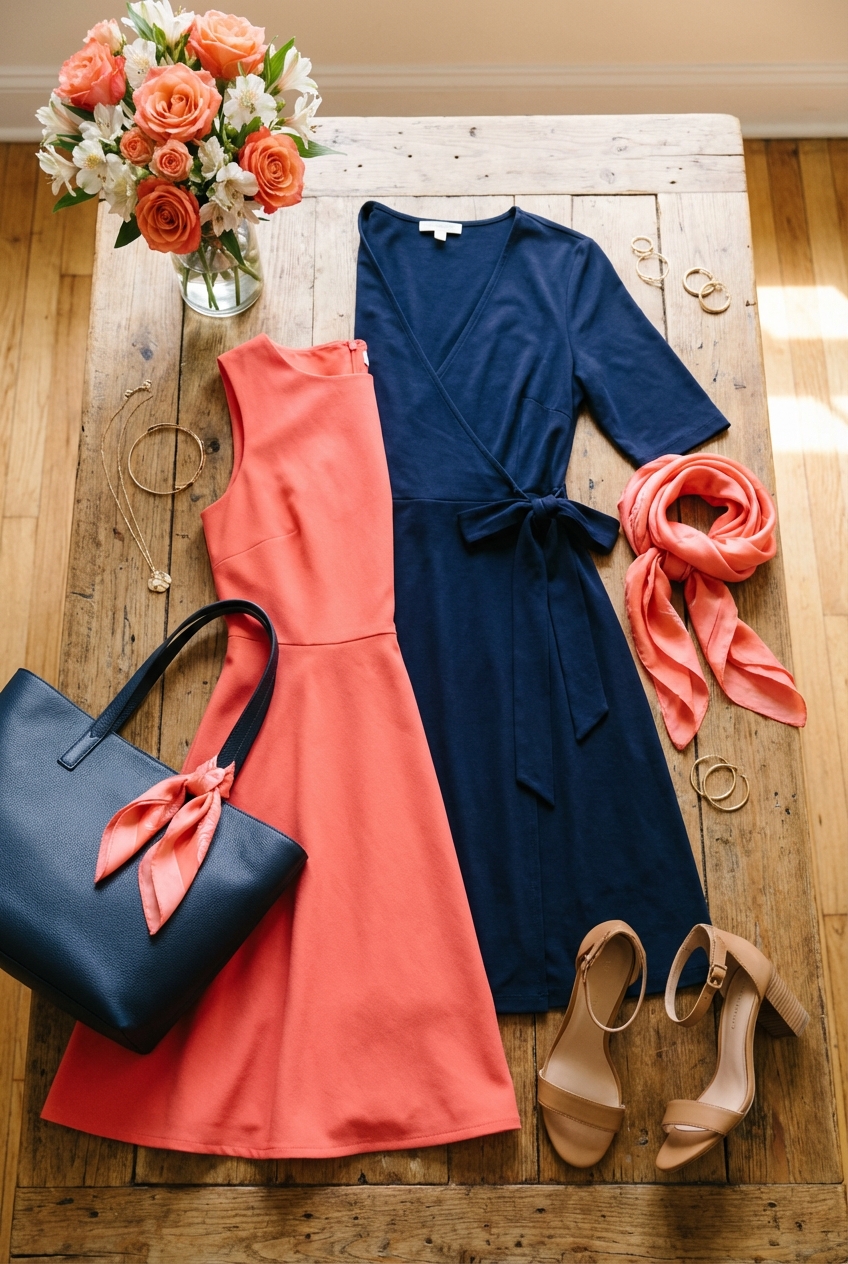
Pairing Navy And Coral In Polished Day Dresses A Bold And Sophisticated Duo
There is a specific kind of magic that happens when you combine a deep, authoritative neutral with a vibrant, spirited accent color. In my years of styling clients for high-stakes daytime events—from charity luncheons to creative boardroom presentations—I have found that few combinations rival the effortless sophistication of navy and coral. It strikes a balance that is difficult to achieve: it is professional without being boring, and feminine without being overly sweet.
Many women gravitate toward black and white as their safety net, but navy offers a softer, more flattering contrast for a wider range of skin tones. When you introduce coral into the mix, you immediately inject a dose of warmth and energy that transforms a standard day dress into a memorable ensemble. The key to mastering this look lies not just in picking the colors, but in understanding the specific saturation levels, fabric textures, and proportions that keep the outfit looking polished rather than costumey.
In this guide, I will walk you through the technical aspects of styling this duo, including fabric weights, accessory scaling, and how to tailor the look to your specific body type. If you are looking for visual inspiration, check out the Picture Gallery at the end of the blog post.
Understanding the Color Theory of Navy and Coral
To pull off this pairing like a professional stylist, you first need to understand why it works on a theoretical level. Navy blue and coral sit nearly opposite each other on the color wheel, creating a complementary relationship. However, unlike the jarring contrast of blue and orange, navy is a shade (blue added to black or grey) and coral is a tint (orange mixed with pink and white). This creates a harmonious tension that is pleasing to the eye.
The success of this pairing depends entirely on undertones. Not all navies are created equal, and neither are corals. If you have a “midnight” navy that reads almost black, it pairs best with a punchy, saturated coral that leans toward tangerine. This high-contrast look is crisp and modern.
Conversely, if your navy is softer—think “marine” or “french navy” with a slight grey cast—you should opt for a coral that leans closer to a soft salmon or pink. Matching the intensity of the colors is crucial. A muddy, muted navy will make a neon coral look cheap, while a sharp, dark navy will drown out a pastel peach.
Designer’s Note: The Lighting Factor
I always tell my clients to check their color combination in natural light before leaving the house. Indoor lighting, especially the fluorescent lighting found in offices, can cast a green hue that makes coral look sickly or brown. Always walk your outfit to a window. If the coral makes your skin look bright and healthy in daylight, you have chosen the right shade.
Choosing the Right Fabrics for Polished Daywear
A “polished” day dress is defined by its material. When working with bold color blocks like navy and coral, the fabric must have enough weight to hold the dye richly and smooth over the body. Flimsy fabrics will make this color combination look like casual beachwear rather than a sophisticated ensemble.
For the navy foundation, I prefer natural fibers or high-quality blends that offer structure. A cotton sateen is excellent for spring and summer; it has a subtle sheen that elevates the navy, making it look expensive. For a more draped look that still retains polish, a silk crepe de chine or a high-quality rayon blend works beautifully, provided it is lined.
When incorporating coral, be wary of cheap polyesters. Coral requires a matte finish to look elegant. Shiny, synthetic coral fabrics tend to reflect light in a way that highlights construction flaws and can appear inexpensive. Linen, matte silk, or a structured ponte knit are your best bets for bringing coral into a polished setting.
Common Mistakes + Fixes
- Mistake: Wearing a jersey knit navy dress with stiff leather coral accessories. The fabric weights clash, making the dress look like pajamas.
- Fix: Upgrade the dress to a structured sheath or A-line in a mid-weight cotton or wool blend. The structure of the dress should match the structure of the accessories.
- Mistake: Choosing a coral fabric that is sheer or unlined.
- Fix: Always ensure your coral elements are opaque. If you fall in love with a sheer coral blouse or skirt overlay, ensure it has a built-in lining in the same shade, not nude or white.
Mastering the Ratio: Who Takes the Lead?
In interior design, we use the 60-30-10 rule, and I apply the exact same logic to fashion styling. You never want a 50/50 split of navy and coral, as this cuts the body in half and looks like a uniform. One color must be the dominant anchor, and the other should be the accent.
For a professional or polished day look, Navy should almost always take the 60% role. A solid navy dress acts as a continuous column of color, which is universally lengthening and slimming. This allows the coral to serve as the 30% or 10% accent, drawing the eye to specific areas you want to highlight.
If you choose a dress that is a print involving both colors, pay attention to the background color. A navy background with a coral floral or geometric print is much easier to style than a coral background with a navy print. The latter can be overwhelming for daytime wear unless you are attending a festive outdoor event like a garden party.
Real-World Styling Scenario
If I am styling a client for a client meeting, I would choose a navy sheath dress (60%). I would add a coral silk scarf tied at the neck and a slim coral belt (10%). The remaining 30% would be neutral accessories, such as nude pumps and a beige trench coat, to ground the look. This keeps the outfit professional but memorable.
Accessorizing Without Overpowering
Accessories are where this color duo truly shines, but they are also where most people make mistakes. Because coral is such a strong color, you must be judicious with your placement. You do not need a coral bag, coral shoes, and coral earrings. That is called “matching,” not “styling.”
When you are wearing a navy dress, choose one major coral accessory and let the rest be neutral. If you carry a structured coral handbag, wear a nude or navy shoe. If you wear a stunning pair of coral suede pumps, keep the bag in a neutral leather like cognac, beige, or navy.
Let’s talk about metallics. The hardware on your accessories plays a massive role in the temperature of the outfit. Gold jewelry warms up the coral and makes the navy look nautical and rich. Silver jewelry cools down the coral, making it look more pink and crisp. For a “polished” day look, I generally lean toward gold hardware, as it bridges the gap between the cool navy and the warm coral.
Designer’s Note: The Shoe Rule
If you are petite (under 5’4″), avoid wearing coral shoes with a navy knee-length dress. The high-contrast break at your feet will shorten your leg line. Instead, opt for a nude shoe that matches your skin tone to extend the leg, and keep the coral accents near your face (necklaces, earrings, or a scarf).
Silhouettes that Elevate the Look
The silhouette of your dress determines the “vibe” of the outfit. Since we are aiming for “polished,” we want cuts that are tailored and intentional. A navy shirt dress is a fantastic canvas for this pairing. The collar and buttons add inherent structure, which balances the playfulness of coral accessories.
The Wrap Dress is another staple. A navy wrap dress is a classic, but you can modernize it by wearing a coral camisole underneath for a peek of color at the neckline. This is subtle and appropriate for conservative environments. Ensure the wrap dress is made of a matte jersey or silk blend that doesn’t cling excessively.
For the most sophisticated look, the Sheath Dress is unrivaled. It should skim the body without being tight. When tailoring a sheath dress, the hemline is critical. For a polished look, the hem should hit exactly at the middle of the knee or just below it. If the dress is too short, the high-contrast color pairing can look juvenile. If it is too long and unstructured, it can look frumpy.
What I’d Do in a Real Project
If I were styling a client with a curvier figure for a summer brunch:
- Base: A navy fit-and-flare dress with a defined waist.
- Accent: A coral statement necklace composed of natural stones or matte beads (adds texture).
- Footwear: A wedge sandal in a cognac leather (bridges the gap between navy and coral).
- Layer: A cropped white denim jacket or a cream cardigan draped over the shoulders to soften the contrast.
Context Matters: From Boardroom to Garden Party
While navy and coral is a versatile duo, the ratio needs to shift depending on where you are going. Understanding the “visual volume” of your outfit is key to fitting in while standing out.
For the Office: Keep the coral minimal. Think of it as a highlighter. A navy suit dress with a coral blouse underneath is powerful. Alternatively, a navy dress with a thin coral belt and simple coral stud earrings is appropriate. Avoid large coral prints or head-to-toe coral in corporate settings, as it can be distracting.
For Social Events: You can turn up the volume here. This is where you can invert the ratio if you dare. A coral dress with a navy blazer draped over the shoulders is chic and spirited. You can also experiment with bolder prints. A large-scale floral print in navy and coral is perfect for a wedding guest look or a high-end lunch date.
For Travel: This combination is excellent for travel capsules because both colors hide stains well (navy) or distract from wrinkles (coral prints). A jersey navy maxi dress paired with a coral pashmina is my go-to airplane outfit. It is comfortable but looks incredibly put-together upon arrival.
Finish & Styling Checklist
Before you walk out the door, run through this quick mental checklist to ensure your look is cohesive and polished.
- Check the Undertones: Does your coral lean orange or pink? Ensure your lipstick and blush are in the same color family. Do not wear cool pink lipstick with warm coral clothes.
- The Third Piece Rule: If you are just wearing a dress and shoes, the look might feel incomplete. Add a “third piece”—a blazer, a belt, a scarf, or a statement cuff—to finish the styling.
- Shoe Condition: Navy and coral is a sharp, clean look. Scuffed shoes or worn-down heels will be immediately noticeable. Ensure your footwear is pristine.
- Fabric Balance: If your dress is matte, add a little shine with patent leather or metallic jewelry. If your dress has a sheen, keep accessories matte.
- Hemline Check: For day dresses, the most polished length is knee-length or midi. Mini skirts in this color combo can look a bit “nautical costume,” so tread carefully with shorter lengths.
FAQs
Can I wear black shoes with a navy and coral outfit?
I generally advise against it. Black can look harsh and heavy against the vibrancy of coral and the depth of navy. Nude, cognac, metallic gold, or even a coordinating navy shoe are much better options that keep the look cohesive.
Is this color combination only for summer?
While it is quintessential for spring and summer, you can transition it into early autumn. To do this, swap bright coral for a deeper “burnt coral” or terracotta shade, and trade the cotton fabrics for wool or heavier knits. The navy anchors it firmly in the cooler months.
I have red hair. Can I still wear coral?
Absolutely. The trick is finding a coral that doesn’t clash with your hair. If your hair is a copper red, look for corals that are more pink-toned to create contrast. If your hair is a strawberry blonde, a punchy orange-coral can look stunning. Use the navy dress to create a buffer between your hair and the coral accents.
What jewelry metal looks best?
Gold is generally the winner here because it complements the warm undertones of the coral. However, if you are wearing a very cool-toned pink-coral and a dark navy, silver or platinum can look very icy and modern.
Conclusion
Pairing navy and coral in polished day dresses is a style strategy that conveys confidence and creativity. It moves away from the safety of all-neutrals without venturing into the chaos of clashing brights. By focusing on high-quality fabrics, maintaining the right 60-30-10 color ratio, and selecting accessories that harmonize rather than compete, you can master this look with ease.
Remember that fashion is about balance. Navy provides the grounding, sophisticated element, while coral brings the joy and personality. When tailored correctly and accessorized thoughtfully, this duo will serve you well from morning meetings to evening aperitifs.
Picture Gallery


