
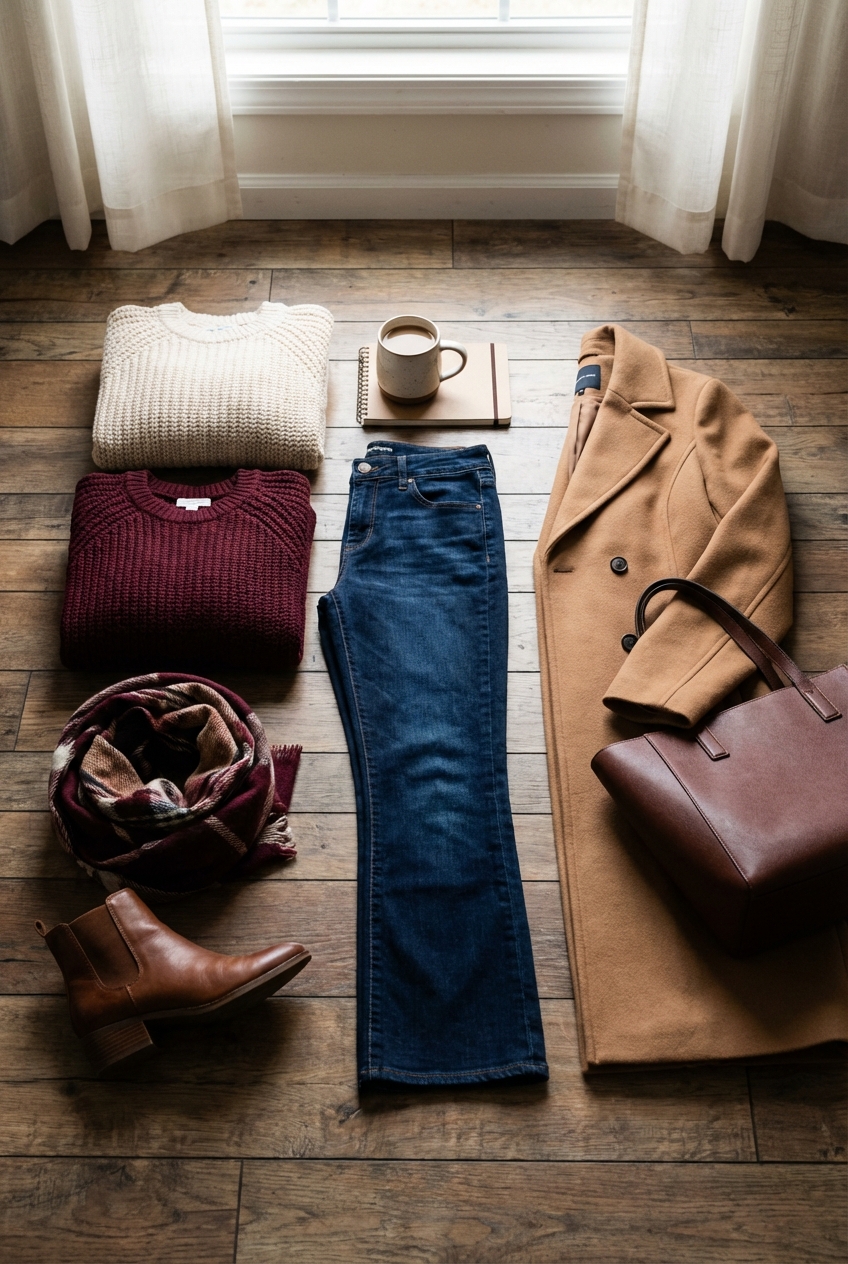
Pear Shape Winter Capsule Wardrobe
Winter styling is notoriously difficult for my clients with pear-shaped figures. We spend the warmer months celebrating curves with waist-cinching dresses, but as soon as the temperature drops, the instinct is to bundle up in heavy layers. Unfortunately, bulk is the enemy of the pear silhouette if it is not placed strategically.
I remember a fitting with a client last November who was convinced she was destined to look shapeless until spring. She kept buying oversized sweaters to cover her hips, which only made her look boxy and wider than she actually was. We stripped her closet down and rebuilt it with just twenty high-quality pieces that emphasized her waist and balanced her proportions.
The transformation wasn’t just physical; it was an immediate confidence shift. A capsule wardrobe isn’t about deprivation; it is about having a highly curated rotation of items that work tirelessly for your specific body type. For plenty of visual inspiration on how to put these looks together, make sure you scroll to the curated Picture Gallery at the end of the blog post.
1. The Architecture of the Pear Silhouette
Before we buy a single sweater, we need to understand the engineering behind dressing a pear shape. In the fashion industry, we view the body as a composition of visual weights. For a pear shape, the hips are the visual anchor.
Our goal is not to hide the hips. Instead, we want to create symmetry by adding visual volume to the upper body and defining the waist. This creates an hourglass illusion.
In winter, this is actually easier to achieve than in summer because we have more fabrics to play with. We can use chunky knits, structured shoulders, and wide lapels to broaden the upper body.
Designer’s Note: The Golden Ratio
When styling a pear shape, I always stick to the “1/3 to 2/3” rule. Your top half (from shoulders to waist) is the 1/3, and your bottom half (waist to floor) is the 2/3. Never cut your body in half visually by wearing a top that ends exactly at the widest part of your hips. It creates a horizontal line that widens you instantly.
2. The Outerwear Investment
For a winter capsule, your coat is the most important piece you will own. You likely wear it every single day. For pear shapes, the cut of the coat dictates the success of the entire outfit.
You need a coat that flares slightly over the hips. A belted wool trench or a wrap coat is the gold standard here. The belt defines the waist, while the skirt of the coat glides over the hips without pulling or bunching.
Avoid straight-cut “man coats” or cocoon shapes. These styles hang from the shoulders and will get stuck on your hips, making the coat look too tight at the bottom and too big at the top.
Common Mistakes + Fixes
- The Mistake: Buying a puffer jacket with an elastic band at the bottom. This creates a “mushroom” effect where the volume puffs out above the hips.
- The Fix: Look for puffer coats with a drawstring waist or a belted silhouette. Ideally, the length should hit mid-thigh, not at the high hip.
- The Mistake: Double-breasted coats that end at the hip. The extra buttons add bulk right where you don’t want it.
- The Fix: If you love double-breasted styles, ensure the coat is knee-length or longer to elongate the vertical line.
3. Strategic Knitwear Selection
Sweaters are tricky. Many standard fits are designed to be boxy, which hides the waist definition we work so hard to create.
I recommend cropping your knits or tucking them in. A sweater that hits at the high hip bone (the iliac crest) is perfect because it highlights the waist while leaving the curve of the hip smooth.
Necklines are your secret weapon. Boat necks, off-the-shoulder cuts, and wide cowls draw the eye horizontally across the shoulders. This widens the top half of your body, balancing out the width of the hips.
What I’d do in a real project:
- Fabric Choice: I avoid thick, stiff cable knits for the bottom hem of a sweater. Instead, I look for cashmere or merino wool blends that drape.
- The French Tuck: If a sweater is too long, I instruct clients to tuck just the front into their waistband. This reveals the leg line and waist while providing coverage in the back.
- Shoulder Details: I actively hunt for sweaters with puff sleeves or embellished shoulders. This draws the eye upward and adds necessary volume to the top half.
4. The Bottom Line: Trousers and Skirts
The goal for bottoms in a winter capsule is elongation. We want to create a long, clean line from the waist to the floor.
Wide-leg trousers are essential for this capsule. They fall straight from the widest part of the hip, masking the exact point where the thigh begins. This creates a streamlined column effect. High-waisted styles are non-negotiable as they anchor the outfit at your smallest point.
For denim, bootcut or flare jeans are mathematically the best choice. The flare at the ankle balances the curve of the hip. If you draw a line from the hip to the hem, a flare creates a balanced hourglass; a skinny jean creates an ice-cream cone shape, emphasizing the hip width.
Designer’s Rules of Thumb for Hemlines:
- Floor Grazing: Wide-leg trousers should break just above the floor, covering most of your shoe. This adds inches to your height.
- Skirt Lengths: A-line skirts should hit just below the knee or at the mid-calf (midi). Avoid hemlines that cut right across the widest part of the calf, as this shortens the leg.
- Fit Check: When fitting clients, I ensure the pockets on trousers lie flat. If they pull open, the pants are too tight across the hips, regardless of what the size tag says. Size up and tailor the waist in.
5. Footwear Function and Form
Winter footwear often ruins a sleek outfit because it adds clunkiness. For a pear shape, the visual transition from pant to shoe needs to be seamless to maintain that vertical line.
I suggest investing in a knee-high leather boot with a structured shaft. These pair beautifully with A-line skirts and dresses. The structure of the boot balances the volume of the skirt.
For trousers, a pointed-toe bootie is vital. A round or square toe can shorten the foot and leg line. A pointed toe extends the visual line of the leg, making you look taller and leaner.
Real-World Constraints:
- Walking in Snow: You can’t wear stilettos on ice. Look for block heels or lug-sole boots. The chunkiness of a lug sole is actually beneficial for pear shapes because it grounds the look and balances wider hips, unlike a delicate kitten heel which might look top-heavy.
- Color Coordination: Match your boots to your pants. Black boots with black trousers create an unbroken line. Cognac boots with dark denim cuts the leg line at the ankle.
6. Color Theory and Textures
Capsule wardrobes rely on mix-and-match efficiency. For a pear shape, color blocking is a highly effective tool.
Keep your bottom half monochromatic and darker. Black, charcoal, navy, and deep chocolate brown are slimming and forgiving in wet winter weather.
Reserve your bright colors, patterns, and heavy textures for the top half. A cream fisherman sweater paired with black wide-leg trousers draws the eye immediately to the upper body. A plaid scarf or a bright beanie does the same work.
Texture Mixing Checklist:
- Top Half: Bouclé, faux fur, chunky cable knits, velvet. These add volume.
- Bottom Half: Wool crepe, gabardine, dark wash denim, matte leather. These absorb light and minimize volume.
- The Exception: If you wear a dress, a continuous print is fine, but belt it to ensure the waist isn’t lost in the pattern.
7. Accessories as Architectural Elements
Accessories are not just decoration; they are tools for directing the eye. In a winter capsule, scarves are your best friend.
A large, chunky scarf wrapped around the neck creates volume at the top, which mimics the effect of a wide collar or broad shoulders. It creates that inverted triangle shape that counteracts the hips.
Statement earrings or a bold hat also serve this purpose. They keep the observer’s focus on your face. Conversely, avoid long shoulder bags that hit right at the hip. The bag adds bulk exactly where we are trying to streamline.
Designer’s Note: Bag Placement
I always advise my pear-shaped clients to switch to a structured top-handle bag or a crossbody bag that sits at the waist (high hip). Never carry a slouchy hobo bag that drags focus down to the thigh area.
Finish & Styling Checklist
Before you walk out the door, run through this mental checklist to ensure your proportions are optimized.
The “Out the Door” Check:
- Waist Definition: Can I see my waist? If not, can I add a belt or do a front tuck?
- Shoulder Width: Do my shoulders look narrower than my hips? If yes, fluff up your scarf or push up your sweater sleeves to add upper-body volume.
- Hemline Logic: Does my coat end at my widest point? If so, leave it open to create a vertical channel down the center.
- Shoe Transition: Is there a gap of skin showing between my boot and pant? If so, wear a taller sock in the same color as the pant to close the gap.
- Verticality: Am I wearing a long necklace or scarf that draws a vertical line down my torso?
FAQs
Can I wear skinny jeans if I am a pear shape?
Yes, but styling is key. Skinny jeans emphasize the hip width because they taper so drastically at the ankle. To balance this, you must wear a chunky boot to add weight to the bottom, and a substantial sweater or blazer on top to broaden the shoulders. Essentially, you are balancing the volume at the top and bottom to make the hips look neutral.
How do I wear oversized blazers without looking frumpy?
The current trend of oversized blazers can be tough for pear shapes. The trick is shoulder pads. You need the blazer to extend beyond your natural shoulder line. Also, ensure the blazer is tailored in at the waist or belted on the outside. If it hangs straight down, it will tent out over your hips and make you look larger.
Are puffer coats off-limits?
Absolutely not. You just need the right construction. Avoid “Michelin Man” horizontal quilting that is evenly spaced. Look for chevron quilting (V-shapes) which draws the eye in, or coats that have a smooth, non-quilted bodice and quilting only on the skirt. Always choose a matte finish over a shiny one, as shine adds visual volume.
What is the best skirt shape for winter?
The A-line skirt is universally flattering. In winter, look for wool or leather A-lines. Avoid bias-cut satin skirts in winter if you are self-conscious about your hips, as static cling and thin fabric can highlight lumps and bumps. A structured wool skirt holds its own shape, skimming over the body rather than clinging to it.
Conclusion
Building a winter capsule wardrobe for a pear shape is about respecting your geometry, not hiding it. By focusing on waist definition, balancing your upper body with texture and volume, and keeping your lower half streamlined, you can embrace winter layers without sacrificing your silhouette.
Remember that these rules are guidelines to help you understand visual balance. Once you master the foundation of the “A-line” logic and the rule of thirds, you can bend the rules to suit your personal style. Fashion should be functional, warm, and above all, make you feel like the most powerful person in the room.
Picture Gallery


