
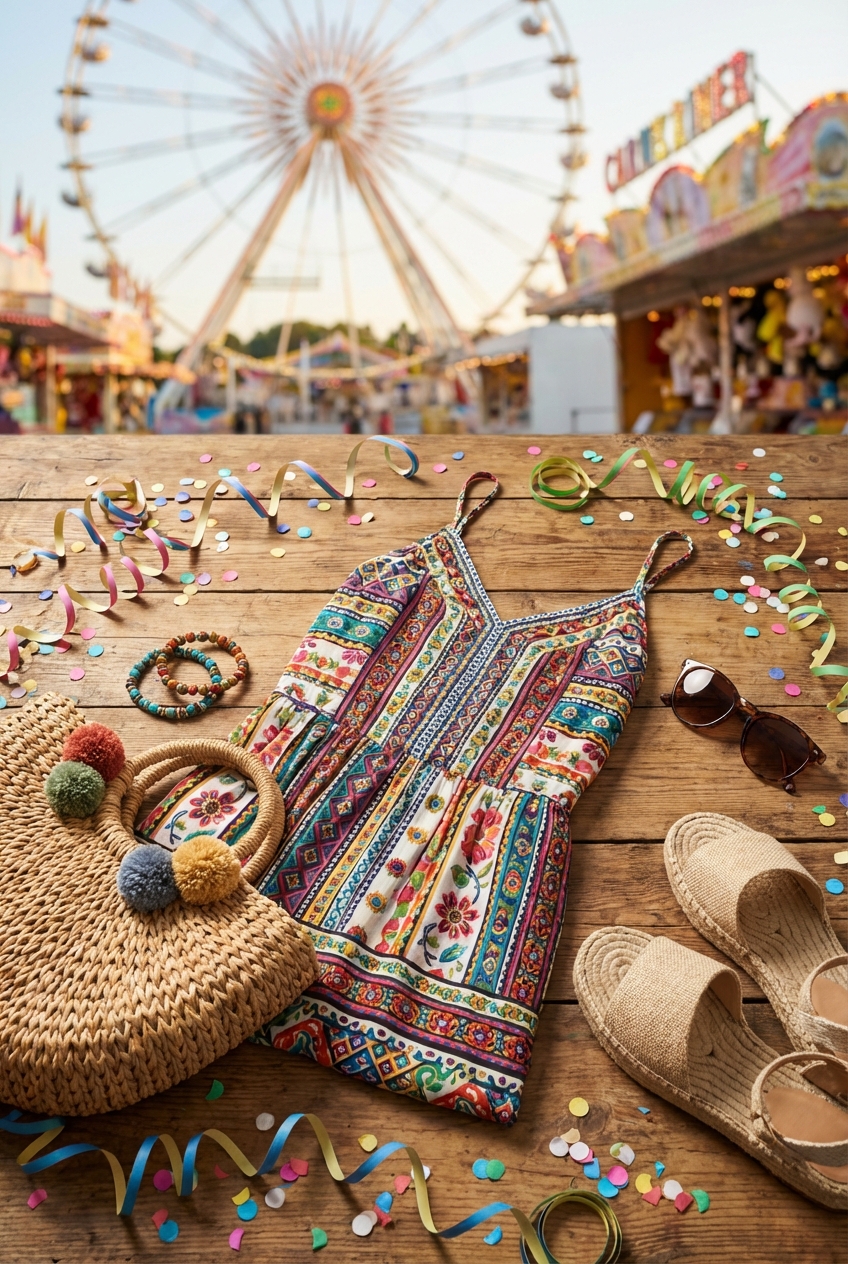
Playful Carnival Looks With Vibrant Patterns Standout Style For A Fun Filled Day
The carnival season is the ultimate playground for high-end fashion enthusiasts who love to experiment. It is one of the few occasions where “too much” is simply not in the vocabulary. The atmosphere demands energy, movement, and a fearless approach to color. When I style clients for outdoor festivals or carnival days, I always tell them that their outfit needs to compete with the lights, the rides, and the crowds.
However, achieving that effortless, editorial look amidst chaos requires strategy. You are not just a mannequin standing still; you are walking miles, navigating crowds, and dealing with fluctuating temperatures. A successful carnival look balances high-impact visuals with extreme practicality. We want the patterns to be vibrant, but the silhouette must allow you to actually enjoy the day.
In this guide, I will break down exactly how to mix bold prints without looking chaotic, choose fabrics that survive the heat, and select footwear that saves your feet without ruining the line of your outfit. If you are looking for specific visual inspiration, make sure to check out our curated Picture Gallery at the end of this blog post. Let’s dive into the mechanics of building a standout look.
The Art of Pattern Mixing: Scale and Proportions
The difference between a high-fashion ensemble and a messy outfit often comes down to the scale of the patterns you choose. When working with vibrant carnival looks, you generally want to mix at least two distinct patterns. The golden rule I use in editorial styling is the “60/30/10” rule, which applies just as much to an outfit as it does to a room.
Sixty percent of your outfit should be a dominant pattern. This is usually a dress, a jumpsuit, or a matching set. The print should be large-scale, such as broad geometric shapes or oversized florals. Because it takes up the most visual real estate, it sets the color palette for the entire look.
The next thirty percent is your secondary pattern. This needs to be a smaller scale to create contrast. If your main piece is a large floral, pair it with a tight gingham, a micro-stripe, or a polka dot. This creates visual friction that looks intentional rather than accidental. This usually comes in the form of a light jacket, a layer underneath a romper, or a substantial accessory.
Designer’s Note: The “Three-Color” Limit
When mixing patterns, beginners often make the mistake of introducing too many new colors. To keep the look cohesive, ensure both patterns share at least one, ideally two, colors. If your primary dress is teal and coral, your secondary stripe pattern should include that same teal or coral. This tricks the eye into seeing the patterns as a set.
Common Mistakes + Fixes
- Mistake: Wearing two patterns of the exact same size (e.g., two medium-sized floral prints).
- Fix: Vary the scale drastically. Pair a palm print (large) with a pinstripe (tiny).
- Mistake: Using two “busy” organic prints together.
- Fix: Balance an organic print (florals, paisleys) with a structured geometric print (stripes, checks, plaids).
Fabric Selection: Breathability and Movement
A carnival is an endurance event. You might be out from noon until midnight. As a stylist, I prioritize fabric composition just as much as the aesthetic. Synthetic fabrics like cheap polyester or heavy acrylics are the enemies of a fun day. They trap heat and hold onto moisture, which ruins the drape of the garment and makes you uncomfortable.
For a vibrant, patterned look, look for cotton poplin or high-quality rayon (viscose). Cotton poplin has a crisp finish that holds vibrant dyes exceptionally well, ensuring your patterns look sharp rather than muddy. It also has enough structure to hold a puff sleeve or a tiered skirt away from the body, allowing for airflow.
Linen is another excellent option, though it creases. For a carnival, I actually embrace the crease. A printed linen hides wrinkles much better than a solid color. If you choose a romper or jumpsuit, ensure the rise (the distance from the crotch seam to the waistband) is long enough. You will be sitting, standing, and walking; a short rise will cut into you and ruin the silhouette.
What I’d Do in a Real Styling Session
If I were dressing a client for Coachella or a local carnival, I would choose a maxi dress in a cotton-silk blend. Here is my checklist for the garment:
- Weight: It must be lightweight but opaque. If I hold my hand behind the fabric, I shouldn’t see my skin.
- Lining: Avoid heavy synthetic linings. If a dress is lined in polyester, it defeats the purpose of the cotton shell. I often cut out cheap linings and recommend wearing a cotton slip instead.
- Fastenings: Zippers must be sturdy. Flimsy invisible zippers often break during active days.
The Footwear Strategy: Elevation Without Pain
Footwear is where most carnival looks fail. You cannot wear a stiletto, and flat sandals often offer zero arch support for eight hours of walking. The goal is to find a shoe that elongates the leg—especially if you are wearing a midi or maxi length—while providing a stable platform.
The best fashion-forward solution is the flatform sandal or a chunky fashion sneaker. A flatform sandal with a cork or rubber sole gives you two to three inches of height but keeps your foot at a nearly flat angle. This protects your arches. Look for straps that are wide and made of soft leather or woven fabric. Thin straps will cut into swelling feet by 4:00 PM.
If you prefer a closed-toe look, a high-top sneaker in a color that complements your print is ideal. It adds a streetwear edge to feminine dresses. Ensure there is a gap of at least one inch between the top of the sneaker and the hem of your skirt to keep the look light.
Designer’s Note: The “Break-In” Rule
Never wear brand-new shoes to a carnival. It is the number one regret I hear. Even high-end designer sneakers need 10 to 12 hours of wear to mold to your foot. If you buy new shoes for the event, wear them around the house with thick socks for a week prior.
Statement Accessories: Function Meets Fashion
When your clothing is heavily patterned, your accessories need to be bold enough to stand out, yet simple enough not to clutter the visual field. We want “architectural” pieces rather than delicate ones. Think chunky resin bangles, oversized hoop earrings, or a structured hat.
The bag you choose is the most critical functional piece. Clutches are impossible for carnivals; you need your hands free for games, food, and rides. A crossbody bag is non-negotiable. However, the strap placement matters. It should sit at your hip, not your waist, to avoid bunching up your dress.
Choose a bag in a solid color that matches the least dominant color in your outfit’s pattern. If your dress is yellow with blue flowers and green leaves, choose a green bag. This “pulls out” the accent color and makes the whole outfit look intentional.
Common Mistakes + Fixes
- Mistake: Wearing long necklaces that swing and tangle.
- Fix: Switch to statement earrings. They draw the eye up to your face and stay out of the way.
- Mistake: Bringing a heavy leather tote.
- Fix: Use a raffia or canvas crossbody. It is lighter and fits the outdoor aesthetic better.
Managing Volume and Silhouette
Vibrant patterns naturally add visual volume to your body. If you are wearing a loud print, the eye perceives it as “larger” than a solid black garment. Therefore, controlling the silhouette is vital to avoid looking like you are wearing a tent.
If you choose a voluminous maxi dress with a bold pattern, define the waist. A belt is your best friend here. A wide woven belt creates an hourglass shape and breaks up the pattern. If the dress is loose and tent-like, ensure it shows some skin elsewhere—either a deep V-neck, a slit in the skirt, or bare arms. You need to show the body underneath the fabric.
Conversely, if you are wearing patterned wide-leg trousers, keep the top relatively fitted. A bodysuit or a cropped tank top balances the volume of the pants. The rule of thumb is “Tight and Loose.” Never do loose on loose with heavy patterns unless you are extremely tall, as it will swallow your frame.
Designer’s Note: Hemlines and Safety
For a carnival, the ideal maxi length is exactly at the ankle bone, not the floor. Floor-dragging hems get filthy within minutes at an outdoor event and are a tripping hazard on rides. When you try on your outfit, do a “squat test.” Can you crouch down without the hem touching the ground? If not, it needs to be hemmed up an inch.
Transitioning from Day to Night
Carnivals often stretch into the evening, and the temperature drop can be significant. Your styling needs to account for this without ruining the look. The “jacket draped over shoulders” look is chic for photos but impractical for actually walking around.
I recommend a denim jacket or a lightweight utility jacket. Denim acts as a neutral. Even with the wildest neon floral print, a vintage-wash denim jacket grounds the look. Alternatively, a brightly colored cardigan that matches the print can be tied around your waist during the day. This adds a layer of texture to your hip area and is ready to be worn when the sun goes down.
If you are wearing a short romper or dress, consider bringing a pair of sheer tights in your bag. They take up almost no space but can save you if the wind picks up. Patterned tights can also be a fun addition if your main outfit is simpler, but with a vibrant pattern look, stick to sheer or fishnet tights to avoid clashing.
Finish & Styling Checklist
Before you head out the door, run through this final check to ensure your look is polished and practical.
- The Squat Test: Can you sit down and stand up easily without the garment riding up or digging in?
- The Shake Test: Jump up and down. Does your top stay in place? Do your shoes feel secure?
- Pattern Balance: Do you have one dominant large-scale print and one smaller accent print?
- Accessory Check: Is your bag hands-free? Are your sunglasses polarized for long sun exposure?
- Fabric Breathability: Are you wearing natural fibers like cotton or linen?
- Emergency Kit: Do you have a blister plaster, a hair tie, and safety pins in your bag?
FAQs
Can I wear black to a carnival?
You absolutely can, but I recommend using black as a base for vibrant patterns. A black background with neon tropical flowers is a very chic, high-contrast look. If you wear solid black, use accessories to bring the carnival vibe—think neon sneakers or a multi-colored headscarf.
What is the best hairstyle for a carnival day?
I always advise against wearing hair completely down if it is long. Wind and sweat will tangle it. A high ponytail with a patterned scrunchie, space buns, or a braid crown are stylish options that keep hair off your neck and stay secure on rides.
How do I mix metals with vibrant prints?
With warm-toned prints (reds, oranges, yellows), gold hardware usually looks best. With cool tones (blues, greens, purples), silver or gunmetal is sleek. However, for a playful carnival look, don’t be afraid to mix metals or skip metal entirely in favor of colorful acrylic or resin jewelry.
Are jumpsuits practical for carnivals?
They are incredibly stylish but pose the “bathroom problem.” If you choose a jumpsuit, ensure it is easy to get in and out of. Avoid designs that zip up the back unless you have a friend to help. Elasticated waists or front buttons are much more practical for all-day wear.
Conclusion
Styling a playful carnival look is about embracing the joy of fashion. It is an opportunity to step outside your usual neutral palette and play with scale, color, and volume. By following the technical rules of pattern mixing and prioritizing high-quality natural fabrics, you can create a look that is visually stunning without feeling like a costume.
Remember that confidence is the final accessory. When you wear vibrant patterns, you are drawing attention to yourself. Stand tall, own the look, and enjoy the energy of the day. The best outfit is one that allows you to live in the moment while looking impeccable.
Picture Gallery


