
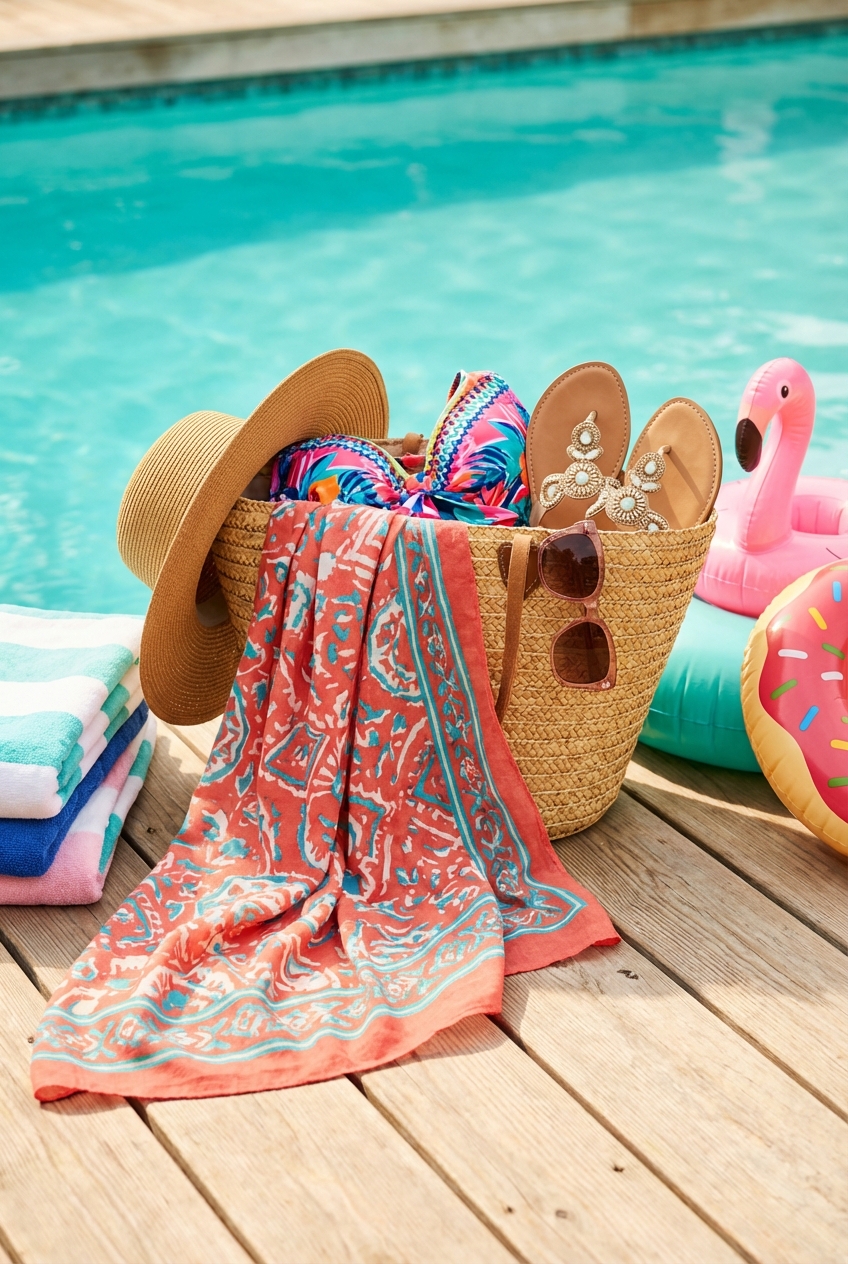
Playful Pool Party Outfits With Statement Sarongs
There is a precise moment when a pool party shifts from a casual swim to a social event, and that transition usually hinges on styling. In my years of styling clients for resort vacations and high-end summer events, I have found that the sarong is the single most underutilized tool in a wardrobe. It bridges the gap between swimwear and ready-to-wear, allowing you to feel dressed up without compromising comfort or practicality.
I remember a specific panic call from a client in the Hamptons who had packed only bikinis and formal dresses, realizing she had nothing for the “casual chic” lunch being hosted right by the water. We improvised with a large silk scarf, tying it into a halter maxi dress. That moment cemented my belief that a statement sarong is not just an accessory; it is a foundational garment that dictates the entire vibe of your look.
When you master the mechanics of wrapping and the art of print mixing, you unlock a level of effortless glamour that is difficult to achieve with traditional cover-ups. I have curated a comprehensive collection of my favorite looks and tying techniques for you to browse in the Picture Gallery at the end of the blog post.
Understanding Fabric Weight and Drape
The success of a statement sarong outfit relies heavily on the physics of the fabric. In fashion styling, we talk about “hand” and “drape,” which refer to how a fabric feels and how it hangs on the body. For a sarong to look expensive and intentional, it must have enough weight to hang straight but be light enough to knot securely.
The Rule of Opacity
If you are attending a party where you will be mingling away from the water, your sarong needs to offer coverage. I always recommend testing the fabric against the light. A high-quality cotton voile or rayon challis provides the best balance. These fabrics breathe in the heat but are opaque enough that you don’t feel exposed while holding a cocktail.
Silk vs. Synthetic
While 100% silk offers the most luxurious sheen, it is incredibly delicate around water and chlorine. For pool parties, I actually prefer high-end synthetic blends or modal. They mimic the luster of silk but are far more durable against splashes and sunscreen oils.
Stylist’s Note: The Volume Equation
A common issue I see is excess bulk at the waist. If you are petite (under 5’4″), avoid heavy terry cloth or thick linen sarongs. They add inches to your midsection when tied. Instead, opt for a chiffon or lightweight crepe that can be knotted tightly without creating a bulge.
The Mechanics of the Perfect Knot
Tying a sarong is architectural. You are essentially creating a garment without seams, so the tension and placement of the knot are critical for both aesthetics and security. A loose knot looks sloppy, while a knot that is too tight can distort the print and create unflattering pulling across the hips.
The Side-Hip Polish
This is the standard for a reason, but the placement matters. The knot should sit exactly on the iliac crest (the hip bone). This elongates the leg line. If you tie it at the true waist, it cuts the torso in half.
1. Hold the top corners of the fabric.
2. Wrap around your back.
3. Bring the ends to your dominant side.
4. Tie a square knot (right over left, left over right) to ensure it lies flat.
The Bandeau Dress Conversion
For a more modest look that transitions to lunch, turn your sarong into a strapless dress. This works best with rectangular sarongs that are at least 66 inches long.
1. Hold the sarong behind your back horizontally.
2. Bring the top corners forward under your armpits.
3. Cross the ends over your chest and tie them securely behind your neck.
4. Use a belt or a second matching fabric strip to cinch the waist for shape.
Common Mistakes + Fixes
Mistake: The “Slipping Slide.” The knot slowly loosens as you walk, requiring constant adjustment.
Fix: Use a sarong buckle or a clear elastic hair tie. Pull the fabric ends through the elastic before knotting. The rubber creates friction that holds the silk or rayon in place, even if the fabric is slippery.
Color Theory and Print Mixing
A “statement” sarong implies bold patterns, vibrant colors, or intricate detailing. The challenge lies in pairing this loud piece with swimwear that complements it rather than competing with it. We use color theory to create visual harmony.
Monochromatic Anchoring
If your sarong features a large-scale tropical print with five or six colors, the safest and most chic route is to pull one of the minor colors for your swimsuit. Avoid matching the dominant color, as this can look too “matchy-matchy.” If the print is green leaves on a pink background, wear a swimsuit in the exact shade of the green leaves.
Scale of Pattern
You can absolutely mix prints (e.g., a striped bikini with a floral sarong), but the scale must be different.
Rule of Thumb: If the sarong has a large, oversized print (blooms larger than your hand), the swimsuit should have a micro-print (polka dots or thin stripes).
Visual Balance: This stops the eye from being overwhelmed and allows the viewer to process the outfit as a whole.
What I’d Do in a Real Project
For a client attending a sunset pool party in Miami:
Sarong: A floor-length, sheer chiffon piece with a geometric Art Deco print in gold and teal.
Swimsuit: A metallic gold one-piece with a deep V-neck.
Why: The metallic suit acts as a neutral against the busy print, while the sheer fabric of the sarong keeps the look airy and appropriate for the humidity.
Proportion Play: Lengths and Silhouettes
The length of your sarong dictates the formality of the outfit. Just as we measure curtain pooling in interior design, we measure hem breaks in fashion. The length should be intentional, not just wherever the fabric happened to fall.
The Mini (Mid-Thigh)
This is the most playful and youthful length. It is perfect for active parties where you might be dipping in and out of the pool.
Best for: Elongating the legs.
Pair with: Wedges or flatform sandals to maximize the leg-lengthening effect.
The Midi (Calf-Length)
This is a tricky length that can cut the leg at the widest part of the calf.
Styling Rule: Ensure the hem hits the narrowest part of your leg, usually just below the knee or just above the ankle bone. Avoid hitting the middle of the calf muscle.
Vibe: Sophisticated and retro, reminiscent of 1950s resort wear.
The Maxi (Floor-Grazing)
This delivers the most drama and is ideal for “poolside cocktails” where swimming is unlikely.
Measurement: Ideally, the hem should hover 0.5 to 1 inch off the ground when you are wearing your chosen shoes.
Warning: Be mindful of tripping hazards. If the fabric is too long, tie the knot tighter or fold the waistband over once before tying to shorten the drop.
Accessorizing Without Clutter
When the sarong is the hero piece, accessories act as the supporting cast. Over-accessorizing can take a look from “high-fashion” to “costume” very quickly. The goal is to elevate the swimwear materials (nylon/spandex) with natural textures and metals.
Jewelry Selection
Water and humidity ruin cheap jewelry. Stick to gold vermeil or solid gold if possible, or high-quality waterproof materials.
Necklaces: If you are wearing a halter swimsuit, skip the necklace. It creates visual clutter near the neck.
Earrings: Statement earrings are fantastic here. A large gold hoop or a raffia drop earring draws the eye up to your face and balances the volume of a maxi sarong.
The Bag and Hat
Natural fibers are the gold standard for pool styling.
Bags: Avoid leather handbags; they look heavy and out of place by the water. Opt for structured wicker, soft raffia, or macramé totes.
Hats: A wide-brimmed straw hat is practical for sun protection and adds a distinct “fashion editor” silhouette. Ensure the color of the straw (cool beige vs. warm wheat) doesn’t clash with the undertones of your sarong.
Footwear: Practicality Meets Style
The wrong shoe can ruin a pool party outfit instantly. I have seen women struggling in stilettos on pool decking or sinking into the grass. It looks uncomfortable and demonstrates a lack of situational awareness.
The Slide Sandal
For a playful, casual look, a leather slide (like an Hermès Oran or similar style) is perfect. It implies luxury without trying too hard. Match the leather color to your skin tone to extend the leg line, or match it to a secondary color in the sarong print.
Espadrilles and Wedges
If you need height—perhaps the sarong is long or you want to adjust your posture—go for a wedge.
Material: Cork or jute soles are thematic for pool parties.
Stability: A wedge provides a flat surface area, making it safe to walk on decking or grass.
Height: Stick to a 3-inch heel or lower. Anything higher feels too aggressive for a swim setting.
Designer’s Note: The “No-Go” List
Velvet or Suede: Water spots will ruin these immediately.
Thin Heel Pumps: Dangerous on wet surfaces and stylistically mismatched with swimwear.
Rubber Flip Flops: Save these for the gym shower. Even a simple leather flip flop is a massive upgrade.
Finish & Styling Checklist
Before you head out the door, run through this mental checklist to ensure your look is polished and practical.
Knot Security: Have you double-knotted or used a buckle? Tug on it gently to ensure it won’t slip.
Opacity Check: Stand in a backlit area (like a window) to check how sheer the sarong is. Are you comfortable with that level of transparency?
Hemline Safety: Walk a few steps. Does the fabric catch under your heel? If so, roll the waist to shorten it.
Sunscreen Guard: Apply your sunscreen 20 minutes before dressing to avoid grease stains on your silk or rayon sarong.
Jewelry Test: Shake your head. Do your earrings get caught in your hair or the sarong ties?
* Coordination: Does your swimsuit bottom color clash with the sarong background? If the sarong slips, the reveal should be cohesive.
FAQs
How do I wash a silk sarong after a pool party?
Dry cleaning is always the safest option for silk. However, if you must hand wash, use cool water and a pH-neutral detergent. Never wring out silk; roll it in a clean white towel to absorb moisture and lay it flat to dry in the shade. Chlorine eats silk fibers, so rinse it immediately if it gets splashed.
Can I wear a sarong if I am plus-size?
Absolutely. In fact, sarongs are one of the most size-inclusive garments available. Look for “pareo” sizes or oversized dimensions (typically 72 inches or wider) to ensure you have enough fabric to wrap fully and tie a secure knot without gaps.
What if my sarong is too long?
Do not cut it unless you can hem it professionally. The easiest fix is to fold the top edge down two or three times before you wrap it around your waist. This creates a makeshift belt and shortens the hem without sewing.
Is it okay to wear a sarong to a hotel bar?
It depends on the resort’s dress code, but generally, yes—if it is styled correctly. A sheer, flimsy sarong looks like beachwear. A higher-quality, opaque sarong tied as a dress or a maxi skirt, paired with nice sandals and jewelry, passes as “resort casual” in most high-end establishments.
How do I stop static cling?
Synthetic sarongs (polyester or chiffon) love static, especially in dry heat. Run a metal hanger over the inside of the fabric before putting it on, or apply a light mist of anti-static spray. In a pinch, moisturizing your legs helps reduce the friction that causes cling.
Conclusion
Embracing the sarong as the centerpiece of your pool party attire changes the way you approach summer dressing. It allows for creativity, comfort, and a level of personalization that a standard kaftan simply cannot offer. By focusing on fabric quality, mastering the knot, and paying attention to the balance of your accessories, you elevate your look from “just swimming” to “resort styling.”
Remember that confidence is the final layer of any outfit. When you know your knot is secure, your colors are cohesive, and your silhouette is balanced, you can focus on enjoying the party rather than fussing with your clothes. Fashion is meant to be functional, and nothing proves that better than a beautifully styled statement sarong.
Picture Gallery


