
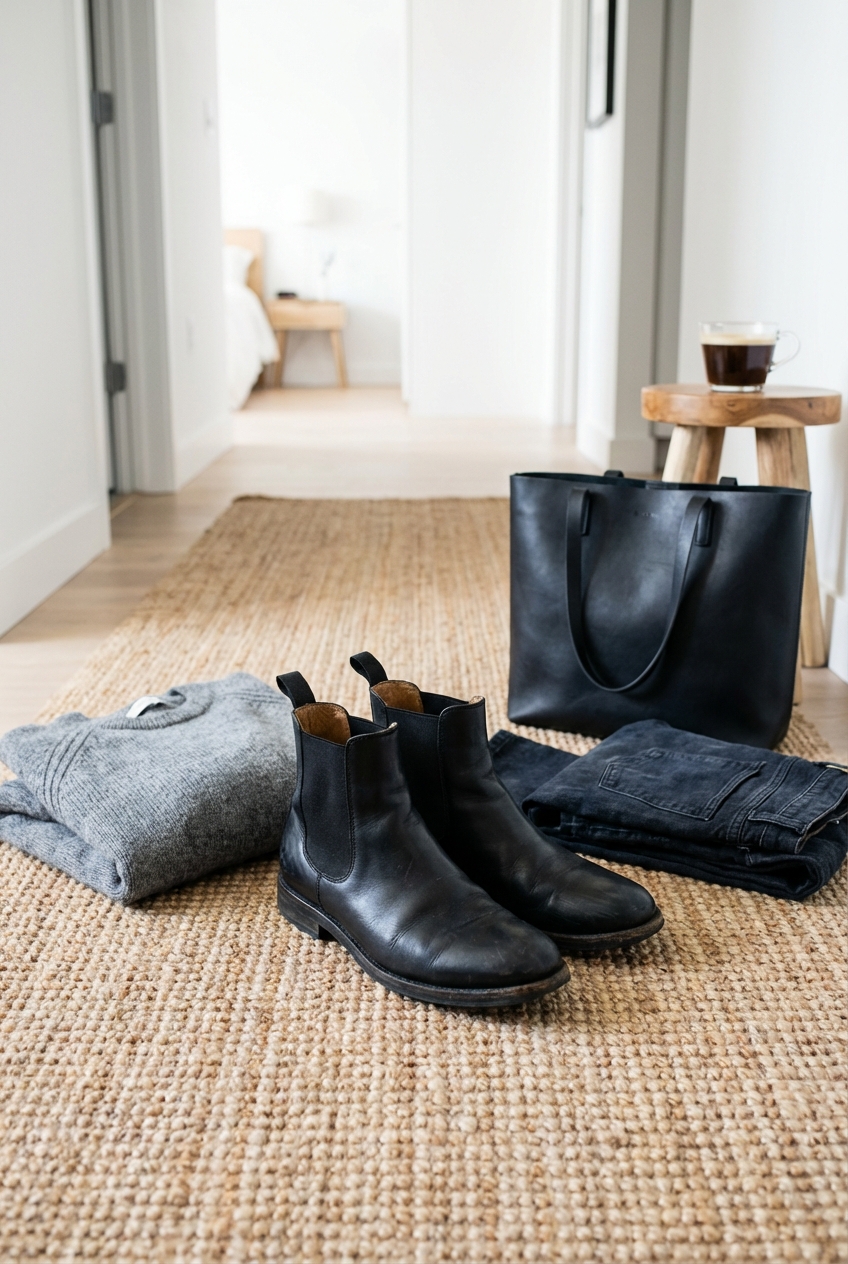
Simple Black Boots For Everyday Wear
Finding the perfect pair of black boots is surprisingly similar to finding the perfect sofa. It is an investment piece that anchors your entire look, needs to withstand daily wear and tear, and must fit your specific lifestyle constraints. I have styled hundreds of clients, and the request for “simple black boots” is the most common yet the most difficult to fulfill because “simple” leaves nowhere for poor quality to hide.
When I am building a wardrobe for a client, I treat black boots as the foundation. If the foundation is shaky, uncomfortable, or disproportionate, the rest of the outfit falls apart. I remember one specific styling session where a client had a closet full of beautiful clothes but nothing to wear because her only boots were sky-high stilettos or beat-up snow boots. We found her a sleek, 2-inch block heel Chelsea boot, and suddenly, thirty outfits unlocked instantly.
This guide goes beyond trends to look at the structural and aesthetic rules of selecting footwear. We will cover the scale of the boot shaft relative to your leg, the physics of comfortable heel pitch, and how to spot leather that will last a decade versus leather that will crack in a month. For visual inspiration on how these principles come together in real life, be sure to scroll all the way down to the Picture Gallery at the end of the blog post.
Analyzing Boot Anatomy and Silhouette
In interior design, we talk about “scale and massing.” In fashion, we talk about silhouette. A simple black boot is defined by its shaft height and its ankle width. This is the most technical part of the purchase and where most people make mistakes. The shaft needs to interact correctly with the hem of your pants or the curvature of your calf.
For everyday wear, the “Goldilocks” shaft height usually hits about one to two inches above the ankle bone. This height is versatile enough to be worn with cropped denim, tucked into skinny jeans, or worn under wide-leg trousers without creating bulk. If the shaft is too low, your pants get caught on the back tab. If it is too high, it cuts off the visual line of the leg, making you look shorter.
You also need to look at the “throat” or the opening of the boot. A wide opening on a skinny ankle creates a “flower pot” effect that can look sloppy. A fitted ankle creates a continuous line, which is universally more flattering. When fitting clients, I always check the gap between the leather and the skin; you should be able to fit one finger comfortably inside the boot shaft, but not two.
Designer’s Note: The Ankle Gap Rule
A common issue I see is boots that are too wide at the ankle being worn with skirts. This visually thickens the leg. If you have narrow ankles, look for boots with elastic gore panels (like Chelsea boots) or functional zippers. These allow the leather to taper tightly against the leg while still allowing you to get your foot in.
Material Selection and Durability
The material of your boot dictates its longevity and its formality. For a “do it all” boot, you generally have three choices: full-grain leather, suede, or synthetic stretch materials. If you are looking for high-intent investment pieces, full-grain leather is the gold standard. It molds to your foot over time, creating a custom fit that synthetics can never replicate.
Full-grain leather is the outermost layer of the hide. It is resistant to moisture and can be polished back to life after a scuff. Bonded leather, often found in cheaper boots, is made of leather scraps glued together. It will peel after a season of heavy walking. If you want these boots to last 5 years, check the material tag.
Suede is beautiful and adds texture, softening an all-black outfit. However, it is high maintenance. I only recommend suede everyday boots for clients who live in dry climates or who are diligent about applying protectant sprays every two weeks. If you live in a rainy city, a polished leather or a patent finish is not just a style choice; it is a functional barrier against the elements.
Common Mistakes + Fixes
- Mistake: Buying smooth leather without checking the grain.
Fix: Press your thumb into the leather. If it wrinkles like your own skin, it is likely good quality. If it stays smooth and feels like plastic, it is heavily coated or synthetic and won’t breathe. - Mistake: Assuming “waterproof” means breathable.
Fix: Rubber rain boots are waterproof but unbreathable for all-day office wear. Look for treated leather with a breathable lining to avoid overheating indoors.
The Physics of Heel Height and Pitch
Comfort is not just about cushioning; it is about physics. The “pitch” of a shoe is the steepness of the angle from the heel to the ball of the foot. You can have a 3-inch heel that feels comfortable because the pitch is gradual, or a 2-inch heel that hurts because the pitch is steep and slides your weight into your toes.
For a true everyday boot that can handle a commute, grocery runs, and a dinner date, I recommend a heel height between 1.5 inches and 2.5 inches. This gives you a slight lift, which helps your posture and pant drape, but keeps your center of gravity stable.
Pay attention to the heel shape as well. A block heel provides surface area. This distributes the impact of each step across a wider zone, reducing fatigue. A stiletto concentrates all impact on a dime-sized point. For everyday wear, a block heel or a “Cuban” heel (which tapers slightly) offers the best balance of style and stability.
What I’d do in a real project:
If I am shopping for a client who walks to work, I prioritize a rubber or lug sole over a leather sole. Leather soles are chic but slippery and have zero shock absorption. A rubber lug sole absorbs the impact of concrete. If the client loves a boot with a leather sole, I immediately send it to a cobbler to have a thin rubber “Topy” or protective sole added before they ever wear them outside.
Toe Shape and Timelessness
Toe shape is where trends cycle the fastest, but for a staple boot, we want longevity. We want a shape that won’t look dated in two years. Currently, square toes are trendy, but an almond toe or a soft point is timeless.
An almond toe mimics the natural shape of the foot but slightly refined. It elongates the leg line without pinching the toes. If you have wide feet, an almond toe or a square toe is significantly more comfortable than a pointed toe.
A pointed toe is the most “high fashion” and creates the longest leg line. It looks fantastic peeking out from under wide-leg trousers. However, it adds length to the foot. If you wear a size 9 or larger, a very pointed toe can make your feet look disproportionately long. In that case, a “chisel toe” (a square tip with tapered sides) is a great compromise.
Pro-Level Rule of Thumb:
When trying on boots, wiggle your toes. You should be able to move them freely. If they are squashed from the sides, the toe box is too narrow. No amount of “breaking in” will fix a narrow toe box; it will only lead to pain.
Styling Ratios and Hemlines
The interaction between your boot and your pant hem is the difference between looking polished and looking messy. This is all about proportion control. We want to avoid the “bunching” effect where the pants hit the top of the boot and crumple.
The Cropped Pant:
With a cropped straight-leg jean or trouser, the hem should end about 1 inch above the top of the boot shaft. This shows a sliver of skin (or a fun sock), highlighting the narrowest part of your leg. If the pants overlap the boot slightly, that is okay, provided the pant leg is wider than the boot shaft.
The Skinny Jean:
While Gen Z debates the skinny jean, it remains a practical staple for tucking into boots. The key here is the ankle fit we discussed earlier. The boot must be wider than the jean encased ankle. If the boot is tight and the jeans are bunching over it, it ruins the silhouette.
The Midi Skirt:
This is my favorite combination for fall and winter. The boot shaft should disappear under the skirt hem, or there should be a visible gap of skin. Avoid the hem hitting exactly at the top of the boot, as this creates a distracting visual line that breaks the flow of the outfit.
Hardware and Details
“Simple” does not have to mean boring, but hardware can date a boot quickly. Excessive buckles, studs, or chains often push a boot into a specific style category (like biker or western) that limits versatility.
For a true everyday boot, look for minimal hardware. A simple zipper in gold, silver, or gunmetal is sufficient. If there is a buckle, ensure it is functional or extremely subtle. The goal is for the boot to be a chameleon.
Pay attention to the zipper placement. A back zipper is sleek and modern but can be uncomfortable on the heel tendon if not lined properly. A side zipper is classic. Elastic gore panels (Chelsea style) eliminate hardware entirely, offering the cleanest, most modern look.
Designer’s Note on Finishes:
Gold hardware forces you to coordinate with gold jewelry; silver forces silver. If you want maximum versatility, choose a boot with “blind” hardware (black zippers) or covered zippers so you never have to worry about mixing metals in the rest of your outfit.
Breaking In and Maintenance
Even the most expensive, perfectly fitted boots require a break-in period. Leather is a natural skin; it needs heat and movement to soften. Do not wear your new boots for a 10-hour day immediately.
Start by wearing them for one to two hours around the house with thick socks. This warms up the leather and starts the molding process without the pressure of a commute. Focus on the heel and the flex point across the toes. These are the high-friction areas.
Maintenance is what keeps a black boot looking “high-end.” Scuffed, grey-looking leather ruins the aesthetic. I tell my clients to buy a small jar of black shoe cream (not just wax polish) when they buy the boots. Cream moisturizes the leather while restoring color.
The “Renovation” Schedule:
- Weekly: Wipe off dust and street salt with a damp cloth. Salt will eat through leather stitching.
- Monthly: Apply a leather conditioner.
- Seasonally: Check the heel caps (the little plastic bit at the bottom of the heel). If the metal nail is showing, take them to a cobbler immediately. Walking on the metal nail damages the heel block structure, turning a $20 repair into a $100 repair.
Finish & Styling Checklist
Before you commit to a purchase, run through this mental checklist to ensure the boots meet the “everyday” criteria.
Shaft Height: Does it hit 1-2 inches above the ankle bone?
Ankle Fit: Can I fit one finger in the shaft, but not two?
Heel Pitch: Is the heel under 3 inches with a stable base?
Sole Construction: Is there rubber or texture for grip?
Material: Is it full-grain leather or high-quality suede?
Toe Box: Can I wiggle my toes freely?
Hardware: Is the hardware minimal enough to match my entire wardrobe?
Flexibility: Does the sole flex when I walk, or is it rigid?
FAQs
Q: Can I wear black boots with brown or navy outfits?
A: Absolutely. The old rule of “no black and brown” is dead. Black boots anchor a camel coat or brown trousers beautifully. It looks intentional and chic. To tie it together, try to have one other black element in the outfit, like a belt, bag, or even black buttons on a coat.
Q: Should I size up in boots to wear thick socks?
A: Generally, yes, go up half a size. Boots are enclosed environments; if they are too tight, air cannot circulate, and your feet will actually get colder. A half-size up allows for a wool sock, which provides insulation and cushioning.
Q: How do I store my boots in the off-season?
A: Never store leather boots in plastic bags; they need to breathe. Stuff the toes with acid-free tissue paper or use boot shapers to prevent the leather from collapsing and creasing. Store them in a dust bag in a cool, dark place to prevent the leather from drying out.
Q: What is the most durable type of heel?
A: A stacked leather heel with a rubber cap is very durable. However, a solid rubber block heel is virtually indestructible. Avoid leather-wrapped heels for everyday wear if you walk on grates or cobblestones, as the leather wrapping will tear easily.
Conclusion
A simple black boot is the workhorse of the modern wardrobe. It bridges the gap between the sharpness of a heel and the comfort of a sneaker. By focusing on the architecture of the boot—the shaft height, the heel pitch, and the quality of the leather—you move past impulse buying and into curating a wardrobe that serves you.
Remember that quality footwear is an investment in your daily comfort. It is better to have one pair of perfectly fitting, high-quality black boots that you maintain for years than five pairs of cheap boots that hurt your feet and fall apart by February. Take the time to measure, assess the fit, and break them in properly. Your feet (and your outfits) will thank you.
Picture Gallery


