
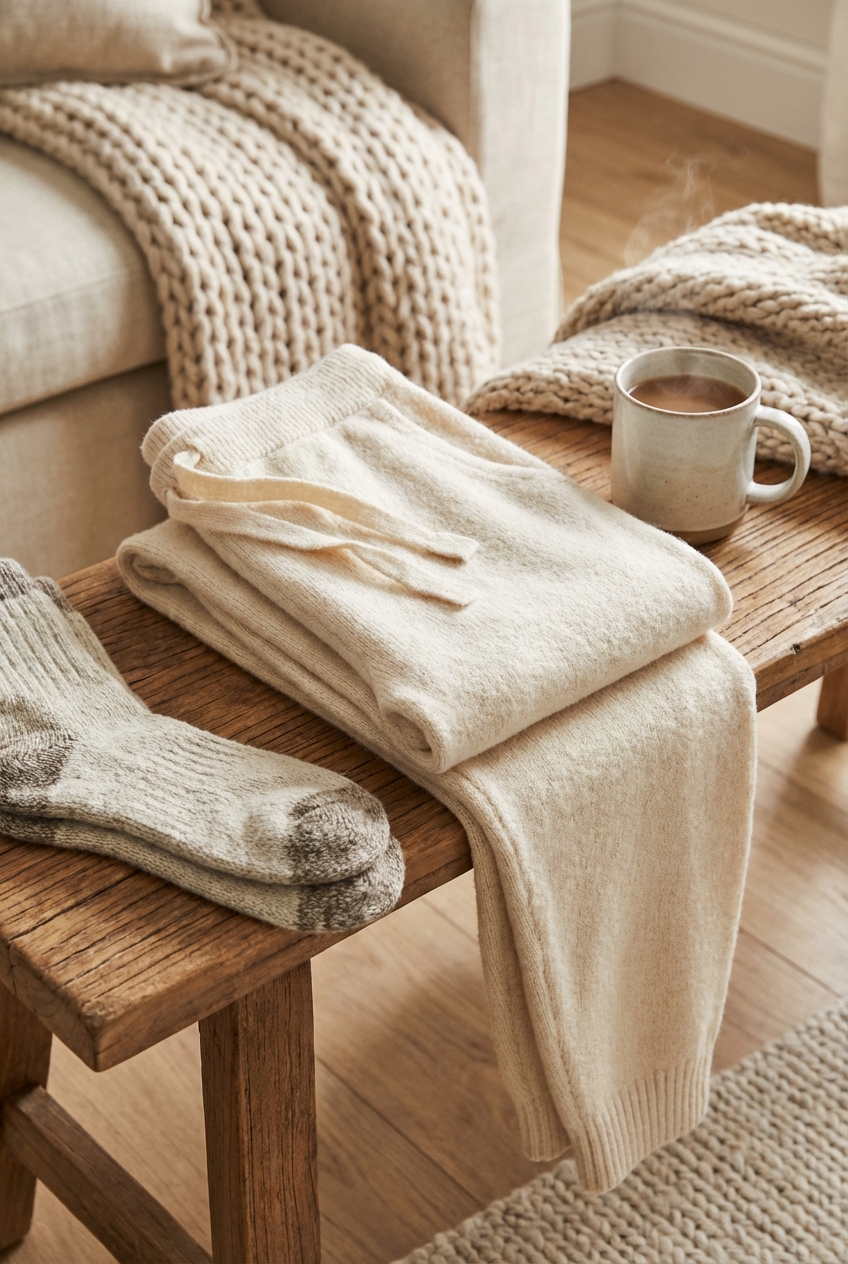
Soft Knit Joggers For Indoor Winter Comfort
There is a distinct shift in the air when winter truly settles in. As the days grow shorter and the temperatures drop, our wardrobe needs undergo a fundamental transformation. We move from the structured, outward-facing garments of autumn into pieces that prioritize personal solace and warmth. However, moving toward comfort does not mean abandoning style. In my years styling high-end wardrobes, I have found that the humble knit jogger is the most critical bridge between luxury and leisure.
I remember a specific consultation with a client who worked from home. She confessed that she spent her winters in old, oversized sweatpants that made her feel sluggish and unpolished. We completely overhauled her loungewear drawer, replacing worn-out cotton fleece with elevated cashmere and modal blends. The change in her demeanor was instant. She felt dressed enough to answer the door or take a video call, yet comfortable enough to curl up on her velvet chaise with a book.
The key lies in selecting the right textiles and understanding the silhouette. Soft knit joggers should drape elegantly, mimicking the line of a trouser while providing the tactile satisfaction of a blanket. If you want to visualize these styling concepts immediately, feel free to scroll down to the Picture Gallery at the end of the blog post.
Understanding the Fabric Science
The primary difference between a “sweatpant” and an “elevated knit jogger” is entirely in the fabrication. When you are looking for winter comfort that reads as expensive and chic, you must look at the fiber content label before anything else. Standard cotton-polyester fleece has its place, but for high-end indoor comfort, we want fibers that regulate temperature and offer a sophisticated hand-feel.
Cashmere is obviously the gold standard. For joggers, look for 2-ply cashmere, which offers a denser weave and higher durability than single-ply. It provides incredible warmth without bulk. However, it requires careful maintenance. If you have pets or small children, 100% cashmere pants can be a risky investment due to the ease of snagging and the difficulty of cleaning.
For a more practical but equally luxurious option, seek out Merino wool blends or Modal hybrids. Merino wool is naturally antimicrobial and temperature-regulating. It wicks moisture away from the skin, preventing that clammy feeling that can happen with synthetic fleeces. Modal, a semi-synthetic derived from beech trees, adds a silky drape and incredible softness. A blend of Cotton (50%), Modal (45%), and Spandex (5%) is often the “sweet spot” for durability, drape, and comfort.
Designer’s Note: The “Hand-Feel” Trap
A common issue I see is clients buying knits based solely on how fluffy they feel in the store. Manufacturers often coat inferior acrylic yarns with softeners that wash out after two cycles, leaving you with a scratchy, pilling garment. Always squeeze the fabric. If it feels “squeaky” or overly shiny, it is likely low-grade acrylic. True quality knits feel dry, dense, and cool to the touch before they warm up against your skin.
The Silhouette and Fit Mechanics
The fit of a knit jogger is arguably more difficult to nail than a tailored wool trouser because you don’t have structure to hide behind. The fabric clings and drapes, so the cut must be intentional. The goal is “slouchy,” not “sloppy.” This distinction comes down to three measurements: the rise, the thigh release, and the hem break.
First, the rise. For winter comfort, a high-rise waist (sitting at or just above the navel) is non-negotiable. It creates a seamless line and ensures your lower back stays warm when you are sitting or bending. A wide, flat waistband—preferably ribbed with a drawstring—is superior to a gathered elastic band. Gathered bands add unnecessary bulk to the midsection, whereas a flat knit band smooths the silhouette.
Next is the leg shape. You want a tapered leg that follows the line of the body without hugging the calf too tightly. If the calf is too tight, the pants will ride up every time you sit down, forcing you to constantly tug them down. There should be at least 1 to 1.5 inches of ease fabric on either side of your calf muscle.
Common Mistakes + Fixes
- Mistake: Buying joggers that are too long, causing the fabric to pool heavily at the ankle.
- Fix: The cuff of the jogger should hit exactly at the ankle bone. If there is too much fabric puddling above the cuff, it ruins the line and makes you look shorter. Look for “petite” or “tall” sizing specifically for inseam length, or take them to a tailor who handles knits.
- Mistake: Choosing a cuff that is too loose.
- Fix: The cuff should have good recovery (elasticity). It needs to grip the ankle gently to create that balloon effect in the leg. If the cuff is loose, the pant just looks like a short straight-leg trouser.
Color Theory for Loungewear
When curating a winter indoor wardrobe, color plays a massive role in how the garment makes you feel. While grey and black are practical standards, they can sometimes feel utilitarian. To elevate the look, I encourage clients to explore “New Neutrals” and monochromatic tonal dressing.
Oatmeal, camel, ecru, and rich cocoa tones immediately make knitwear look more expensive. These warm neutrals reflect indoor lighting beautifully and create a sense of calm. If you are worried about stains, opt for heathered versions of these colors. A heathered oatmeal yarn hides lint and minor spots much better than a solid flat cream.
For those who prefer color, look to deep, saturated jewel tones. Navy, forest green, and burgundy are excellent choices for winter. They feel cozy and seasonal but are dark enough to be slimming and forgiving. Avoid bright, primary colors (fire engine red, royal blue) for joggers, as these tend to look like athletic team gear rather than luxury loungewear.
What I’d do in a real project: The Monochromatic Rule
When I style a client for a “winter weekend” capsule, I always pair the joggers with a matching top. A cohesive column of color elongates the body and looks like an intentional outfit rather than something you threw on.
- The Look: Charcoal cashmere joggers + Charcoal oversized turtleneck.
- The Detail: Break up the texture. If the pants are a flat knit, choose a ribbed or cable-knit top in the same color.
Layering and Styling for “At-Home” Hosting
The true test of a great pair of knit joggers is versatility. Can you wear them while watching a movie? Yes. Can you wear them when neighbors drop by for an impromptu glass of wine? You should be able to. The bridge between these two scenarios is styling.
To dress up a knit jogger, focus on contrasting textures. Since the pants are soft and matte, pair them with something that has a bit of sheen or structure. A silk camisole worn under a chunky open cardigan creates a beautiful juxtaposition. The silk elevates the look, while the cardigan keeps it grounded in comfort.
Jewelry is another tool. Small gold hoops or a delicate pendant necklace can signal that you are “dressed” without compromising comfort. Avoid heavy statement pieces, which feel out of place with loungewear.
Footwear is the final touch. For indoor comfort, you obviously aren’t wearing heels. However, avoid dirty athletic sneakers or oversized novelty slippers. Opt for shearling-lined slides, velvet loafers, or high-end structured slippers in leather or suede. This keeps the visual line neat and tidy.
Longevity and Care: Protecting Your Investment
High-quality knits are delicate. Friction is the enemy. The inner thighs of joggers are high-friction areas, which means pilling is inevitable, even with expensive cashmere. This is not necessarily a sign of bad quality; it is simply the nature of natural fibers rubbing together.
To maintain your joggers, you must own a fabric shaver or a cashmere comb. Do not pull pills off by hand, as this pulls the fiber loose and creates more pilling. Run the shaver lightly over the friction areas once every few wears to keep the surface smooth.
Washing is critical. Heat destroys elasticity. Spandex and elastane, which give your joggers their shape, break down in high heat. Never put your knit joggers in the dryer, even on low. The tumbling action combined with heat will shrink the inseam and cause the waistband to ripple.
The Wash Routine Checklist
- Turn the joggers inside out to protect the outer face from abrasion.
- Use a mesh laundry bag. This prevents the legs from getting tangled and stretched around the agitator.
- Wash on a cold, delicate cycle with a wool-specific detergent (pH neutral).
- Lay flat to dry on a drying rack. Do not hang them wet; the weight of the water will stretch the fabric lengthwise, ruining the fit.
Navigating Price Points and Value
Is it worth spending $200 on pants you wear inside? In my professional opinion, yes—if you look at “cost per wear.” We often spend hundreds on a dress we wear to two weddings a year, yet hesitate to spend money on the pants we wear for four hours every single evening.
If you wear a pair of joggers 150 days a year, a $150 investment works out to a dollar a day for superior comfort. Cheaper synthetic joggers ($20-$40 range) often trap heat, causing you to sweat, and they tend to lose their shape at the knees within a month (the dreaded “knee bags”).
However, you don’t always have to buy designer labels. Many mid-range brands specialize in basics and offer excellent cotton-modal blends. Look for details that signal quality construction, such as reinforced seams at the crotch (a gusset) which prevents tearing, and pockets that are anchored to the waistband so they don’t bunch up inside the pant.
Finish & Styling Checklist
Before you finalize your winter loungewear purchase or style your look for the evening, run through this quick mental checklist to ensure you have hit the mark on both comfort and style.
- Fabric Check: Is the blend at least 50% natural fiber (Cotton, Wool, Modal)? Avoid 100% Polyester/Acrylic.
- The Opacity Test: Bend the knee fully. does the fabric sheer out and show skin? If so, it is too thin for winter warmth.
- Waistband Logic: Is the waistband wide and flat? Avoid thin elastic bands that dig in.
- Length Logic: Does the cuff hit the ankle bone? If it drags on the floor, it needs hemming.
- Color Coordination: Do you have a top in a similar tonal family to create a “set” look?
- Hardware Inspection: Are the drawstring tips metal or plastic? Metal tips (aglets) generally indicate higher quality construction and won’t fray in the wash.
- Pocket Placement: Do the side pockets lay flat against the hip? If they gape open when you stand still, the pants are likely too tight across the hips.
FAQs
Q: How do I stop my knit joggers from getting “baggy knees” after sitting for an hour?
A: This is known as “recovery.” Fabrics with a small percentage of Spandex or Elastane (2-5%) have better memory than 100% cotton or wool. If you buy 100% natural fibers, knee bagging is almost unavoidable between washes. Look for blends with stretch for better shape retention.
Q: Can I wear knit joggers out of the house for errands?
A: Absolutely, provided the styling is intentional. Swap your slippers for a clean white leather sneaker or a combat boot. Throw on a structured wool coat (specifically a longline coat) over your matching set. The structure of the coat balances the softness of the pants.
Q: My wool joggers are itchy. Is there a fix?
A: If the itch is mild, soaking them in a bath of tepid water and hair conditioner (or specialized wool conditioner) can soften the fibers. However, if you have sensitive skin, it is better to switch to Modal, Bamboo, or Cashmere blends, as coarse wool scales will always cause some irritation.
Q: What is the best weight for winter joggers?
A: Look for fabric weights described as “mid-weight” or roughly 250-300 GSM (grams per square meter). Anything under 200 GSM is usually t-shirt weight and won’t provide enough insulation for winter draftiness.
Conclusion
Embracing soft knit joggers for the winter season is not about giving up on style; it is about refining your downtime. By choosing high-quality materials like cashmere, merino, and modal, and paying close attention to fit and silhouette, you create a home environment that feels luxurious and restorative.
The clothes we wear in our private spaces affect our mood just as much as the clothes we wear to the office. Investing in pieces that feel wonderful against the skin and drape beautifully on the body is an act of self-care. As the temperatures drop, there is no greater luxury than knowing you are perfectly dressed for the warmth of home.
Picture Gallery


