
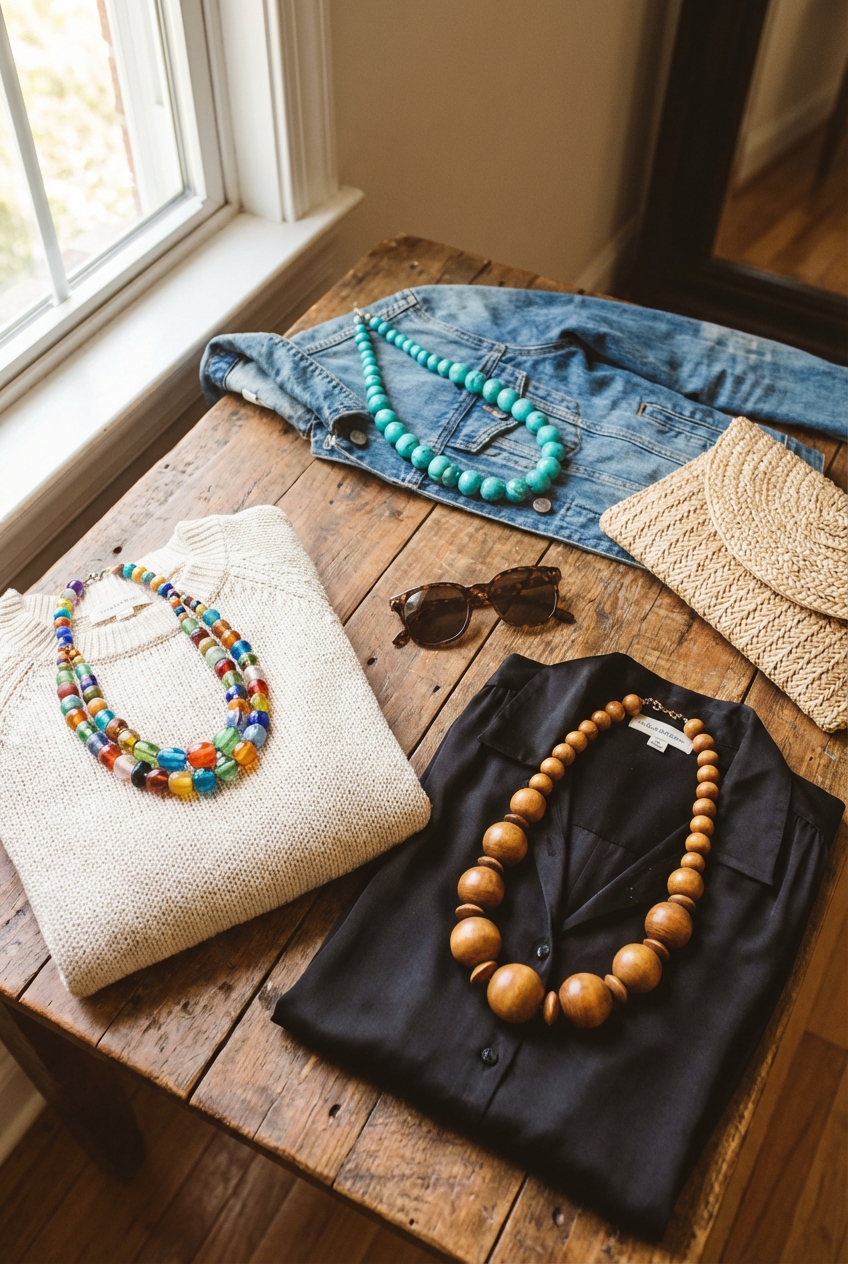
Styling Bold Beaded Necklaces For Statement Looks
Introduction
I distinctly remember a styling session with a client who had an incredible collection of artisanal beaded jewelry hidden away in a velvet drawer. She treated them like museum artifacts, terrified that wearing them would look too “costume” or chaotic for her streamlined, minimalist wardrobe. We spent the afternoon proving that bold beads are actually the ultimate anchor for a sophisticated outfit, much like a chandelier defines a dining room.
Beaded necklaces offer a texture and depth that metals simply cannot achieve on their own. Whether it is recycled African glass, polished semi-precious stones, or architectural wood elements, beads bring an organic warmth to high-fashion looks. The secret lies in understanding volume, weight, and the crucial balance between your jewelry and your garment’s silhouette.
To see some of the stunning combinations we discuss in this guide, make sure to check out the curated Picture Gallery located at the very end of this blog post.
Understanding Scale and Proportion
The first rule of styling statement jewelry is respecting the canvas, which in this case, is your frame. High-end styling isn’t just about putting on a pretty piece; it is about architectural balance.
If you have a petite frame (5’3″ or under), massive, chunky beads can overwhelm your visual line. This doesn’t mean you can’t wear them, but you must be strategic about length. A “bib” style that sits high on the collarbone is often more flattering than a long, heavy rope that drags the eye downward and shortens your silhouette.
For taller frames or broader shoulders, scale is your friend. Tiny beads often get lost or look accidental. You want pieces with substantial diameter—think beads ranging from 12mm to 20mm in size. These hold their own against your proportions and act as a deliberate focal point.
Designer’s Note: The Volume Rule
In my years of styling, the most common error I see is ignoring the volume of the hair. If you have voluminous, curly hair and wear a massive beaded necklace, the look can feel top-heavy. If your hair is big, consider a slightly longer necklace length (matinee or opera) to create breathing room between your chin and the jewelry.
Mastering the Neckline
The interaction between your necklace and your neckline is the make-or-break factor in styling. This is precise geometry. A bold beaded necklace should never fight with the hem of your top for attention.
The Crew Neck and Turtleneck
High necklines create a blank canvas that is perfect for statement beads. The key measurement here is vertical spacing.
For a crew neck, the necklace should sit at least 1.5 inches below the collar seam. If it touches the seam, it looks cluttered. For turtlenecks, you have two strong options: a short, chunky collar that mimics the neckline shape, or a long pendant style that hits below the bust line to elongate the torso.
The V-Neck and Plunge
The goal here is to fill the negative space without overcrowding it. The curve of the beads should mimic the angle of the V.
Common Mistake: The Overlap
I often see clients wearing a necklace that sits exactly on the edge of the fabric. This causes the necklace to dip in and out of the shirt as you move.
The Fix: Choose a length that sits clearly on the skin (at least 1 inch of clearance above the fabric) or clearly on the fabric (at least 2 inches below the neckline drop).
Material Mixology and Color Theory
High-fashion styling is moving away from perfectly matched sets and toward interesting textural contrasts. Beads offer a unique opportunity to introduce matte, rough, or semi-translucent finishes.
If you are wearing silk or satin, polished stone beads (like agate or jade) complement the sheen of the fabric. The gloss-on-gloss effect is incredibly luxurious.
However, if you are wearing heavy knits, wool, or denim, try contrasting that weight with something organic like wood, bone, or matte glass. The friction between the cozy fabric and the smooth, cool beads adds necessary visual tension.
Real-World Application: The Monochromatic Shift
I recently styled a look using a navy cashmere sweater. Instead of silver or gold, we used deep Lapis Lazuli beads. The tone-on-tone effect was striking. It added texture without breaking the color column, which instantly made the client look taller and more expensive.
The Art of Layering Beads
Layering bold beads is an advanced move, but when done correctly, it looks editorial and collected. The danger here is creating a tangled mess that looks like you raided a costume box.
Rule of Thumb: The 2-Inch Gap
If you are layering two beaded necklaces, they must have distinct lengths. There should be a minimum of 2 inches of vertical space between the bottom of the shorter necklace and the top of the longer one. This allows each piece to drape independently.
Mixing Weights
Do not layer two necklaces of equal visual weight. Pair one chunky, bold strand with a finer, smaller gauge strand. This establishes a hierarchy so the eye knows where to focus.
Designer’s Note: The Anchor Piece
When layering, start with the heaviest piece first. Let it settle on your body. Then add the lighter pieces. If you start light, the heavy piece will often crush or tangle the delicate ones underneath.
Occasion-Based Styling Strategies
Context is everything. A turquoise slab necklace reads very differently at a beach resort than it does in a boardroom.
Corporate and Professional Settings
In an office environment, noise is a factor. You want to avoid “clacking.” Choose beads that are strung on silk with hand-knotted spacing. This prevents the beads from hitting each other and making noise while you speak or move.
Stick to single-strand statement pieces in neutral tones or deep jewel tones (onyx, pearl, carnelian). Wear them inside the collar of a crisp white button-down shirt. It shows personality but remains contained and professional.
Evening and Formal Events
For black-tie or cocktail attire, treat the necklace as part of the dress architecture. If you are wearing a strapless gown, a multi-strand choker fills the bare skin beautifully.
Look for beads with light-reflecting properties. Faceted glass or crystals mixed with opaque stones can catch the dim evening light perfectly. Avoid wood or unfinished ceramic for formal evening wear, as they tend to read too casual.
Balancing Other Accessories
When you commit to a bold beaded necklace, you must edit your other accessories ruthlessly. This is the concept of “negative space” applied to the body.
Earrings
If the necklace is the star, the earrings must be the supporting actors. Avoid chandeliers or long drops that compete with the necklace.
What I’d Do in a Real Project:
If I put a client in a chunky 18-inch amber necklace, I almost always reach for simple gold studs or very small huggie hoops. You want to draw the eye to the face, not create a visual wall of jewelry from ear to chest.
Bracelets and Rings
You have more freedom here because the hands are far away from the neck. You can balance the visual weight of a heavy necklace with a substantial cuff bracelet on the wrist. This creates a diagonal line of interest across the body.
Choosing the Right Stringing Material
As a fashion expert, I look at the construction of jewelry just as closely as the aesthetics. A heavy beaded necklace requires robust engineering.
If you are buying or commissioning a bold piece, check the “drape.” The necklace should be fluid, not stiff. If it is strung on a cheap, thick wire, it will stand away from your collarbone in an awkward hoop shape.
Preferred Materials
Look for beads strung on multi-strand coated steel wire (for durability) or heavy-gauge silk cord (for drape). Silk is traditional for pearls, but it works beautifully for heavy stone beads because it allows them to settle naturally against the skin warmth.
The Clasp Factor
Heavy beads need a heavy clasp. A tiny spring ring will eventually break under the weight of 14mm stone beads. Look for large lobster claws or toggle clasps. A toggle clasp can actually be a design feature—wear it on the side or front for an extra detail.
Styling for Comfort and Posture
We rarely talk about the physicality of jewelry, but bold beads can be heavy. I have seen clients get tension headaches from wearing three pounds of stone around their necks for an eight-hour day.
Weight Distribution
Wide, flat beads distribute weight better than perfectly round, dense spheres. If you are sensitive to weight, look for materials like resin, acrylic, or wood, which offer high impact with very low mass.
The “Desk Test”
If you work at a computer, long beaded necklaces can be a hazard. They bang against the desk edge or get caught on keyboard trays. For work days, stick to lengths 20 inches or shorter to keep the jewelry secure against your body.
Finish & Styling Checklist
Before you walk out the door, run through this quick mental checklist to ensure your statement look is polished, not chaotic.
The Bend Test: Bend forward at the waist. Does the necklace swing out and hit something, or stay relatively secure?
The Noise Check: Walk across the room. Do you sound like a windchime? If yes, edit the layers.
The Neckline Gap: Is there clear separation between the jewelry and the fabric edge (either 1 inch above or 2 inches below)?
The Earring Edit: If you cover the necklace with your hand, do the earrings look too small? If you cover the earrings, does the necklace look lonely? Aim for balance, not matching.
* The Clasp Position: Is the clasp sitting securely at the back of the neck, or has the weight of the beads pulled it forward?
FAQs
How do I clean makeup off my beaded necklaces?
Makeup transfer is common with bold necklaces that sit on the skin. For stone or glass, use a soft, damp microfiber cloth with a tiny drop of mild soap. Avoid soaking the string, as water weakens silk and nylon over time. For wood beads, use a dry cloth only, as moisture can warp them.
Can I wear bold beads with patterns?
Absolutely, but scale is key. If you are wearing a busy, small-scale floral print, wear large, solid-colored beads. The size contrast helps the eye distinguish between the jewelry and the fabric. Avoid wearing small, intricate beads with a small, intricate print, as they will visually blend together.
My heavy necklace keeps sliding to the side. How do I fix this?
This usually happens because the beads are heavier than the clasp, or the pendant is unbalanced. You can use a tiny piece of double-sided fashion tape on the back of the central bead to anchor it to your skin or fabric. Alternatively, a jeweler can add a small counterweight to the clasp at the back.
Are beaded necklaces appropriate for formal weddings?
Yes, provided the material is elevated. Avoid plastic, rough wood, or casual shell. Opt for faceted semi-precious stones (labradorite, moonstone), freshwater pearls, or high-quality glass. The sparkle and finish should match the formality of the event.
How should I store heavy beaded necklaces?
Never hang heavy beaded necklaces. Gravity will stretch the cord over time, leading to gaps between beads or inevitable breakage. Store them flat in a velvet-lined drawer or a compartmentalized jewelry tray. Coil them gently to prevent kinks in the wire.
Conclusion
Styling bold beaded necklaces is about confidence and architecture. It is about understanding that jewelry is not just an accessory, but a structural component of your outfit. Whether you are using a chunky turquoise collar to brighten a winter coat or a long strand of trade beads to add history to a summer dress, the principles remain the same.
Focus on the balance of scale, the interaction with your neckline, and the quality of the materials. When you get the proportions right, a statement necklace doesn’t just complete an outfit—it transforms your entire presence. Trust your eye, respect the weight of the piece, and don’t be afraid to let the beads take center stage.
Picture Gallery


