
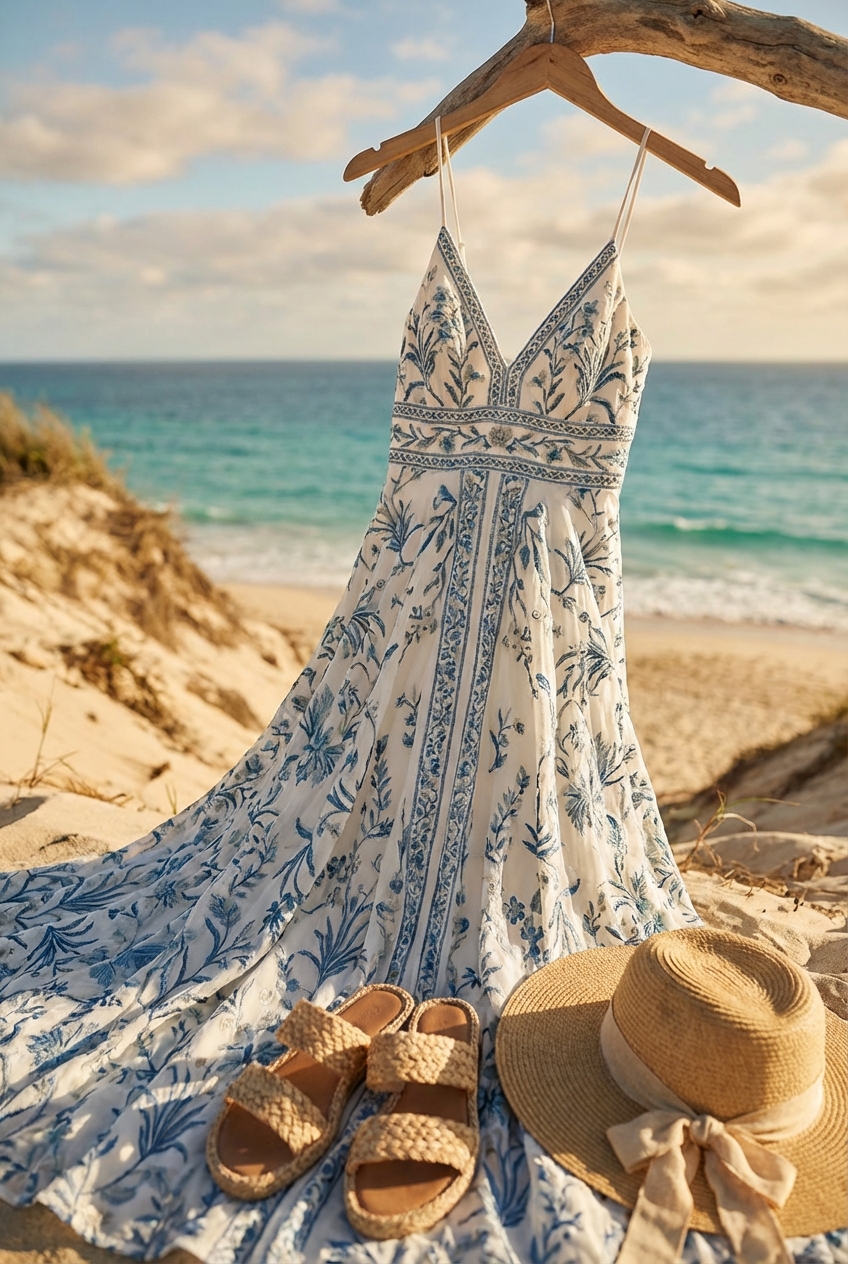
Stylish Destination Wedding Dresses With Beachy Prints Effortless Elegance By The Shore
There was a time when the mere suggestion of a print on a wedding gown would have sent a traditional bridal consultant into a faint. However, the landscape of bridal fashion has shifted dramatically, especially for destination weddings where the environment dictates a looser, more organic approach to luxury. I vividly remember styling a bride for a ceremony in Positano who insisted on a heavy, beaded ballgown; by the time she reached the altar, she was overheated and the dress looked disconnected from the stunning cliffside backdrop.
True luxury in a destination setting is about harmony between the garment and the location. A printed gown allows you to mirror the natural palette of your surroundings, whether that is the soft azure of the Mediterranean or the lush emerald of a Caribbean jungle. It signals a bride who is confident, fashion-forward, and willing to break archaic rules to achieve a look that feels authentic to her personal style.
Choosing a printed gown requires a different set of criteria than selecting a standard ivory dress. You must consider how the pattern scales against your frame, how the colors interact with natural sunlight versus flash photography, and how the fabric behaves in coastal humidity. I have curated a comprehensive collection of visual inspiration in the Picture Gallery at the end of this blog post to help you visualize these concepts.
1. Decoding Fabric Performance for Humidity and Wind
When we design for coastal environments, the fabric is not just an aesthetic choice; it is a functional tool. The biggest enemy of a beach bride is not sand, but humidity and heat. A printed dress in a synthetic fiber like polyester satin will act as a greenhouse, trapping heat against the skin and causing immediate discomfort.
You need natural fibers that breathe. My top recommendations for printed destination gowns are silk chiffon, cotton voile, and silk crepe de chine. These fabrics allow air to circulate and have a natural “wicking” property that keeps you cooler. For a printed gown, silk chiffon is particularly exquisite because the print appears softer and slightly translucent, creating a dreamlike, ethereal quality as the layers move.
Wind is the second factor. A stiff fabric like organza or heavy brocade fights the wind, creating awkward angles in photos. Soft, fluid fabrics embrace the wind. When the ocean breeze catches a silk skirt, it creates dynamic, editorial-style movement that looks incredible on camera.
Designer’s Note: The Lining Lesson
I once worked with a bride who bought a gorgeous printed silk dress off the rack, but it was lined with cheap acetate. Within twenty minutes of standing in the Tulum sun, she was miserable. We had to emergency-cut the lining out before the reception. Always check the content tag of the lining, not just the shell. If it’s synthetic, have a seamstress replace it with a cotton or silk lining before you travel.
2. Mastering Print Scale and Placement
The scale of the print must correspond to your body frame and the venue’s grandeur. In high-end fashion styling, we use “scale theory” to ensure the dress doesn’t wear the bride. If you are petite (under 5’4″), a massive, sprawling tropical print can overwhelm your figure. You want to look for “micro-florals” or medium-scale botanical prints that allow your silhouette to remain defined.
For taller brides or grander venues, like a castle terrace in Sintra, you can handle “macro-prints.” These are large, sweeping patterns—think oversized hibiscus or broad watercolor strokes—that read clearly from a distance. If the print is too small in a grand setting, it can read as “texture” or “noise” rather than a deliberate design element.
Placement prints are the hallmark of luxury design. Unlike a “repeat pattern” (like polka dots that repeat endlessly), a placement print is engineered to fit the body. This might mean the dense floral pattern starts at the hem and fades into white as it moves up the waist, drawing the eye upward and elongating the body.
Common Mistakes + Fixes
- Mistake: Choosing a print with high contrast (like black on white) for a midday ceremony.
- Fix: High noon sun creates harsh shadows. High-contrast prints can look jarring. Opt for tonal prints (blue on light blue, sage on cream) which look softer and more expensive in bright natural light.
- Mistake: Ignoring the “repeat line” on the seams.
- Fix: On cheaper garments, the print gets cut off awkwardly at the side seams. Inspect the side seams to ensure the pattern flows continuously or matches up. This is a tell-tale sign of quality.
3. Color Theory: Harmonizing with the Landscape
Your destination dictates your palette. A dress that looks spectacular in Cabo San Lucas might look out of place in the English countryside. For beach settings, we want to harmonize with the environment, not compete with it.
For “Golden Hour” weddings (sunset ceremonies), warm tones are magical. Prints featuring blush, coral, pale gold, or warm terracotta will glow under the setting sun. If you are getting married at midday when the light is bluer and harsher, cool tones work best. Think cerulean blues, seafoam greens, and lavender.
Consider the “background noise” of your venue. If you are getting married on a white sand beach with turquoise water, a dress with blue and white porcelain prints (think Dolce & Gabbana aesthetics) creates a cohesive, high-fashion narrative. If you are in a jungle setting like Bali or Costa Rica, botanical prints with deep greens and creams connect you to the flora.
What I’d Do in a Real Project: The Swatch Test
If I am styling a client for a destination wedding, I ask for photos of the venue at the exact time of the ceremony. I then take fabric swatches outside at that same time of day to see how the colors react. You can do this too. Take the dress (or a swatch) outside at 5:00 PM. Does the print pop, or does it look muddy? If the print has yellow undertones, it might look dirty in low light. Stick to clean, crisp background colors like true white or soft champagne.
4. The Silhouette Strategy: Practicality vs. Drama
The silhouette of a printed dress needs to be simpler than a solid dress. When you combine a busy print with ruffles, pleats, beading, and complex draping, the eye doesn’t know where to rest. It becomes visually chaotic. The rule of thumb is: The bolder the print, the simpler the cut.
For beach weddings, I almost always recommend an A-line or a soft column silhouette with a slit. A slit is functional engineering for a beach bride. It allows air flow to your legs, gives you a full range of motion for walking in soft sand, and allows for that “Angelina Jolie” leg moment in photos.
Regarding trains: Be realistic. A cathedral-length train on a printed dress is risky on a beach. It will collect sand, twigs, and potentially wet debris. The print can disguise some dirt, which is a benefit over pure white, but dragging a heavy fabric through sand is exhausting.
Pro-Level Rule of Thumb: The Hemline Calculation
For a beach ceremony, hem your dress to “float” exactly 0.5 to 1 inch off the ground with your wedding shoes on. In an indoor wedding, we graze the floor. On the beach, if the hem touches the sand, you might trip, and the hem will inevitably get wet and heavy. That slight hover prevents the “wet dog” look at the bottom of your dress while still looking floor-length in photos.
5. Accessorizing the Printed Bride
Styling a printed gown requires restraint. The dress is the statement; everything else is the supporting cast. If your dress has a busy floral pattern, skip the necklace. Let the neckline and the print speak. Focus instead on earrings—perhaps baroque pearls or hammered gold drops that catch the light without competing with the pattern.
Veils can be tricky with prints. A lace veil over a floral print dress is a visual clash—it’s pattern on pattern. Instead, opt for a raw-edge tulle veil in a single sheer layer. This allows the print of the back of the dress to show through the veil without obstruction. Alternatively, ditch the veil entirely for a silk hair ribbon or fresh flowers that match the print of the dress.
Footwear is critical for the “effortless” vibe. Stilettos are non-negotiable failures on sand. You will sink. I recommend block heels with a wide surface area or fancy flat sandals. If you want height, look for a wedge espadrille, but ensure the straps are delicate enough to look bridal, not casual.
The “Guest” Dilemma
A common fear is: “If I wear a print, will I look like a guest?” To avoid this, ensure the “ground” of the print (the background color) is white, ivory, or cream. A white dress with blue flowers reads “Bride.” A blue dress with white flowers reads “Guest.” Additionally, the fabric quality and construction (boning, bust cups, volume) separate a bridal gown from a maxi dress.
6. Travel Logistics and Garment Care
You have bought the dress; now you have to get it there. Printed fabrics, especially silks, are prone to wrinkling. Never check your wedding dress. It goes in a garment bag as your carry-on item. Most flight attendants will hang it in the first-class closet if you ask nicely.
Pack a portable steamer. Do not rely on the hotel to have a high-quality one, and definitely do not use a standard hotel iron on silk—you risk scorching the print or leaving water spots. When you arrive, hang the dress immediately in the bathroom while you take a hot shower (don’t get it wet, just let the steam relax the fibers).
If your dress is 100% cotton voile, it will wrinkle the moment you sit down. Embrace it. That is the nature of the fabric and fits the “wabi-sabi” (perfectly imperfect) aesthetic of a beach wedding. If you cannot stand wrinkles, choose a silk blend or a high-quality viscose that has better memory and drape.
Finish & Styling Checklist
Before you finalize your look, run through this quick stylist check:
- The Sit Test: Sit in a low chair for 5 minutes. Does the dress dig into your ribs? Is the fabric pinching? You will be sitting for dinner; ensure you can breathe.
- The Opacity Check: Stand with the sun behind you (or a bright light). Can you see the outline of your legs? Backlighting is common at beaches. You may need a nude slip.
- The Wind Proofing: If you have a wrap skirt or high slit, use fashion tape or a weighted hem to prevent a wardrobe malfunction in a gust of wind.
- Hardware Temperature: If your dress has metal hardware or zippers touching the skin, remember metal gets hot in the sun. Ensure there is a fabric guard behind any metal.
- Tan Lines: If your dress is strapless, manage your sun exposure in the days leading up to the wedding to avoid conflicting tan lines.
FAQs
Can I wear a black and white print for a beach wedding?
Yes, but be careful with the ratio. A white dress with delicate black botanical drawings (Toile de Jouy style) is chic and modern. A heavy black geometric print may look too harsh against a soft seaside background. Keep the white base dominant.
What should my bridesmaids wear if I am in a print?
This is a great styling opportunity. Pull a color from your print—for example, if your dress has sage green leaves and pink flowers—and put your bridesmaids in solid dresses of those specific shades. It creates a cohesive color story where you are the anchor.
Is a train completely off-limits?
Not completely, but it requires a “handler.” If you want the drama of a train for the ceremony, ensure you have a bustle system sewn in for the reception. A “French Bustle” (which folds the fabric under) keeps the print looking continuous better than an “American Bustle” (which folds fabric over).
How do I handle sweat marks on a silk dress?
This is a reality of tropical weddings. Dress shields (absorbent pads stuck to the underarm of the dress) are a lifesaver. Also, choose a print that is busy around the underarm or waist area—patterns hide wet spots much better than solid solids.
Conclusion
Choosing a destination wedding dress with beachy prints is a declaration of style. It steps away from the expected and embraces the joy, color, and vibrancy of the location you have chosen. Whether you opt for a subtle watercolor wash or a bold tropical botanical, the key is to prioritize natural fabrics, appropriate scale, and effortless silhouettes.
True elegance by the shore isn’t about looking perfect and preserved in plastic; it’s about movement, light, and interacting with the elements. A printed gown captures the mood of the ocean—unpredictable, beautiful, and utterly unforgettable. Trust your taste, mind the technical details, and enjoy the freedom of breaking tradition.
Picture Gallery


