
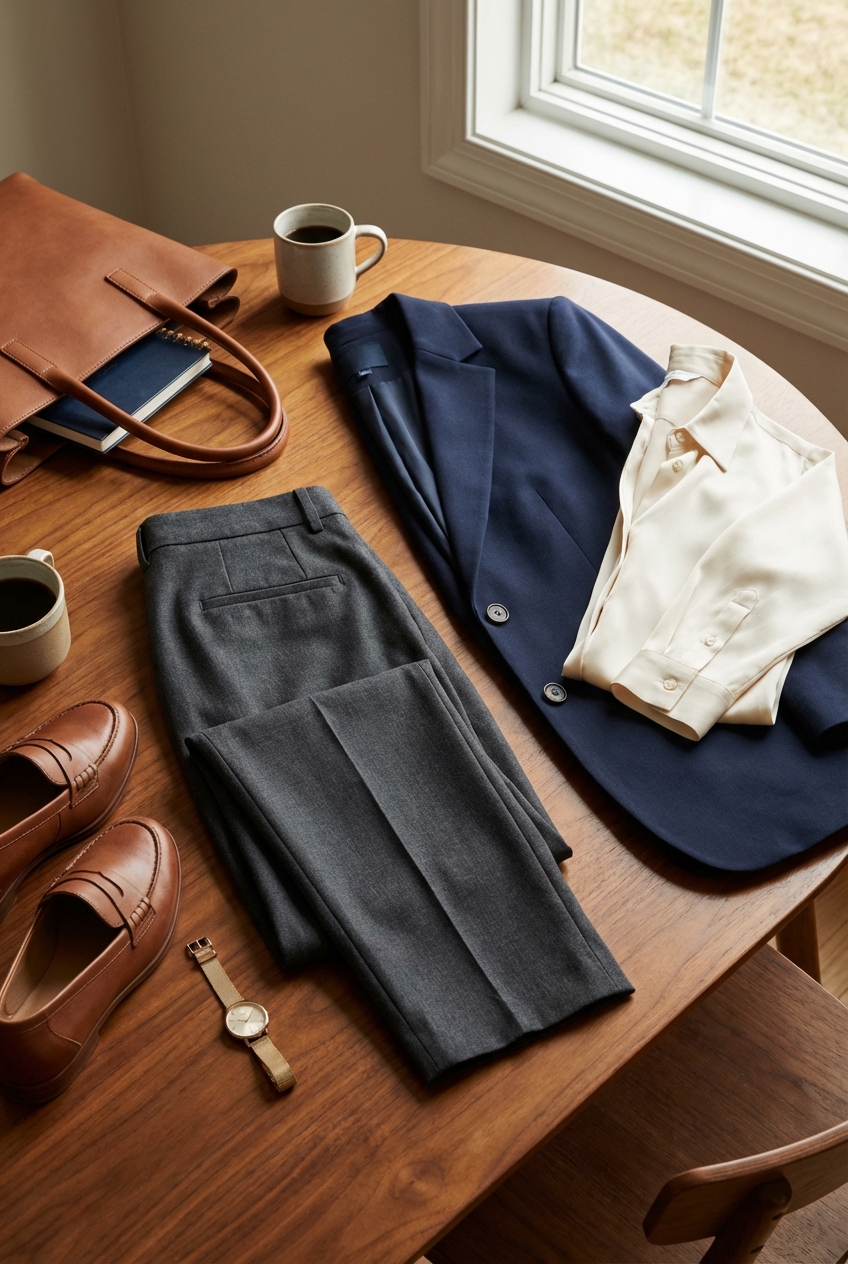
Tapered Trousers For Polished Professional Looks
Introduction
Finding the perfect balance between comfort and authority in a professional wardrobe is a challenge every woman faces. We often oscillate between stiff, uncomfortable suits and pieces that feel too casual for the boardroom. The tapered trouser solves this dilemma by offering a silhouette that is tailored yet forgiving. It respects the body’s natural lines while maintaining a sharp, architectural structure essential for high-end styling.
I remember my first year working as a stylist in the city, running between showrooms and client meetings. I tried to survive in pencil skirts, but the mobility just wasn’t there. Once I switched to a high-quality wool tapered trouser, everything changed. I looked pulled together, but I could move freely. It became my uniform for navigating the fashion world with confidence.
In this guide, we will break down the anatomy of the perfect tapered pant, from fabric selection to the crucial shoe pairing. We will look at how to tailor them for your specific body type and how to style them for various office environments. If you are looking for visual inspiration, please note that a curated Picture Gallery is available at the end of this blog post to spark your creativity.
The Anatomy of the Perfect Taper
To master this look, you first have to understand what makes a trouser “tapered.” Unlike a skinny jean that hugs the calf and ankle tight, a tapered trouser creates a gradual narrowing. It should be comfortable through the hip and thigh, then slowly decrease in width from the knee down to the hem.
The goal is a “carrot” shape—wider at the top, narrow at the bottom. This silhouette is incredibly flattering because it emphasizes the waist and elongates the leg line without clinging. In high-end fashion, we look for a “clean hang.” This means the fabric should drape from the hip to the hem without catching on the calves.
Rise and Waist fit
For a professional look, a mid-to-high rise is non-negotiable. A rise that sits at or just below the belly button elongates the lower body. It also ensures that shirts stay tucked in during a long workday.
When fitting clients, I always check the “seat” of the pants. There should be enough fabric to sit comfortably without the material pulling across the front fly. If you see horizontal whiskers pulling at the crotch, the rise is likely too short or the hip is too tight.
Designer’s Note: The Volume Rule
One lesson I learned early in my career is that volume needs management. If a tapered trouser has pleats at the waistband, it adds volume to the hips. To balance this, the taper at the ankle must be sharp. If you have volume at the hip and a wide ankle, you lose the shape entirely. Always ensure that volume at the top is met with structure at the bottom.
Fabric Selection: The Foundation of Luxury
The difference between a polished professional look and a sloppy one usually comes down to fabric. In the world of luxury styling, natural fibers are king. They breathe better, drape better, and last longer than cheap synthetics.
Wool and Wool Blends
For year-round office wear, “tropical weight” wool is the gold standard. It resists wrinkles, which is vital if you spend hours sitting at a desk. Wool has a natural memory, meaning it snaps back into shape after being stretched. Look for a trouser that is lined to the knee. This prevents the wool from itching and helps the pant leg slide over your skin smoothly.
Heavyweight Crepe
If you prefer a fluid, feminine drape, matte crepe is an excellent choice. It has a beautiful weight that falls heavily, skimming over curves rather than clinging to them. This is often the preferred fabric for evening-transition looks. Avoid thin polyester crepe that has a high sheen; it tends to look inexpensive under harsh office lighting.
Cotton Sateen (with caution)
Cotton blends are great for warmer months or creative offices. However, cotton wrinkles easily. If you choose cotton, look for a “sateen” finish, which has a slight luster and a tighter weave. This looks dressier than a standard chino or twill weave.
Mastering the Hemline and Break
The single most common mistake with tapered trousers is the length. Because the leg opening is narrow, the hem cannot rest on the shoe like a bootcut pant. If a tapered pant is too long, the fabric bunches up at the ankle, ruining the clean line you are trying to create.
The Ankle Bone Rule
For the most modern, polished look, the hem should hit exactly at the ankle bone or slightly above it. You want to see the articulation of the ankle. This creates a visual break that lightens the entire outfit.
The “No Break” Look
In tailoring terms, a “break” is where the pant leg hits the shoe and folds. Tapered trousers look best with “no break” or a “shivering break” (where the fabric barely touches the shoe). Avoid a “full break” where the fabric pools.
Tailoring Specifics
When you take your trousers to a tailor, bring the shoes you intend to wear most often. Ask the tailor to taper the leg opening to between 12 and 14 inches in circumference, depending on your shoe size. This ensures the pant leg doesn’t swallow your foot.
Shoe Pairings: Navigating the Gap
Since tapered trousers draw attention to the ankle, your shoe choice is critical. You are essentially framing your feet. The transition from pant to shoe must be intentional.
Pointed Toe Pumps
This is the classic power look. A pointed toe extends the leg line, continuing the taper of the pant. It creates a sharp, arrow-like silhouette that implies authority. Nude pumps will elongate the leg further, while black pumps ground the look.
Loafers and Brogues
For a menswear-inspired vibe, pair tapered trousers with chunky loafers. The key here is to show some skin. If you wear socks, make them intentional—either a sheer stocking or a high-quality ribbed sock in a coordinating color. Invisible socks are often the best bet for a clean look.
Ankle Boots
This is the trickiest pairing. The shaft of the boot needs to fit under the pant leg, or the pant leg needs to end above the boot. You want to avoid the “fight” between the hem and the boot top, which creates bulk. A sock boot with a tight ankle shaft is the perfect companion for tapered trousers in winter.
Styling for Different Professional Codes
Tapered trousers are incredibly versatile. They can act as a chameleon depending on what you pair them with. Here is how I style them for different dress codes.
Corporate Formal
Stick to neutrals: black, charcoal, navy, or camel. Pair the trousers with a matching blazer. This creates a modern suit. Unlike the boxy suits of the 90s, a tapered pant suit looks agile. Wear a silk blouse tucked in. Keep jewelry minimal—a watch and stud earrings.
Creative / Smart Casual
Here you can play with texture and pattern. Try a plaid or checked tapered trouser. Pair it with a high-quality cashmere sweater, half-tucked at the waist. You can be more adventurous with shoes here—perhaps a metallic loafer or a brightly colored block heel.
The “Friday” Look
You can dress down tapered trousers without looking sloppy. Pair them with a pristine white leather sneaker and a denim jacket over a crisp white tee. The structure of the trouser elevates the sneakers, making the outfit appropriate for casual Fridays.
Common Mistakes + Fixes
Even with the best intentions, things can go wrong. Here are the most frequent errors I see and how to correct them quickly.
Mistake 1: The Pocket Flare
The Issue: The side pockets pop open like ears, breaking the smooth hip line.
The Fix: This usually means the pants are too tight across the hips, even if they fit at the waist. Size up to fit your hips and have the waist taken in by a tailor. Alternatively, a tailor can sew the pockets shut for a sleeker silhouette.
Mistake 2: Visible Panty Lines (VPL)
The Issue: The tapered fit is snug against the glutes, showing underwear outlines.
The Fix: Seamless, laser-cut underwear is essential. For lighter fabrics like cream or camel wool, consider shapewear shorts that stop mid-thigh to smooth everything out.
Mistake 3: The “Muffin Top” Effect
The Issue: The waistband cuts into the midsection, creating a roll over the top.
The Fix: This is often a rise issue. A low-rise tapered pant is difficult to wear professionally. Switch to a high-rise cut that sits at the natural waist (the smallest part of your torso). It is more comfortable and creates a smooth vertical line.
Upper Body Balance: Tops and Layers
Because the bottom half of your silhouette is narrowing, you have options for the upper body. You can either mirror the slim line or contrast it with volume.
The Volume Contrast
If your trousers are very fitted at the ankle, a slightly oversized blazer or a blouse with bishop sleeves looks fantastic. The volume on top balances the slimness on the bottom, creating an inverted triangle shape that looks powerful.
The Column of Color
For a slimming effect, wear a top in the exact same color as your trousers. A navy turtleneck with navy tapered trousers creates a seamless column. Throw a trench coat in a contrasting color (like beige) over the top for a classic, high-end finish.
Tucking Techniques
The Full Tuck: Best for high-waisted trousers and thin blouses. It defines the waist clearly.
The French Tuck: Tuck just the front of a sweater or button-down, leaving the back loose. This provides waist definition without feeling too formal. It also covers the backside, which some women prefer in a professional setting.
Finish & Styling Checklist: What I’d Do
If I were building a professional wardrobe for a client from scratch today, this is the exact process I would follow to ensure success with tapered trousers.
- Buy for the hips: I would buy the size that fits the widest part of the hip perfectly, ignoring the waist gap.
- Tailor the waist: I would immediately take the pants to a tailor to take in the waist. This costs about $20-$30 but makes a $100 pant look like a $500 pant.
- Check the sit test: Before cutting tags, I would sit down in a hard chair. If the fabric cuts into the stomach or the rise pulls, I would return them.
- Set the length: I would hem them to hit 1 inch above the ankle bone. This is shorter than most people think, but it ensures the shoes shine.
- Fabric check: I would crush a corner of the fabric in my hand for 10 seconds. If it stays wrinkled, I won’t buy it. Commuting ruins high-maintenance fabrics.
- Color Palette: I would start with one black pair and one grey check pair. These two cover 90% of professional styling needs.
FAQs
Can I wear tapered trousers if I have wide hips or pear shape?
Absolutely. In fact, they are often the most flattering cut for pear shapes. Look for pairs with front pleats, which provide extra room in the hip area without pulling. Ensure the taper at the ankle is not skin-tight, as you want to balance the hip width, not exaggerate it.
Are tapered trousers appropriate for conservative law or finance offices?
Yes, provided they are not too tight. Stick to dark wools and ensure the fit is structured, not clingy. Pair them with a blazer. They are a modern alternative to the straight-leg pant and are fully accepted in formal business attire.
How do I care for wool trousers?
Do not dry clean them too often; the chemicals damage the fibers over time. Brush them down with a clothing brush after wearing to remove dust. Hang them upside down by the hems using a clamp hanger to let gravity pull out wrinkles. Steam them rather than iron them to avoid “shining” the wool.
Can I wear flats with tapered trousers?
Yes, but the vamp of the shoe matters. A “low vamp” shoe (one that shows toe cleavage or the top of the foot) works best because it extends the leg line. Pointed-toe flats are ideal. Avoid high-vamp loafers that cover the whole foot unless you are going for a specific menswear look.
Conclusion
Tapered trousers are the unsung hero of the modern professional wardrobe. They offer a sophisticated alternative to the monotony of traditional suiting while providing the comfort required for a dynamic career. By focusing on fit—specifically the rise and the hem—you can elevate your daily office look from functional to fashionable.
Remember that high-end style is rarely about the brand name on the label; it is about the precision of the fit and the quality of the fabric. Investing in a few pairs of well-tailored tapered trousers gives you a foundation that makes getting dressed in the morning effortless. Whether you pair them with a silk blouse or a cashmere knit, the silhouette remains polished, professional, and powerful.
Picture Gallery


