
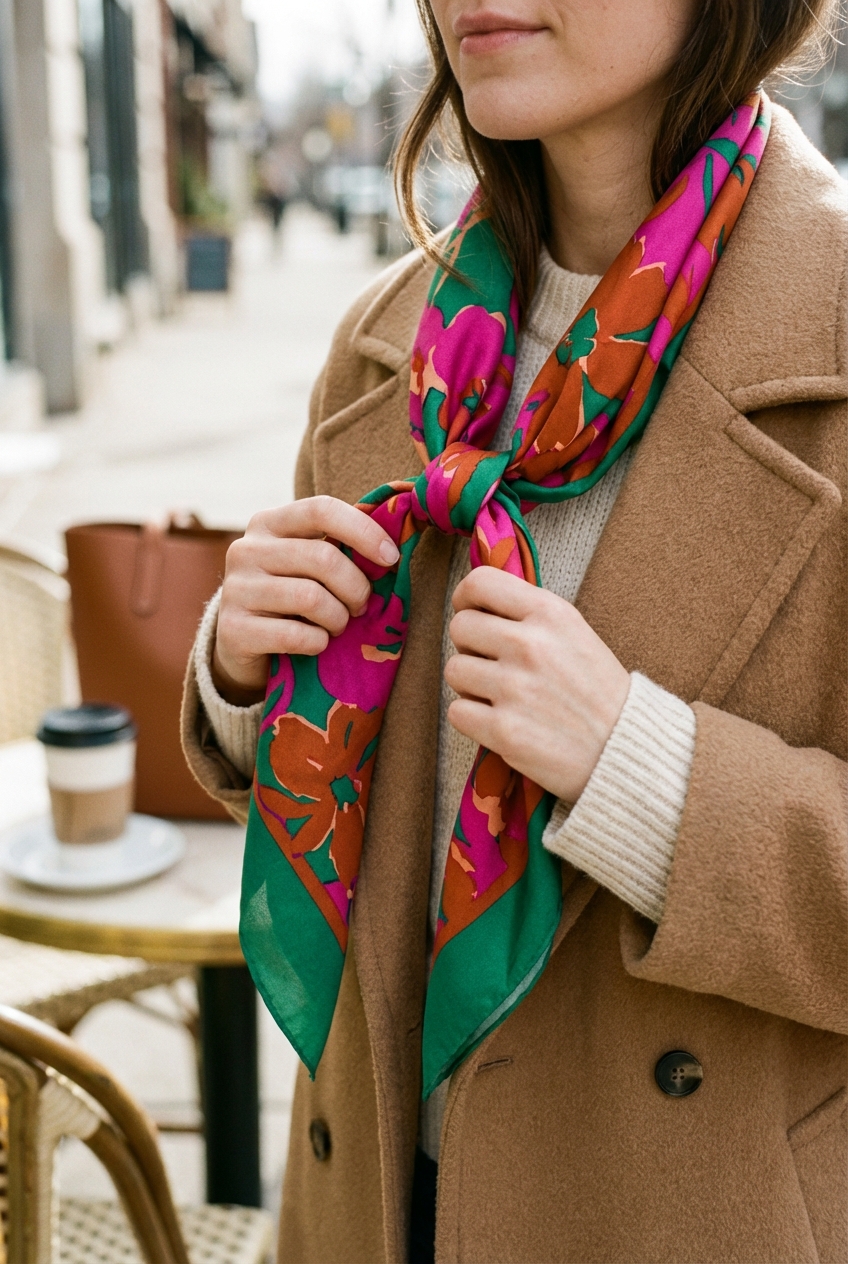
The Art Of Choosing A Bold Scarf To Complete Your Look
I still remember the first time I realized the true architectural power of a scarf. I was styling a client for a gallery opening who felt her classic camel coat and denim combination was too pedestrian for the crowd, but she refused to change into a dress.
We added a vintage, oversized silk twill scarf in electric blue and emerald, knotted structurally at the neck. Suddenly, the coat wasn’t just a covering; it became a canvas that framed her face and elevated her entire silhouette.
A bold scarf is not merely an accessory for warmth; it is the “third piece” that finishes an outfit and separates style from mere utility. If you are looking for visual inspiration on how to tie and style these pieces, you can find our curated Picture Gallery at the end of the blog post.
Understanding Scale and Proportion
The most common mistake I see in my styling practice is a disconnect between the volume of the scarf and the wearer’s frame. In interior design, you wouldn’t put a tiny rug in a massive ballroom; in fashion, you cannot let a massive blanket scarf swallow a petite silhouette.
Scale is about balance. If you have a petite frame (under 5’4″), an oversized 140cm x 140cm square can look like it is wearing you. For petite clients, I recommend sticking to the classic 90cm square or a narrow rectangular stole (approx. 45cm x 180cm) to maintain vertical lines without adding bulk.
Conversely, if you are tall or have broad shoulders, tiny neckerchiefs can disappear and make the head appear disproportionately large. You have the luxury of carrying volume. Look for “blanket” styles or substantial cashmere wraps that drape elegantly across the shoulders.
Stylist’s Note: The Neckline Rule
When choosing scale, you must consider your neck length. This is a detail often overlooked until you look in the mirror and feel “stifled.”
- Short Neck: Avoid bulk directly under the chin. Keep the knot low (near the décolletage) or wear the scarf open and draped to create a V-shape that elongates the neck.
- Long Neck: You can handle high chokers, tight distinct knots, and volume right up to the jawline.
Mastering Color Theory and Complexion
A bold scarf is the closest garment to your face. Because of this proximity, the color reflects light directly onto your skin, effectively acting as a lighting filter. The wrong color can highlight dark circles, while the right one can mimic a full night’s sleep.
When selecting a bold hue, determine your skin’s undertone first. If you have cool undertones (veins appear blue), look for jewel tones like sapphire, magenta, or icy greys. If you have warm undertones (veins appear green), lean toward terracotta, mustard, olive, or cream.
Don’t be afraid of “clashing” colors if they share the same intensity. A bright poppy red scarf looks incredibly chic against a shocking pink sweater because both have high saturation. This is called “dopamine dressing,” and it signals confidence.
Common Mistakes + Fixes
- Mistake: Matching the scarf exactly to your top.
- Fix: This creates a “uniform” look that lacks depth. Instead, match the scarf to a secondary color in your outfit, like your shoes, bag, or even your lipstick.
- Mistake: Ignoring hair color.
- Fix: Create contrast. If you have dark hair, a black scarf might blend in too much. Opt for a vibrant emerald or ivory to create separation between your hair and your outfit.
Fabric Selection: Texture and drape
The material of your scarf dictates how it knots, holds its shape, and sits on the body. As a stylist, I select fabric based on the “architecture” I want to build around the neck.
Silk Twill: This is the gold standard for high-end scarves (think classic French fashion houses). It has a diagonal weave that reflects light softly but, more importantly, it has “body.” When you tie a bow or a structural knot, silk twill stays standing. It does not flop.
Cashmere and Wool: These are for softness and volume. They do not hold intricate knots well. Instead, they are best for “loops” and simple drapes. When buying wool, check the label for blend percentages. A blend with at least 10% silk or cashmere adds a sheen that elevates the scarf from “winter gear” to “luxury accessory.”
Chiffon and Georgette: These are sheer and fluid. They offer zero structure and will drape closely to the body. Use these for a romantic, ethereal look, but avoid them if you are trying to hide a neckline or create a bold, structural statement.
What I’d Do in a Real Styling Session
If I am styling a client for a corporate event wearing a stiff blazer, I soften the look with a cashmere or modal blend scarf. The matte texture contrasts beautifully with the structure of the jacket.
If the client is wearing a soft, knit sweater, I add a crisp silk twill scarf. The silk adds the necessary polish and structure to prevent the outfit from looking like loungewear.
The Mechanics of the Knot
A bold scarf fails if you are constantly adjusting it. The secret to an effortless look is actually a very secure, intentional knot. You want “sprezzatura”—studied carelessness—but the mechanics must be solid.
The European Loop (The City Knot): Fold a long rectangular scarf in half. Drape it around your neck. Pull the loose ends through the loop. This is functional, secure, and creates a clean vertical line down the chest which is slimming.
The Asymmetrical Toss: Ideal for oversized square scarves. Fold the square into a triangle. Place the triangle in front of your chest. Cross the ends behind your neck and bring them back to the front. Tie them loosely at the side. This looks artistic and breaks up the symmetry of a coat.
The Belt Tuck: This is a modern, high-fashion approach. Drape a large rectangular scarf over your shoulders, letting the ends fall down your front to your thighs. Belt your coat or blazer over the scarf. It turns the accessory into a lapel, adding color without bulk at the neck.
Designer’s Note: Friction Matters
Silk is slippery. If you struggle to keep a silk scarf in place, do not just tie it tighter (which ruins the drape). Use a hidden safety pin on the shoulder or a magnetic scarf brooch. Alternatively, wear a base layer with some texture, like a wool coat, rather than layering silk over silk.
Pattern Mixing 101
Many women avoid bold patterned scarves because they don’t know how to wear them with other prints. They assume a printed scarf requires a solid white shirt. This is a missed opportunity.
The rule of thumb for mixing patterns is to vary the scale. You can wear a floral scarf with a striped shirt, provided the stripes are narrow (small scale) and the floral print is oversized (large scale).
You must also look for a “grounding color.” If your checkered blazer has a navy thread running through it, choose a bold paisley scarf where navy is a prominent secondary color. This visual link ties the two chaotic patterns together.
Be wary of logos. A scarf covered in brand logos is a pattern in itself. If you wear a logo scarf, keep the rest of your outfit devoid of visible branding to avoid looking like a walking billboard.
Investment Strategy: Cost-Per-Wear
In the world of high-end accessories, a scarf is often the smartest entry point. A designer handbag might cost $3,000, while a designer scarf from the same house—using the same color palette and brand prestige—might cost $500.
From a “cost-per-wear” perspective, a bold scarf is a workhorse. It does not require dry cleaning as often as a blouse (since it sits atop clothes). It does not wear out at the soles like shoes. It does not fluctuate with weight changes like trousers.
When investing, look for “hand-rolled edges.” On a luxury silk scarf, the hem is rolled by hand and stitched in place, leaving a plump, round edge. Machine-stitched hems are flat and often pucker. The hand-rolled edge is a sign of artisanal quality and ensures the scarf drapes correctly.
Realistic Budgeting
If a $500 Hermès scarf isn’t in the budget, look for vintage. Silk is incredibly durable. A 20-year-old high-quality silk scarf often looks better than a brand new cheap synthetic one. Consignment stores are gold mines for these pieces.
Finish & Styling Checklist
Before you leave the house, run through this mental checklist to ensure your bold scarf is enhancing, not hindering, your look. This is the exact process I use on set.
- The Jawline Check: Does the scarf color make your skin look bright, or does it cast a shadow? If it’s a “bad color” day, move the scarf lower away from the face or add a brighter lipstick.
- The Volume Check: If you are wearing a puffy coat, avoid a puffy scarf. Contrast volumes. Slim coat + puffy scarf, or Puffy coat + sleek silk scarf.
- The Jewelry Audit: If you are wearing a bold, busy scarf, remove large drop earrings. They will get tangled and look cluttered. Switch to studs or no earrings at all.
- The “Stay Put” Test: Shake your head and shoulders. Does the scarf slip? If yes, secure it now with a double knot or a pin before you step out.
- The Occasion Match: Is the scarf dragging on the dinner plate? For meals, ensure ends are tucked in or short. Long flowing ends are for walking, not eating.
FAQs
How do I store my silk scarves to prevent creases?
Never fold them tightly. Ideally, roll them gently around a cardboard tube or drape them over a padded hanger. If you must fold them in a drawer, minimize the creases and keep them away from direct sunlight which can fade the dyes.
Can I wash my silk scarf at home?
I strongly advise against it for high-end silk twill. Water can alter the finish and sheen, or cause the dyes to bleed. Dry cleaning is the safest route. If it is a casual cotton or synthetic blend, hand washing in cool water is acceptable.
Is there an age limit on bold scarves?
Absolutely not. In fact, as we age, a bold scarf is a secret weapon. It brings light to the face and adds a touch of drama that reads as sophisticated and worldly. It is a timeless accessory.
My scarf feels too stiff. How do I soften it?
New silk twill can be stiff; this is actually a sign of quality (the sericin in the silk). It will soften naturally with wear. Do not try to artificially soften it with chemicals, as you will ruin the structural integrity that makes it pop.
Conclusion
Choosing a bold scarf is an exercise in confidence. It signals that you are not just getting dressed to cover your body, but that you are curating an image. It transforms a basic capsule wardrobe into an infinite array of outfits.
Remember that the rules of proportion, color theory, and fabric weight are there to guide you, but the ultimate goal is personal expression. Whether you choose a vintage geometric print or a lush cashmere wrap, wear it with intention.
Allow the scarf to be the focal point. Keep the rest of your outfit simple, and let this accessory do the heavy lifting. You will find that with the right piece around your neck, you walk a little taller.
Picture Gallery


