
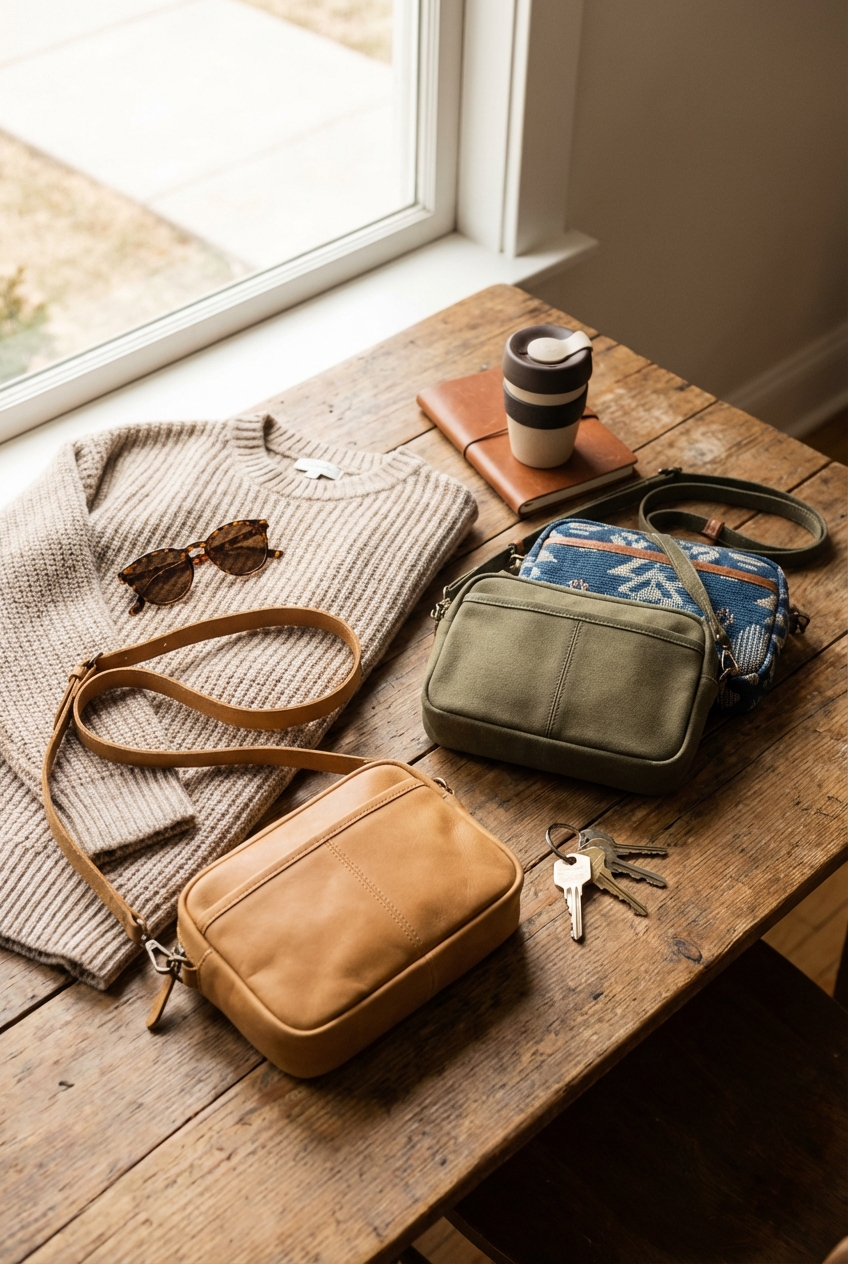
The Best Compact Crossbody Bags For Every Day
There is a distinct freedom that comes with the perfect crossbody bag. In my years styling clients for everything from fashion weeks to school drop-offs, I have found that switching to a hands-free silhouette is often the most practical lifestyle shift a woman can make. It signifies a move away from carrying “everything just in case” toward a curated, streamlined existence where you only carry what truly serves you.
However, finding that “unicorn” bag—the one that is small enough to be unobtrusive but large enough to hold a modern smartphone, keys, and sunglasses—is a technical challenge. It requires a deep understanding of gussets, strap drops, and hardware weight. I have seen too many clients purchase beautiful designer bags that sit on a shelf because the zipper scratches their hand or the chain digs into their shoulder after an hour.
This guide is designed to help you navigate the architecture of the ideal daily companion. We will look at this purchase not just as an accessory, but as a piece of mobile engineering that needs to function flawlessly. For visual inspiration on how to style these silhouettes, make sure to browse the curated Picture Gallery at the end of the blog post.
1. The Architecture of “Compact”: Defining Size and Scale
In the fashion world, the word “compact” is subjective. For some, it implies a wallet on a chain; for others, it means a scaled-down tote. For a functional daily driver, we are looking for a specific volume “sweet spot.”
The golden rule for a functional compact bag is that it must house your non-negotiables without distorting the leather. If you have to angle your phone to zip the bag, it is too small. If your keys bulge out against the side panel, the leather will eventually warp and lose its resale value.
I generally recommend a width between 8 and 10 inches for a primary daily bag. This accommodates the largest iPhone models (Pro Max sizes) with a case, while leaving room for a cardholder and lip balm. Depth, or the gusset measurement, is equally important. A flat pouch offers zero storage expansion, whereas a bag with a 2-to-3-inch gusset provides significant interior volume without looking bulky.
Designer’s Note: The “Box” vs. The “Saddle”
When choosing a shape, consider the rigidity of the structure.
- Box Bags: These offer maximum volume usage because corners are squared off. You can stack items like Tetris blocks. However, they are rigid against the hip.
- Saddle/Rounded Bags: These are more comfortable as they contour to the body, but you lose usable space in the curved bottom corners.
2. Material Selection: Balancing Luxury with Durability
When investing in a bag you intend to wear five to seven days a week, material selection is the most critical longevity factor. You need a material that can withstand friction against denim, exposure to rain, and the oils from your hands.
For daily use, I almost always steer clients toward pebbled or grained calfskin. The texture naturally camouflages minor scuffs and scratches that are inevitable with daily wear. Smooth box calf leather is undeniably elegant, but it is a magnet for fingerprints and scratches. It requires a level of babying that defeats the purpose of an effortless everyday bag.
If you prefer a lighter weight option, coated canvas or high-denier nylon are excellent choices. They offer water resistance and are significantly lighter than leather, which matters if you suffer from shoulder or back pain. However, ensure the trim and stress points are reinforced with real leather to prevent fraying.
Common Mistakes + Fixes
- Mistake: Buying suede for a daily bag.
- Fix: Suede absorbs denim dye and water stains instantly. Save suede for evening clutches or occasional totes. For a textural look, opt for embossed leather (like croc or lizard print) which offers durability with visual interest.
- Mistake: Ignoring the lining.
- Fix: Avoid black linings. A dark interior makes it impossible to find small items. Look for microsuede or light-colored canvas linings that provide contrast so you can see your belongings.
3. The Strap Drop: Ergonomics and Adjustability
The “drop” is the vertical distance from the top of the strap to the top of the bag. A standard crossbody drop ranges from 18 to 23 inches. However, this is not a one-size-fits-all metric. Your height and torso length dictate where the bag sits, which directly impacts your proportions.
Ideally, the top of the bag should hit right at the high hip bone. If it sits too high (at the waist), it adds bulk to your midsection and can interfere with arm movement. If it sits too low (mid-thigh), it swings wildly when you walk, hitting your legs and causing a “pendulum” effect that is annoying and bad for your posture.
Adjustability is non-negotiable. Look for straps with a buckle or sliding mechanism. Even better are removable straps. This allows you to swap a thin leather strap for a wide webbing strap—a “guitar strap” style—which distributes weight more evenly across the shoulder for travel or heavy walking days.
What I’d Do in a Real Styling Session
If a client falls in love with a bag that has a fixed, non-adjustable chain strap, I perform the “coat test.”
- Put on your heaviest winter coat.
- Put the bag on crossbody.
- Check if the strap digs into the padding or if the bag sits awkwardly high in the armpit.
Chain straps often lack the length needed to clear bulky outerwear. If it fails the coat test, it’s a seasonal bag, not a daily driver.
4. Interior Organization and Hardware Quality
Minimalism on the outside should not mean chaos on the inside. A great compact bag eliminates the need for a bulky separate wallet. Look for bags that feature built-in card slots or a slim interior slip pocket. This saves approximately one inch of thickness, which is massive real estate in a small bag.
Hardware is the jewelry of the bag, but it is also the mechanical failure point. Solid brass hardware will maintain its color, while zinc alloy plated with gold or silver will eventually chip and turn pink or grey. Feel the weight of the zipper pull and the clasps. They should feel cool to the touch and substantial.
Pay close attention to the zipper action. A high-quality zipper (like a Riri or YKK Excella) should glide smoothly around corners. If a zipper fights you when the bag is empty, it will likely separate or jam when the bag is full. I also look for a “back slip pocket” on the exterior. This is crucial for sliding your phone in and out without having to undo the main closure of the bag constantly.
Designer’s Checklist: The Hardware Test
- The Clasp Sound: A magnetic closure should snap shut with a confident, audible click. If you have to fiddle to align the magnets, it’s a design flaw.
- The Swivel: The clips attaching the strap to the bag should swivel 360 degrees. This prevents the strap from twisting and tangling as you take it on and off.
- The Scratch Test: Reach your hand in and out of the bag quickly. Does the zipper teeth scratch your knuckles? If the opening is too narrow or the zipper too sharp, you will resent using the bag.
5. Investment Logic: Cost Per Wear
When we discuss “investment pieces,” we aren’t necessarily talking about resale value, but rather “Cost Per Wear” (CPW). A $400 bag worn 300 days a year costs you about $1.33 per day. A $50 bag that breaks after a month or is too uncomfortable to wear has a much higher functional cost.
For a daily crossbody, I advise clients to spend at the top of their comfortable budget to secure better materials. You are paying for edge glazing that doesn’t peel, stitching that doesn’t unravel, and leather that develops a patina rather than cracking.
In terms of color, black is the default safely net, but it isn’t always the most versatile. A deep taupe, mushroom, or cognac tan often transitions better between seasons and times of day. These neutrals work with black coats in winter and white linen in summer, whereas a black bag can sometimes look too heavy against light summer fabrics.
Trending vs. Timeless
Avoid heavy branding or logos if you want maximum longevity. A bag covered in logos dates itself to a specific era. Clean lines and subtle branding allow the bag to remain relevant for decades. Think about the silhouette first, the brand second.
6. Styling the Crossbody: Day to Night Transitions
The beauty of a compact crossbody is its ability to shapeshift. During the day, worn across the chest, it is utilitarian and sporty. It breaks up the vertical lines of a blazer or trench coat, adding visual interest to the torso.
To transition to evening, the strap length becomes key. Shortening the strap so the bag sits under the arm (shoulder carry) instantly elevates the formality. If the strap is removable, taking it off entirely converts the bag into a clutch. This is why I emphasize the “removable strap” feature so heavily—it effectively gives you two bags for the price of one.
When wearing a crossbody with a blazer, wear the bag under the blazer for a sleek, editorial look, or over the blazer for a practical, on-the-go vibe. Never wear a crossbody over a delicate silk blouse without checking the strap for rough edges, as friction can cause pilling on fine fabrics.
Finish & Styling Checklist
Before you commit to a purchase, run through this final punch list to ensure the bag meets the demands of real life.
- Phone Test: Does your phone fit easily with its case on?
- Strap Check: Is the strap adjustable? Does it have a swivel mechanism to prevent twisting?
- Access Test: Can you get your things out with one hand? (Crucial for moms and commuters).
- Weight Check: Is the bag heavy before you even put anything in it? (Aim for under 1.5 lbs empty).
- Lining Color: Is the interior light enough to see your keys?
- Closure Security: Does it zip or close securely enough to prevent pickpocketing or spilling if tipped over?
FAQs
How do I stop my jeans from transferring dye to my light-colored bag?
This is a common issue called “crocking.” Treat your leather bag with a stain repellent spray specifically designed for leather before you wear it. If dye transfer happens, use a leather cleaner immediately. Prevention is easier than the cure; avoid wearing brand new raw denim with a light beige bag.
What is the best strap length for a petite frame?
For women under 5’4″, a standard 23-inch drop is often too long, causing the bag to hit the thigh. Look for adjustable straps that can shorten to 18 or 19 inches. Alternatively, a leather cobbler can easily punch extra holes or shorten a strap for a custom fit.
Can I wear a crossbody bag to a formal event?
Generally, wide leather or webbing straps read as “casual.” For a formal event, a compact bag with a delicate chain strap or a removable strap (used as a clutch) is appropriate. The material also matters; patent leather or metallic finishes transition better to evening wear than matte pebbled leather.
How should I store my bag to keep its shape?
Never hang a leather bag by its strap for long periods when not in use; this stretches the leather and stresses the hardware. Stuff the bag with acid-free tissue paper or a small pillow to maintain the structure, and store it upright on a shelf in its dust bag.
Conclusion
Finding the best compact crossbody bag is an exercise in realism. It asks you to be honest about what you carry and how you move through the world. It requires you to prioritize engineering over ornamentation.
When you find that perfect balance—where the leather feels substantial, the strap sits comfortably on your shoulder, and your essentials fit like a puzzle—it changes your daily rhythm. You stop fumbling. You stop adjusting. You simply move with a lighter, more organized energy.
Take your time with this purchase. Measure your phone, audit your wallet, and pay attention to the hardware details. A well-chosen crossbody isn’t just a bag; it is the anchor of a functional, stylish wardrobe.
Picture Gallery


