
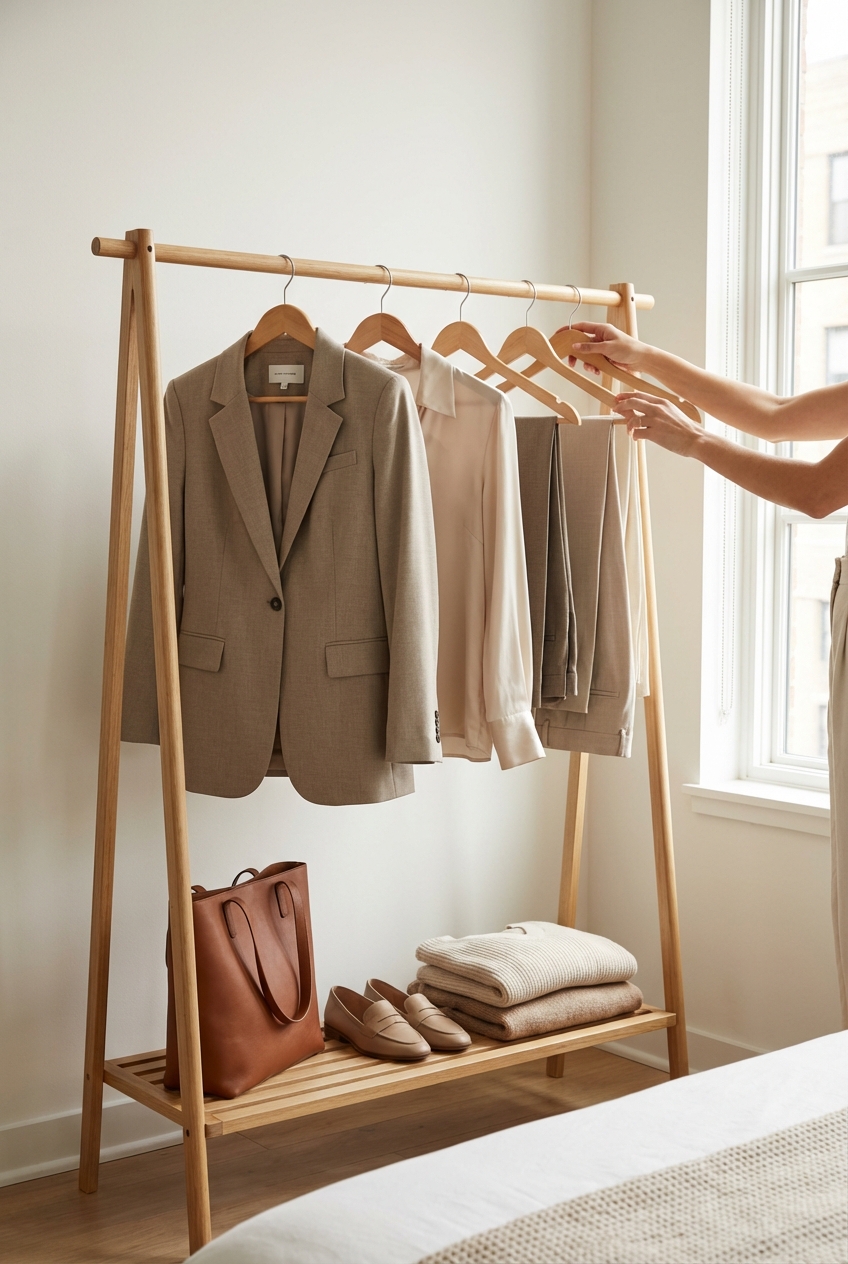
The Minimalist Capsule Wardrobe For Busy Professionals
Every morning, countless successful women stand before bursting closets and think the same frustrating thought: “I have nothing to wear.” This phenomenon is known as the paradox of choice. When you are overwhelmed by options that don’t fit, need ironing, or simply don’t match your current lifestyle, getting dressed becomes a chore rather than a joy.
I have spent years styling high-powered executives, and the secret to their effortless elegance is never more clothes. It is fewer, better clothes. A minimalist capsule wardrobe eliminates decision fatigue, ensuring that every item you pull off the hanger makes you feel confident, polished, and ready to command the room.
This guide will walk you through building a high-functioning wardrobe that respects your time and elevates your professional image. If you need visual inspiration to kickstart your purge, I have curated a stunning Picture Gallery at the end of this blog post to guide your aesthetic.
The Foundation: Understanding Fabrics and “Return on Investment” Pieces
In the world of high-end fashion, the fabric is the single most important variable. You cannot build a durable capsule wardrobe on a foundation of cheap synthetics. When you are working a 10-hour day, breathability and wrinkle resistance are not luxuries; they are necessities.
For your core pieces, focus on natural fibers or high-tech blends. Merino wool is a miracle fabric for trousers and blazers because it regulates temperature and naturally resists odors. For blouses, look for silk crepe de chine or high-quality Tencel, which offers the drape of silk but is often machine washable.
A “Return on Investment” (ROI) piece is an item you will wear at least twice a week. If you spend $300 on a pair of black trousers you wear 100 times, the cost per wear is $3.00. If you buy a trendy $50 top you wear once, that is a bad investment. Shift your budget to the items that carry the weight of your weekly rotation.
Designer’s Note:
The most common mistake I see is buying “dry clean only” items for daily basics. If you hate running errands, be realistic. Look for “hand wash” or “gentle cycle” labels for your tops. If you can’t easily clean it, it will sit in your hamper, not on your body.
Defining Your Color Palette and Proportion Rules
A functional capsule wardrobe relies on strict color discipline. This does not mean you are resigned to a life of monochrome boredom, but it does mean your core items must mix and match without effort. If your blazer clashes with three of your five shirts, your system is broken.
I recommend the “3+1 Rule” for professional capsules. Choose three neutrals (such as Navy, Cream, and Camel, or Black, White, and Grey) and one accent color (like Burgundy, Forest Green, or Cobalt). This ensures that 100% of your bottoms match 100% of your tops.
Proportion is equally vital. If you prefer wide-leg trousers, your tops should be more fitted or tuckable to balance the volume. If you prefer slim cigarette pants, you can get away with looser, architectural tunics or oversized blazers. Understanding your preferred silhouette prevents you from buying items that look good on the mannequin but feel “off” on you.
Common Mistakes + Fixes:
- Mistake: Buying mismatched hardware.
- Fix: Decide on gold or silver for your bag hardware, belt buckles, and shoe accents. keeping this consistent instantly makes an outfit look expensive and intentional.
- Mistake: Ignoring skin tone in neutrals.
- Fix: If pure white washes you out, swap it for ivory or oatmeal. If black feels too harsh, switch your dark neutral base to charcoal or navy.
The Core Checklist: Tops and Layers
The top half of your outfit is what people see the most, especially in the era of Zoom calls and conference tables. Your selection here needs to be versatile enough to layer under a jacket but structured enough to stand alone. I recommend starting with five distinct tops.
First, secure the Crisp Button-Down. Avoid stiff oxford cloth which can look rumpled; opt for a cotton poplin with a bit of elastane for stretch. Ensure the buttons differ from the fabric color slightly for a higher-end look, or cover them with a placket for minimalism.
Second, the Silk or Satin Blouse. This adds a feminine texture to rigid suiting. High necklines or bow-tie necks frame the face beautifully. Next, invest in two high-quality knit shells or tees. These should be a mid-weight material (at least 150 GSM) so they are opaque and don’t show bra lines.
Finally, the Power Blazer. This is non-negotiable. It should nip in slightly at the waist and the shoulder seam must hit exactly at the edge of your shoulder bone. If it extends past your shoulder, you will look like you are playing dress-up.
What I’d do for a client:
I always take new blazers to a tailor immediately. We often shorten the sleeves by half an inch to show a peek of the shirt cuff or a watch. It is a tiny detail that signals “custom made.”
The Core Checklist: Bottoms and One-Pieces
For bottoms, fit is paramount. You need three pairs of trousers and two skirts, or four trousers if you aren’t a skirt person. The fundamental cuts are the cigarette pant (ankle length, slim) and the wide-leg trouser (full length, drapes over the shoe).
The hemline logic is specific here. Ankle pants should hit just above the ankle bone to elongate the leg. Wide-leg trousers should sit 1/4 to 1/2 inch off the floor while you are wearing your preferred heel height. Never let them drag; it ruins the fabric and looks messy.
Dresses are the ultimate efficiency hack because they are a complete outfit in one zip. The Sheath Dress and the Wrap Dress are the two pillars. The Sheath is structured and authoritative; the Wrap is comfortable and forgiving. Ensure necklines are office-appropriate—generally, no lower than two inches below the collarbone.
Designer’s Note:
Pockets are a professional woman’s best friend. When sourcing dresses or skirts for clients, I prioritize garments with functional pockets. It changes your posture and gives you a place for your phone while moving between meetings.
Footwear and Accessories: The Elevators
In a minimalist wardrobe, accessories provide the personality. They are the variables that take a look from “uniform” to “style.” However, comfort must align with aesthetics. Hobbling in high heels projects insecurity, not power.
You need three pairs of shoes: The Power Flat (pointed toe, leather or suede), The Daily Heel (block heel, 2-3 inches max), and The Clean Sneaker (leather, pristine white or black) for casual Fridays or commutes. The pointed toe on a flat is crucial—it elongates the leg line just like a heel does.
For bags, function dictates form. You need a structured tote that fits a 13-inch or 15-inch laptop without bulging. Look for a bag with metal feet on the bottom to protect the leather when you set it down. A smaller crossbody is essential for lunches or after-work drinks.
What I’d do for a client:
I advise clients to buy two belts: one roughly one inch wide for trousers loops, and a wider waist belt to cinch dresses and blazers. This instantly changes the silhouette of your core items, doubling their versatility.
Maintenance and Longevity
A capsule wardrobe only works if the clothes are ready to wear. If your “favorite” shirt is always in the laundry pile or wrinkled, it is not serving you. You must have a maintenance system in place.
Invest in a high-quality handheld steamer. It is faster than ironing and gentler on fibers. Steaming also kills bacteria, meaning you can often refresh a blazer or wool trousers between dry cleanings just by steaming the armpits and crotch area.
Use velvet non-slip hangers. They save space, allowing you to see your entire capsule at a glance, and they prevent the “shoulder bumps” caused by wire or plastic hangers. Knitwear should never be hung; fold it to maintain its shape.
Common Mistakes + Fixes:
- Mistake: Over-washing denim and wool.
- Fix: Spot clean stains and air out these fabrics. Washing them too often breaks down the fibers and fades the dye.
- Mistake: Ignoring shoe repair.
- Fix: Take your leather shoes to a cobbler before you even wear them to have a rubber sole added. This prevents slipping and extends the life of the shoe by years.
Finish & Styling Checklist
Before you walk out the door, run through this quick mental checklist to ensure your look is cohesive. These small tweaks separate the average from the exceptional.
- The Tuck: Is your shirt fully tucked, half-tucked (French tuck), or intentionally loose? Commit to one; don’t let it look accidental.
- The Sleeve Roll: If you are wearing a blazer or button-down, roll or push the sleeves up to the mid-forearm. It highlights the waist and looks more dynamic.
- Lint Check: Keep a lint roller in your desk drawer and your car. Dark trousers attract everything.
- Shoe Condition: Are your heels scuffed? A quick wipe with a baby wipe or leather conditioner makes a huge difference.
- Jewelry Balance: If you are wearing statement earrings, skip the necklace. If you have a bold necklace, wear studs. One focal point is enough.
FAQs
How much should I budget for a professional capsule wardrobe?
It varies, but aim for quality over quantity. You can build a solid starting capsule for $1,500 by mixing high-street basics with investment footwear and outerwear. Remember, you are buying fewer items, so you can spend more per item.
How do I handle seasonal changes?
Your core neutrals (trousers, blazers, button-downs) usually stay year-round. Rotate the “layers” and textures. Swap the cotton tees for cashmere sweaters in winter, and swap the wool trousers for linen blends in summer.
Won’t I get bored wearing the same things?
Creativity thrives under constraints. You will find that changing your accessories, lipstick color, or hair styling drastically alters the look. Plus, the relief of getting dressed in under 5 minutes usually outweighs the desire for novelty.
Conclusion
Building a minimalist capsule wardrobe is not about depriving yourself of fashion. It is about curating a toolkit that serves your ambition. When you strip away the clutter, the ill-fitting impulse buys, and the morning stress, you are left with a closet that supports your lifestyle rather than draining your energy.
By focusing on fit, fabric, and a cohesive color story, you reclaim your time and project an image of effortless competence. The goal is to walk into any room and have people focus on your ideas, not your outfit—even though your outfit will be impeccable.
Picture Gallery


