
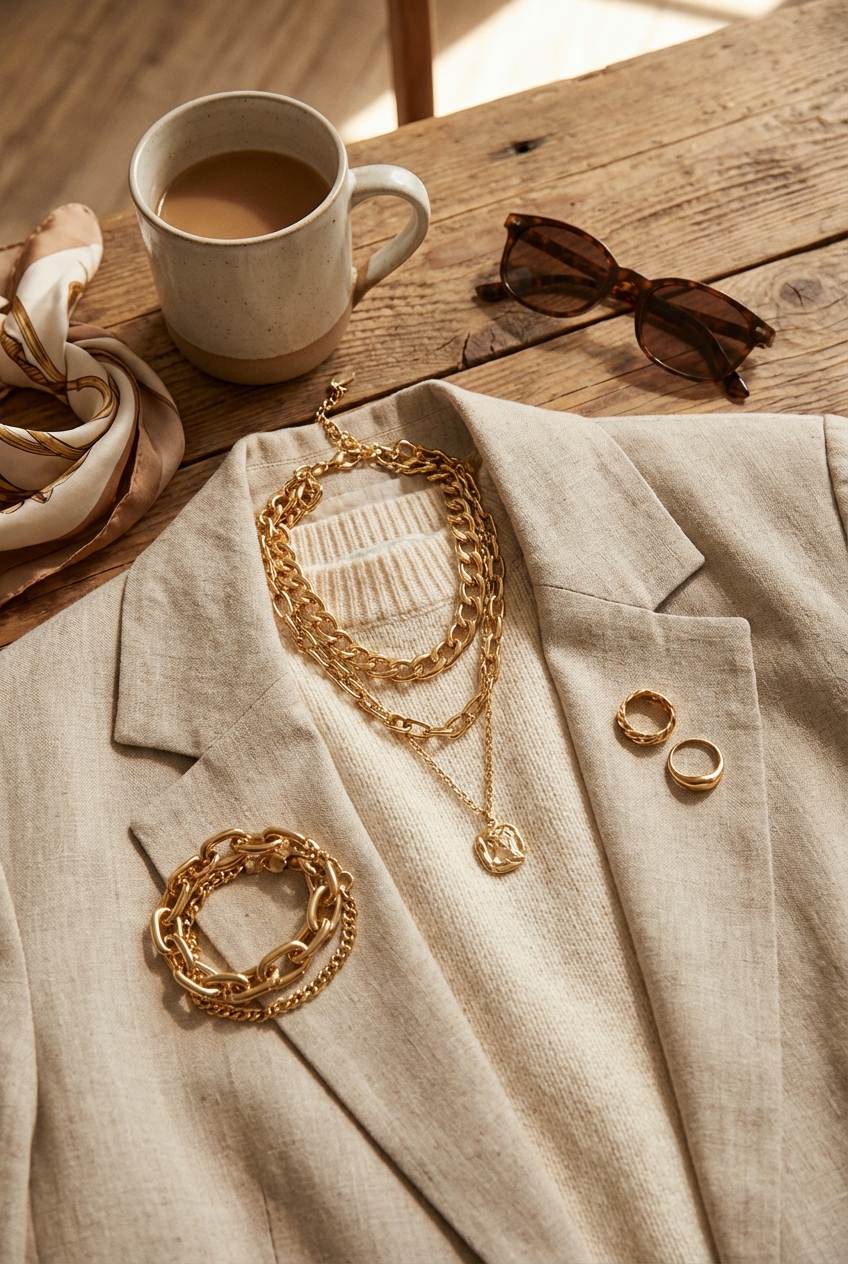
The Ultimate Guide To Styling Chunky Gold Jewelry
I still remember the first time I invested in a truly substantial piece of gold jewelry. It was a vintage curb chain bracelet, heavy enough to feel comforting on my wrist but bright enough to catch the light from across the room. That single piece completely transformed my uniform of white tees and vintage denim. It taught me that jewelry isn’t just an accessory; it is the architecture of an outfit.
Chunky gold jewelry has moved beyond a fleeting trend to become a staple of the modern wardrobe. It bridges the gap between 80s maximalism and contemporary minimalism, offering a way to make a statement without screaming for attention. Whether you are dressing for a board meeting or a Sunday brunch, the right gold weight adds an immediate polish that delicate pieces often miss.
However, styling heavy metals requires a strategic eye to avoid looking costumey or cluttered. In this guide, I will walk you through the mechanics of layering, the importance of scale, and how to select pieces that offer longevity. If you are looking for visual inspiration to help you visualize these combinations, be sure to check out the Picture Gallery at the end of the blog post.
Understanding Gold Tones and Materials
Before you start stacking, you need to understand the medium you are working with. Not all gold looks the same, and the difference in tone can drastically affect how your jewelry interacts with your skin and your clothing. As a stylist, I treat gold tones much like paint swatches; the undertone matters.
14k vs. 18k vs. 24k
The karat count tells you the purity of the gold, which dictates the color. 14k gold is standard for chunky pieces because it is durable and has a softer, more neutral yellow tone. 18k is richer and more saturated, offering a “sunny” look. 24k is pure gold, which is very orange-yellow and often too soft for heavy daily wear. If you are mixing pieces, try to stick within the 14k-18k range so the color disparity isn’t jarring.
Solid, Filled, or Vermeil?
Chunky jewelry requires a lot of metal, which makes solid gold significantly expensive.
- Solid Gold: The investment choice. It never fades, but a heavy chain can cost as much as a small car.
- Gold Filled: This is my top recommendation for chunky fashion jewelry. It has a thick layer of gold mechanically bonded to base metal. It withstands water and wear much better than plating.
- Gold Vermeil: Gold plating over sterling silver. It is hypoallergenic but can fade over time if rubbed constantly against skin or fabric.
Stylist’s Note: The Skin Tone Rule
I often see clients disappointed with a piece they bought online because it looks “off” when they put it on. This is usually a mismatch between metal undertone and skin undertone.
- Cool undertones (veins look blue): Opt for 14k gold or pale European gold. The lighter yellow complements rather than clashes.
- Warm undertones (veins look green): You can handle the rich saturation of 18k or even 22k gold.
- Olive skin: You are the universal recipient; almost any gold tone will look luxurious on you.
The Mechanics of the Neckmess
The “neckmess”—a curated tangle of chains—is the most popular way to wear chunky gold. However, achieving that effortless look actually takes quite a bit of effort and measurement. If you just throw three heavy chains on, they will tangle, twist, and compete for visual space.
Rule of Thumb: The 2-Inch Gap
To prevent chains from bunching, aim for a minimum of 2 inches of difference in length between each necklace.
- Base Layer (16 inches): A choker-style chunky chain (like a herringbone or thick curb). This sits at the collarbone.
- Middle Layer (18–20 inches): A pendant or a medium-weight link (like a paperclip chain).
- Long Layer (22–24 inches): A thinner chain with a heavier pendant to anchor the look vertically.
Texture Mixing
Never layer three chains of the exact same style. Visual interest comes from contrast. If your main piece is a heavy, smooth Snake chain (high shine), pair it with a Rope chain (twisted texture) or a Figaro chain (patterned links). The difference in how the light hits the metal helps the eye distinguish between the layers.
Common Mistakes + Fixes
The Mistake: Wearing heavy chunky chains on a delicate fabric like silk or open-weave knits.
The Fix: Check your clasps and links. Chunky chains often have heavy hardware that can snag fine materials. Save the heaviest curb chains for cotton, linen, denim, or structure blazers. For silk, use smooth snake chains or seamless styling.
Earring Equilibrium
When styling chunky gold earrings, you are dealing with face framing. The wrong scale can drag your features down or get lost in your hair. We want to lift the face, not weigh it down.
The Hoop Hierarchy
Gold hoops are the bread and butter of chunky jewelry.
- The Huggie: Good for second or third piercings.
- The Tube Hoop: The classic “chunky” look. Look for hollow tubing. Solid gold tube hoops are incredibly heavy and will stretch your earlobes over time. Hollow tubing gives you the volume without the weight.
- The Sculptural Statement: These are abstract shapes. If you wear these, skip the necklace. Let the earrings stand alone.
Hairstyle Considerations
If you are wearing your hair down and it is voluminous or curly, you need a high-polish, thick surface area on your earring so it catches the light through the hair. Matte or textured gold will disappear. If your hair is pulled back in a sleek bun, you can get away with smaller, more intricate chunky studs or vintage knots.
What I’d Do in a Real Project
If I am styling a client who has a shorter neck or a strong jawline, I avoid hoops that end right at the jawline. This emphasizes width. Instead, I choose a chunky drop earring or a smaller chunky huggie that sits higher up. This draws the eye upward and lengthens the neck profile.
Wrist Stacking Strategies
The wrist is where you can have the most fun because you can see it yourself throughout the day. However, comfort is key here. If you work at a computer, chunky bracelets can be a nightmare of clacking and wrist pain.
The Watch Anchor
If you wear a watch, especially a metal one, it acts as your “anchor” piece.
- Placement: Wear the watch highest on the arm (furthest from the hand) so it stays secure.
- The Spacer: Place a thinner, solid bangle or a tennis bracelet next to the watch.
- The Chunky Finish: Place your heavy link bracelet closest to your hand. This allows for movement without scratching the face of your watch.
The Click Test
When stacking bangles or cuffs, I perform the “click test.” Put them on and move your arm. If the sound is a heavy, dull thud, the pieces are too heavy to wear together comfortably for 8 hours. If it’s a bright, sharp jingle, you have a good mix of weights. If it sounds tinny, the quality of the metal might be lacking.
Ring Stacking Mechanics
Chunky rings are currently dominating fashion, with signet rings and dome rings leading the charge. The secret to styling them is negative space. You cannot put a heavy dome ring on every finger; you will look like you are wearing brass knuckles.
The Triangle Method
To balance a heavy ring stack, create a visual triangle across your hand.
1. Pointer Finger: A medium-weight band or statement piece.
2. Middle Finger: Leave bare. This negative space is crucial.
3. Ring Finger: Your heaviest piece (like a chunky signet or dome).
4. Pinky: A small signet or midi ring.
Mixing Heights
Avoid wearing two rings of the same height next to each other. They will rub and feel uncomfortable. If you wear a tall dome ring on your ring finger, wear a flat band on your pinky or pointer. This variation in height makes the hand look elegant rather than encumbered.
Stylist’s Note: Sizing Up
Wide bands fit tighter than thin bands. If you are buying a chunky cigar band or a thick dome ring, always size up by half a size. If you buy your standard size, the width of the metal will compress your finger, creating a “muffin top” effect and making it difficult to bend your knuckle.
Outfit Coordination Rules
Your jewelry does not exist in a vacuum. It interacts with your clothing. The goal is to have the jewelry complement the outfit, not fight with it.
High Necklines (Turtlenecks, Mock Necks)
This is the perfect canvas for your heaviest pieces. The fabric provides a buffer for your skin and a solid background color.
- Recommendation: Long, heavy curb chains or a statement pendant that hits mid-chest.
- Avoid: Chokers. They can feel suffocating over a turtleneck and often ruin the line of the neck.
Deep V-Necks and Button-Downs
This creates a natural frame for jewelry.
- Recommendation: A graduated stack. Start with a short chain that sits on the skin and cascade down into the V of the shirt.
- Pro Tip: Unbutton your shirt one button lower than usual to allow the longest chain to hang freely without getting tucked under the fabric.
Crew Necks (The T-Shirt Uniform)
You have two choices here: sit the necklace on the collar or below the collar.
- On the Collar: Use a 15-16 inch heavy chain that covers the ribbed seam of the t-shirt. This elevates the basic tee instantly.
- Below the Collar: Use an 18-20 inch chain that clears the neckline entirely. Avoid lengths that hit exactly at the seam, as the necklace will constantly flip in and out of your shirt.
Finish & Styling Checklist
Before you walk out the door, run through this mental checklist. This is the exact process I use when finalizing a look for a photo shoot or a client event.
- The Focal Point Check: Look in the mirror. Where does your eye go first? If it jumps between your earrings and your necklace, remove one. Choose one hero piece.
- The Clasp Check: Rotate all necklaces so the clasps are at the back. Heavy pendants tend to pull chains forward.
- The Skin Sensitivity Check: Did you apply perfume or lotion? Wait 10 minutes before putting on gold vermeil or plated jewelry to prevent immediate tarnishing.
- The Balance Check: If you are wearing a chunky knit sweater, you need chunky jewelry to match the visual weight. Delicate chains will disappear. Conversely, if you are in a slip dress, one chunky piece is enough to ground the look.
What I’d Do in a Real Project: The Capsule Collection
If a client came to me with a $500 budget to start a chunky gold collection, here is exactly what I would buy:
1. One pair of hollow gold tube hoops (medium size).
2. One 18-inch paperclip chain (gold filled).
3. One heavy dome ring (gold vermeil).
These three pieces can be worn together or separately and cover 90% of styling needs.
FAQs
Can I mix chunky gold with silver?
Absolutely. Mixed metals are very current. The trick is to have a “bridge” piece—like a ring or bracelet that contains both silver and gold. This intentional piece ties the two metals together so the mix looks deliberate, not accidental.
How do I clean chunky chains?
Chunky links trap lotion, sweat, and dead skin. Once a month, soak your solid or gold-filled pieces in warm water with a drop of mild dish soap. Use a soft baby toothbrush to gently scrub between the links. Dry thoroughly with a microfiber cloth. Avoid ultrasonic cleaners for plated jewelry as they can strip the finish.
Why does my chunky necklace keep flipping over?
This usually happens with flat chains like Herringbone or Omega chains. It means the chain is slightly too long for your collarbone structure, or it was stored improperly and developed a kink. Store flat chains laying flat, never hung up, to maintain their drape.
Is chunky jewelry appropriate for formal events?
Yes, but keep it sculptural. Avoid “street style” links like heavy curbs or figaros. Instead, opt for a thick gold collar necklace or statement gold cuffs. These read as “art” rather than “accessory” and pair beautifully with evening wear.
Conclusion
Styling chunky gold jewelry is about balancing boldness with restraint. It is the easiest way to add a sense of luxury and intention to even the most basic outfit. By understanding the scale of your pieces, paying attention to the undertones of the metal, and respecting the lines of your clothing, you can curate a look that feels both timeless and modern.
Remember that the best jewelry wardrobe is built slowly. Start with one substantial piece that makes you feel confident, wear it until it feels like a second skin, and then layer from there. Fashion is personal, and your jewelry should tell a story of your personal style evolution.
Picture Gallery


