
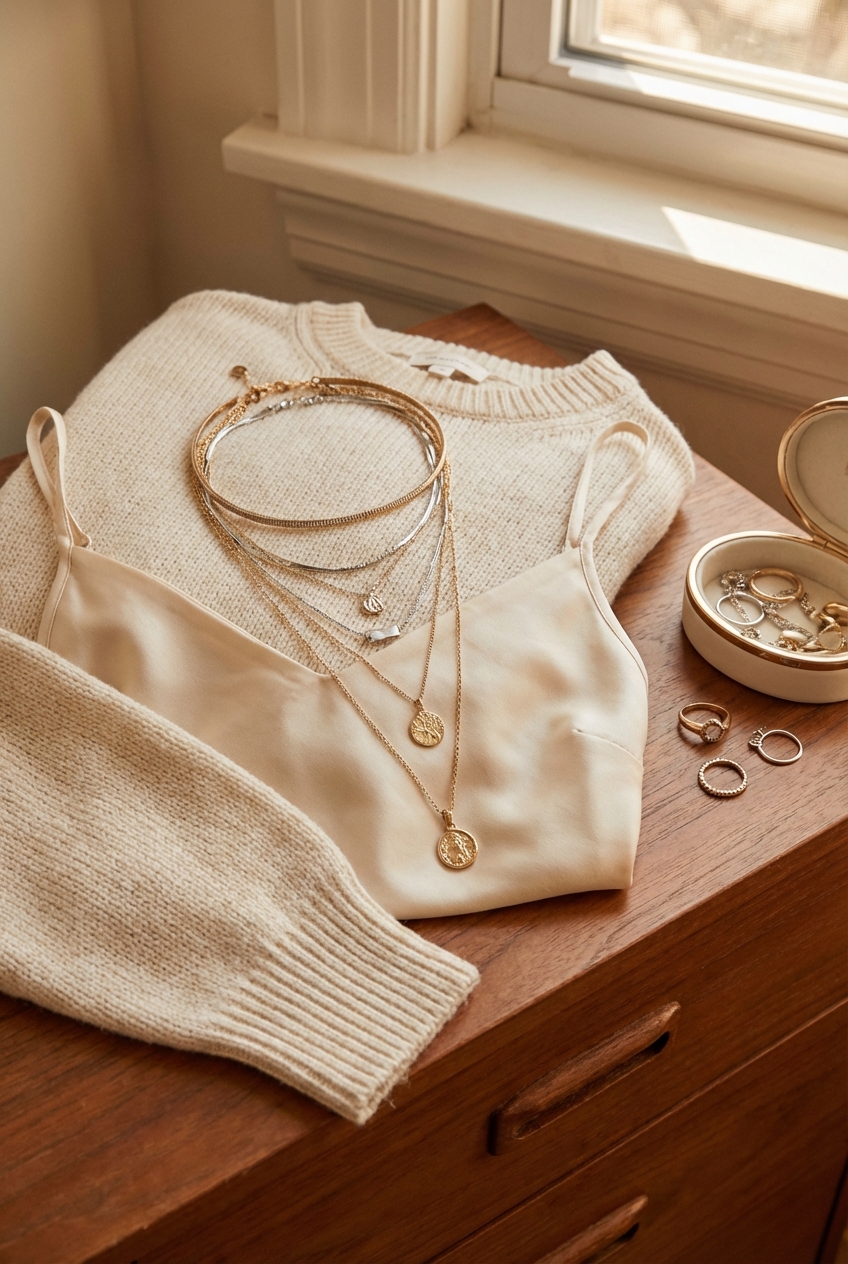
Layering Necklaces Tips For Achieving The Perfect Look
Introduction
There is a distinct moment in styling where an outfit transforms from merely “wearing clothes” to a curated look, and more often than not, that transition happens at the jewelry box. As a stylist, I have seen a simple white t-shirt and vintage denim evolve into a high-fashion statement simply by adding the right stack of gold chains. Layering necklaces is an art form that balances weight, texture, and length to create a silhouette that feels personal and collected, rather than cluttered.
However, achieving that effortless “casually thrown together” aesthetic is rarely accidental. It requires a strategic understanding of chain hierarchy, metal mixing, and spacing. I often see clients get frustrated because their necklaces inevitably twist into a single rope within an hour, or the visual proportions shorten their neck instead of elongating it. The goal is to create a cascade of light and texture that flatters your bone structure while staying secure throughout the day.
In this guide, I will walk you through the exact formulas I use on set and with private clients to build the perfect neck stack. We will cover everything from the “two-inch rule” of spacing to selecting the right weights to prevent tangling. If you are looking for visual inspiration to guide your own collection, make sure to browse the Picture Gallery at the end of the blog post.
1. Master the Math: Chain Lengths and Spacing
The most fundamental error in layering necklaces is choosing chains that are too similar in length. When chains sit at the same elevation on the chest, they compete for attention and physically rub against each other, leading to friction and tangles. To create a defined look, you must treat the neckline like a tiered landscape.
The golden rule of layering is to maintain at least a 2-inch difference between each necklace. This spacing allows each chain to drape independently, forming distinct “U” shapes rather than a messy “V.” A standard starting trio usually consists of a 14-to-16-inch choker or short chain, an 18-inch mid-length chain, and a 20-to-24-inch pendant necklace.
When I am fitting a client, I always measure their neck circumference first. If you have a wider neck, a 14-inch choker might feel like a stranglehold; in that case, your “base” layer should start at 16 inches. Conversely, for petite frames, starting at 14 inches prevents the longest layer from dipping awkwardly below the bust line.
Stylist’s Note: The Extender Hack
A common issue arises when you buy pre-layered sets or standard chains that don’t hit quite right. I always keep a supply of detachable 2-inch chain extenders in my kit. These small, inexpensive additions allow you to micro-adjust the drop of a necklace. If two chains are colliding, simply adding an extender to the lower one creates that necessary breathing room without requiring a new piece of jewelry.
2. varying Texture and Chain Styles
Once you have your lengths established, the next variable is texture. If you layer three identical delicate cable chains, they will disappear into one another. Visual interest comes from contrast. You want the eye to travel from a high-shine piece to a matte piece, or from a structured link to a fluid chain.
I recommend mixing three distinct categories of chain styles:
- The Fluid Chain: This is usually a snake chain, herringbone, or omega. These lay flat against the skin and reflect light like a ribbon of liquid metal. They work best as the shortest layer (the choker position).
- The Structured Chain: Think paperclip links, box chains, or figaro chains. These have open space within the links, adding airiness and architectural detail. They are ideal for the middle layer.
- The Delicate Chain: Standard cable or rope chains work best for holding pendants on the longest layer. They are subtle and let the charm take center stage.
Common Mistake: The Herringbone Kink
Flat chains like herringbones are stunning, but they are unforgiving. If you place a heavy pendant on top of a herringbone chain, or if you sleep in it, the chain will develop a permanent kink. I always advise clients to wear flat chains at the very top of the stack where they are less likely to be crushed by longer, heavier pieces.
3. The Art of the Anchor: Pendants and Charms
A necklace stack without a focal point can feel busy but directionless. The “anchor” is usually a pendant necklace that sits at the bottom of your layers, drawing the eye downward and elongating the torso. This creates a vertical line that balances the horizontal lines of the shorter chains.
In my styling projects, I choose the pendant based on the vibe of the outfit. A coin pendant offers a vintage, bohemian feel, while a geometric bar or locket reads more modern and minimal. If you are layering three necklaces, only one—maximum two—should have a pendant. If every layer has a charm, they will overlap and clamor against each other, creating noise rather than style.
For the middle layer, consider a smaller, integrated detail like a small diamond bezel or a horizontal bar. This bridges the gap between the plain choker and the heavy pendant without overwhelming the composition.
What I’d Do in a Real Project
If I am styling a client for an event wearing a V-neck silk blouse:
- Layer 1 (15″): A 3mm gold herringbone chain (texture and shine).
- Layer 2 (18″): A thin cable chain with a small floating pearl or diamond (subtle sparkle).
- Layer 3 (22″): A heavier rope chain with a vintage coin pendant (the anchor).
This combination offers three different weights and focuses, ensuring distinct separation.
4. Mixing Metals: Breaking the Old Rules
For decades, the prevailing wisdom was to stick to one metal: all gold or all silver. Fortunately, modern fashion has done away with this restriction. Mixing metals is now a sign of a sophisticated eye, adding depth and versatility to your jewelry collection. It also solves the problem of matching your necklace hardware to your handbag or belt buckles—when you wear mixed metals, everything matches.
The trick to mixing metals effectively is the “Bridge Piece.” This is a single item that contains both silver and gold (or rose gold). It could be a pendant with a two-tone bezel, or a chain that alternates links. Placing this piece in the middle of your stack acts as a visual connector, signaling that the mix is intentional rather than accidental.
If you don’t own a two-tone piece, rely on the ratio rule. Aim for a 70/30 split rather than a 50/50 split. For example, wear two gold chains and one silver chain, or vice versa. The dominant metal sets the tone, while the accent metal adds a fresh, modern edge.
Stylist’s Note: Skin Tone Considerations
While you can mix metals, usually one tone will flatter your skin more. If you have cool undertones (veins look blue), silver or platinum will pop. If you have warm undertones (veins look green), yellow gold adds a rich glow. I usually use the flattering metal for the chain closest to the face (the choker) to brighten the complexion, and mix the secondary metal lower down in the stack.
5. Coordinating with Necklines
Your clothing is the canvas for your jewelry. The neckline of your top dictates the shape and length of your necklace stack. Ignoring the neckline is the fastest way to make an outfit look disjointed. The goal is to either follow the neckline or contrast it deliberately.
The V-Neck
This is the easiest neckline for layering. The “V” shape frames the jewelry perfectly. You want your stack to mimic the shape of the V, getting longer and narrower as it goes down. Ensure the longest pendant sits above the fabric of the shirt, resting on the skin, unless it is a very long opera-length chain designed to sit over clothing.
The Crew Neck
High, round necklines can be tricky. You have two options: stay high and tight with a collar-style stack that sits entirely on the skin above the fabric, or go long and bold over the fabric. I prefer the “collar” look for T-shirts: a chunky chain and a slightly longer pearl strand, both sitting snugly on the collarbone.
The Button-Down Shirt
Wearing a button-down offers a natural frame. I love unbuttoning one extra button and filling that negative space with delicate layers. However, be mindful of the collar. Avoid thick chokers that compete with the shirt collar; instead, opt for delicate, shimmering chains that catch the light from within the shirt opening.
6. Practicality: Preventing the Tangle
The “neck mess” is a trendy term for a curated jumble of charms, but an actual knot of chains is a nightmare to untangle. Physics dictates that lighter chains will move more than heavy ones, and friction causes them to twist. While you cannot eliminate movement entirely, you can mitigate it.
Weight distribution is your best defense. Heavier chains tend to stay in place. If you are layering three whisper-thin chains, they will inevitably braid themselves together. Try to ensure each necklace has a significantly different weight. The heaviest piece should generally be the longest to anchor the entire arrangement.
The Necklace Detangler Clasp
For clients who wear stacks daily, I highly recommend investing in a “necklace spacer” or “detangler clasp.” This is a single magnetic or slide-lock clasp that has multiple jump rings attached to it. You attach all your necklaces to this one bar behind your neck. It separates the chains by a fixed distance at the nape of your neck, making it nearly impossible for them to twist around each other.
Stylist’s Note: The Put-On Order
Order matters. Put on your shortest necklace first and your longest last. When taking them off, reverse the order: longest first, shortest last. This prevents the clasps from snagging on the other chains during the removal process.
Finish & Styling Checklist
Before you head out the door, run through this mental checklist to ensure your stack is polished and secure. This is the same process I use before sending a model onto the runway or a client to an event.
- Check the Spacing: Is there visible skin or fabric between each chain? If they are overlapping too much, add an extender to the lower piece or tighten the upper piece.
- Test the Clasp: Rotate all clasps to the back of your neck. Heavy pendants usually pull the chain down, but if a chain is light, the clasp might slide forward. If this happens, I sometimes put a tiny dab of clear eyelash glue on the back of the neck to hold the chain in place (a pro set trick!).
- Balance the Weights: specific to visuals—does one area look too heavy? If you have a chunky chain, balance it with a negative space (skin).
- Movement Test: Lean forward and stand back up. Do the necklaces fall back into place, or do they catch? If they catch, the surfaces of the chains might be too rough (like two rope chains rubbing). Swap one for a smoother texture.
- Metal Mix: If mixing metals, do you have a cohesive link (like a two-tone watch, ring, or the bridge piece mentioned earlier)?
FAQs
Can I sleep in my layered necklaces?
I strongly advise against it. Sleeping in layers guarantees tangles that can take hours to undo and can stretch delicate links. Furthermore, flat chains like herringbones can kink permanently if bent at a sharp angle against a pillow. Make it a ritual to remove them.
How do I stop my pendant from flipping over?
This is a common annoyance. It usually happens because the pendant is top-heavy or the bail (the loop attached to the pendant) is too large for the chain. Try threading the pendant onto a slightly thicker chain to create more friction, or use a tiny piece of double-sided fashion tape on the back of the pendant to secure it to your skin.
Is there a limit to how many necklaces I can layer?
In fashion, rules are meant to be pushed, but for a functional, day-to-day look, the “Rule of Three” is the sweet spot. Three necklaces offer a beginning, middle, and end. Going beyond five usually results in a bulky look that hides the beauty of the individual pieces, unless you are aiming for a very specific maximalist statement.
Can I mix costume jewelry with fine jewelry?
Absolutely. High-low mixing is a staple of modern style. You can pair a solid 14k gold heirloom locket with a trendy, gold-plated paperclip chain. The key is ensuring the gold tones are relatively similar—bright yellow gold plating can sometimes look jarring next to the softer hue of 10k or 14k gold.
Conclusion
Layering necklaces is more than just piling on accessories; it is a way to maximize your wardrobe and express your personal style narrative. It allows you to breathe new life into heirloom pieces by pairing them with modern trends, creating a look that is uniquely yours. By paying attention to the mechanics of length, weight, and texture, you can build a stack that looks effortless and stays tangle-free.
Remember that these rules are foundational guidelines. Once you understand the logic behind spacing and balance, you have the freedom to experiment. Start with the Rule of Three, find your anchor piece, and build outward from there. With a little practice, you will find the combination that feels right for your neckline and your personality.
Picture Gallery


